
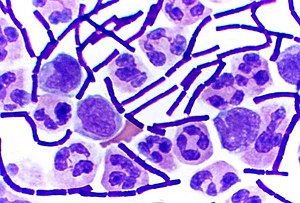
Gram-positive bacteria (denoted by Gram (+)) - bacteria that, unlike gram - negative bacteria , retain their color, do not discolor when washed using the stain of microorganisms according to the Gram method .
Most Gram (+) bacteria have a single-layer cell membrane, without the outer membrane inherent in gram-negative bacteria . An exception is the Deinococcus-Thermus type .
Pathogenicity
Most of the pathogens for humans microorganisms are gram-positive. Six genera of gram-positive organisms are typical human pathogens. Two of them, streptococci and staphylococci , are cocci (spherical bacteria). The rest are rod-shaped and further divide as far as possible to form spores. Non-spore-forming: Corynebacterium and Listeria ; spore-forming: Bacilli and Clostridia . Spore-forming can be divided into facultative anaerobes of Bacillus and obligate anaerobes of Clostridium.
Term History
In the early classifications, gram-positive bacteria made up the Firmicutes type, but now this term is used only for one, although the largest, group of them. The type of Firmicutes includes many well-known genera such as Bacillus , Listeria , Staphylococcus , Streptococcus , Enterococcus and Clostridium . Now this type also includes Mollicutes , bacteria like mycoplasmas , which do not have a bacterial cell wall at all and therefore do not stain according to Gram , but have a common origin with gram-positive forms.
Another major group of gram-positive bacteria is the Actinobacteria type, or a group of gram-positive bacteria with a high G + C content (containing guanosine and cytosine in DNA ), unlike Firmicutes with a low G + C content. Historically it was believed that if the second membrane is an acquired trait, both groups can be basic on the phylogenetic tree of bacteria, otherwise they are probably a relatively recent monophyletic group. At some point, they were even considered as possible ancestors of archaea and eukaryotes , due to the absence of a second membrane and due to some biochemical characteristics, for example, the presence of sterols . With the advent of molecular phylogenetics based on analysis of 16S rRNA , gram-positive bacteria were finally divided into Firmicutes and Actinobacteria.
Feature
- A thicker peptidoglycan layer compared to gram-negative bacteria .
- There is only one membrane , cytoplasmic.
- The main component is multilayer murein (40–90%). Additional component: proteins, lipids, teichoic acids and teichuronic acids.
- Form endospores.