

Complementary colors are complementary colors - pairs of colors , the optical mixing of which leads to the formation of a psychological sensation of achromatic color ( black , white or gray ). A synonym for the concept is opposite colors [1] . The concept is closely related to the concept of primary colors introduced into colorimetry . Complementary colors give achromatic colors when mixed: [2]
- with additive mixing (typical for mixing light fluxes) give a color perceived as white , [3] and
- with subtractive mixing (subtraction of the spectra characteristic of mixing various pigments ) - gray or black .
Content
General Information
With the combined action of a photon flux of equal intensity of all wavelengths of the visible spectrum on the human visual apparatus, a sensation of white , unpainted light arises.
Thus, the combined action of light fluxes, causing a sensation of the corresponding spectral and complementary to the spectral colors, causes a white sensation. This is the term “complementary color”.
Complementary colors are mixed colors, since their sensation is caused by the combined action of monochromatic rays, which would separately cause sensations of their spectral colors.
Finding Additional Colors in the Color Wheel
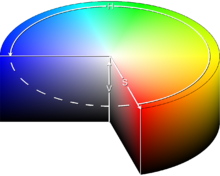
The color wheel allows you to quickly find additional color to the spectral . Typical combinations are blue and orange , red and green .
Primary and secondary colors
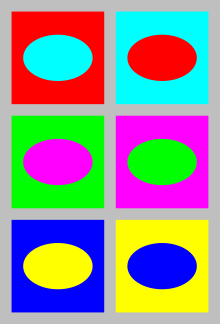
In the RGB system, the triad red - green - blue corresponds to the triad cyan - magenta - yellow .
More details:
- red and cyan ( red - cyan ; cyan - blue-green color).
- green and purple ( green - magenta ; purple or magenta - a mixture of red and blue).
- blue and yellow ( blue - yellow ).
Radiations constituting complementary colors may have a different spectral composition (see Metamerism ).
For mechanical obtaining of additional color, special non-absorbing beam splitting mirrors were used.
In the RYB system (the main triad: red - yellow - blue), the concepts and relationships of primary and secondary colors are different [4] :
- red - green
- yellow - purple
- blue - orange
Practical use of complementary colors
In design , decoration practice, and in the creation of advertising , effects related to the psychological assessment of colors as complementary are widely used. Combinations of complementary colors are often perceived by a person as harmonious .
For artistic purposes and various design, the following properties of complementary colors are used:
- high contrast;
- the integrity of the composition, if the colors are taken in the correct proportions;
- to attract attention;
- the effect of revitalization and dynamism [5] .
Also, the principle of complementary colors is used to create glasses for viewing anaglyphs . When viewing a specially prepared image through filters of additional colors, the effect of a three-dimensional image is created.
See also
- Spectral colors
- RGB
- CMYK
- Psychology of color perception
- Technology for flowers
Notes
- ↑ Complementary colors
- ↑ Additional colors - Advertising and printing - Yandex. Dictionaries (inaccessible link) (inaccessible link from 06/14/2016 [1181 days])
- ↑ Complementary colors. - Natural sciences - Yandex. Dictionaries (inaccessible link) (inaccessible link from 06/14/2016 [1181 days])
- ↑ Whelan B., Harmony of Color: A New Guide to Creating Color Combinations / B. Whelan; Per. from English G. Shchelokova. - M .: Astrel Publishing House LLC: AST Publishing House LLC, 2005
- ↑ Complementary colors .
Literature
- Gurevich M.M., Color and its measurement, M. - L., 1950.