Big cats ( Latin Pantherinae ) - feline subfamily, including the largest representatives of this family. The criterion for belonging to big cats, however, is not size, but morphological details, such as the structure of the hyoid bone . Because of this, large cats, such as cougar and cheetah, do not belong to large cats.
| Big cats |
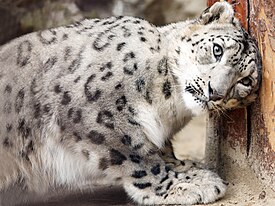
Irbis , or snow leopard |
| Scientific classification |
|---|
| No rank : | Bilateral symmetrical |
|
| International scientific name |
|---|
Pantherinae Pocock , 1917 |
| Childbirth |
|---|
- Panthers ( Panthera )
- Smoky Leopards ( Neofelis )
- Snow Leopards ( Uncia )
|
|
The following genera and species are classified as large cats:
- genus panther ( Panthera )
- lion ( P. leo )
- jaguar ( P. onca )
- leopard ( P. pardus )
- tiger ( P. tigris )
- genus smoky leopards ( Neofelis )
- smoky leopard ( N. nebulosa )
- Borean smoky leopard ( N. diardi ), until recently, was considered as a subspecies of smoky leopard ( N. n. diardi )
- genus Uncia
- snow leopard ( U. uncia ), a species often considered as part of the genus Panthera ( P. uncia )
There is debate about the affiliation of a marbled cat ( Pardofelis marmorata ) to big cats in the world of zoologists. According to the traditional point of view, it is referred to as small cats , however, there were suggestions about its connection with big cats. Recent molecular genetic studies speak in favor of its close relationship with the catopum genus, which is why the latest taxonomy again refers it to small cats.
Black panthers are not a separate species, but only a manifestation of melanism (black) in leopards or jaguars.
There are spots on the coat of all large cats, even if they are not visible at first glance. They are evident in leopards, smoky leopards, snow leopards and jaguars. Stripes on the hair of a tiger are elongated spots. In lions, spots appear, as a rule, in childhood.
Big cats differ from their smaller relatives in the structure of the hyoid bone. It consists of small bones that serve to consolidate the lingual muscle in the throat. Previously, this symptom was associated with the ability to growl. However, newer studies show that the growl is based on other anatomical features, primarily on the special structure of the larynx . In a lion, tiger, leopard and jaguar, it is characterized by very long vocal cords and thick elastic tissue that allows growling. The snow leopard, smoky leopard and other cat species do not have such features and cannot growl.
