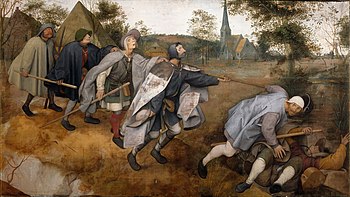
“The Parable of the Blind” ( Dutch: De parabel der blinden ) - painting by Peter Brueghel the Elder . Other names - "Blind", "Blind leads the blind."
| ||
| Peter Brueghel the Elder | ||
| The parable of the blind . 1568 | ||
| De parabel der blinden | ||
| Tempera on canvas . 86 × 154 cm | ||
| Capodimonte Museum , Naples | ||
Story
The picture depicts six blind people who are moving forward in a chain, holding on to each other. The blind guide, who comes first, stumbles and falls into the pit with his staff. The blind man following him falls on him. The third, associated with the second staff , will follow its predecessors. The fifth and sixth still have no idea, but they will inevitably be in the pit after their companions. Six figures represent six different phases of the fall. Art historians also draw attention to the fact that the two (second and fourth) in the chain are not just blind - they were blinded by force.
It is believed that the plot of the picture is based on the biblical parable of the blind (Matt. 15:14 ): "If the blind leads the blind, then both of them will fall into the pit."
Here is how the Austrian art historian Max Dvorak described the impression of this work in his book “History of Art as a History of Spirit”:
From the elevation, which is emphasized by the sharp roofs of two peasant houses in the upper left corner of the picture, the blind descend along the dam. The last of them are moving at their usual pace, vertically, slowly, step by step, like machines. They don’t know what happened yet. The dam makes a turn, the leader does not notice this and falls through the slope into the depression, which in the lower right corner forms a counterpost to the rising roofs of houses in the left corner. Between these two poles, a tragic fate unfolds now. The blind, connected with each other with their hands on their shoulders and poles, form a chain, which suddenly, due to the fact that the leader stumbled, is pulled with great force. The result is an eerie, rapid increase in the falling movement. Both middle figures are ready to fall, and mechanical striding forward turns into uncertain stumbling; the blind behind the leader falls, and there, further, the abyss absorbs the leader already. In accordance with this, a figured motive is transformed from a solid, like lump, standing to compliant surrender and, finally, to a mass that is not statically and organically controlled; starting from a controlled or semi-controlled body right up to a rolling stone, or, in spiritual terms, “in these terribly individualized amazing heads,” says Romdahl, “a stepwise increase in fear is visible,” and all this becomes even more terrible and exciting due to the dull the inexpressiveness of the blind. This is based on the mobile counter-action of the baroque spatial diagonal of a grandiose theme of tragedy. Just as the compositional diagonal is sharply and ruthlessly opposed to the beautiful flow of lines and the harmonious distribution of masses in the landscape, on the other hand, the serenity and stillness of this landscape contrast sharply with the catastrophe playing out against its background. Except for those who are covered by it, not a single person is visible anywhere - only a cow grazes calmly on the shore of a pond into which the blind fall. Nature is indifferent, and even seem to be more closely associated with individual human fate, this merger is only once; man’s fate is nothing compared to the universality of nature and its immutable laws. The death of the blind is an alternation of moments of nature’s invasion of individual fate, moments that follow one another so quickly that the artist could depict them as one terrible moment, but nature is eternal, and it is on the other side of the human scale with which a miserable human existence is associated .
The figures of the old parable acquire universal deep human significance from the artist. “At Brueghel, they have been raised to a degree of general significance for all ages and generations, we feel ourselves in front of his picture as links in this dark chain of blind people leading each other to perdition, in implacable solidarity of fate,” says Romdahl, who compares from the side of uttermost completeness in mastering the theme - a picture of Brueghel from the Last Supper by Leonardo ... “Bruegel portrays a small, stunning, but significant everyday episode. Somewhere a few poor blind people became victims of an accident. No one will pay attention to this, it is unlikely that one or another of their relatives will shed a tear on them; life in nature and people's lives take their course as if only a leaf fell from a tree. But this is precisely what is new, that such an insignificant fact, with such insignificant heroes, is placed in the center of worldview. What seems to be a single, temporarily and locally limited event, which seems to be a historically insignificant event, embodies a fate that no one can escape and to which mankind is blindly subordinate in its totality. The eternal unshakable laws and forces of nature and life dominate will, suffering and sensation; they mercilessly determine the life of an individual person, and where we think to lead, it turns out that we are guided by a hidden purpose for our understanding, as if blind to the abyss. "
Some art historians identify the church depicted by Brueghel as the Church of St. Anne in the Belgian Dilbeck [1] .
Notes
- ↑ Gerhard Larchner / Karl M. Woschitz - Religion, Utopie, Kunst: die Stadt als Fokus, Wien: Lit-Verlag 2005 S. 57 ISBN 3-8258-7724-8
Literature
- Rose-Marie und Rainer Hagen: Meisterwerke im Detail Band 2, Taschen Verlag Köln 2003. ISBN 3-8228-1371-0
- Sudhoff, Heinke: Ikonographische Untersuchungen zur 'Blindenheilung' und zum 'Blindensturz'. Ein Beitrag zu Pieter Bruegels Neapler Gemälde von 1568. Bonn 1981.
- MAX DVOK, Kunstgeschichte als Geistesgeschichte Studien zur Abendländischen Kunstentwicklung, München (1924)
- Dvorak M. History of art as a history of spirit / Per. from German A. A. Sidorov, V. S. Sidorova, A. K. Lepork, under the general editorship. A.K. Leporka. - SPb. : Humanitarian Agency "Academic Project", 2001. - 336 p. - (World of Art).
- Lvov S. L. Peter Bruegel the Elder. - M .: Art, 1971. - 204 p. - (Life in art).