José de Sosa Saramago (also Saramagu [2] , port. José de Sousa Saramago [ʒuˈzɛ sɐɾɐˈmaɣu] ; November 16, 1922 , Azignaga , Ribatejo , Portugal - June 18, 2010 [3] , Tias , Las Palmas , Canary Islands , Spain ) - Portuguese writer and poet, playwright and translator, Nobel laureate in literature ( 1998 ). Founder of the National Front for the Protection of Culture.
| Jose Saramago | |||
|---|---|---|---|
| José de sousa saramago | |||
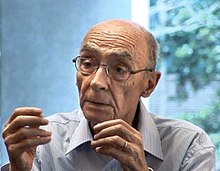 Jose Saramago at the presentation of the film “La Flor mas grande del Mundo” (2008) | |||
| Birth name | Jose de Sosa | ||
| Date of Birth | November 16, 1922 | ||
| Place of Birth | Asignaga , Ribatejo , Portugal | ||
| Date of death | June 18, 2010 (87 years old) | ||
| Place of death | Tias , Las Palmas , Canary Islands , Spain | ||
| Citizenship |  Portugal Portugal | ||
| Occupation | prose writer, poet, essayist | ||
| Direction | postmodernism | ||
| Genre | |||
| Language of Works | |||
| Awards |  Nobel Prize for Literature ( 1998 ) Nobel Prize for Literature ( 1998 ) | ||
| Awards |
| ||
| Autograph |  | ||


Content
Biography
Jose de Soza was born on November 16, 1922 into a peasant family in the province of Ribatejo in the village of Azignaga , 100 km from Lisbon . A new surname ( Saramago , the Portuguese national name for wild radish) appeared in the future writer seven years later, when it turned out that the archive worker “at his own peril and risk added the nickname of our family to the name” [4] . Since 1924, he lived with his family in the capital. Due to the poverty of his parents, he did not even receive secondary education. He worked as a car mechanic, a draftsman, and served in the field of healthcare and social insurance. At the same time he studied foreign languages, read a lot. At 22, Saramago married Portuguese artist Ilde Reis.
He published his first book (Sinful Land) in 1947 , after which until 1966 he did not publish anything. In 1969, Saramago joined the underground Portuguese Communist Party . After the Red Carnations Revolution, for some time (1974-1975) he worked as a political observer and headed the culture department in the newspaper Diário de Lisboa, and in 1975 he became deputy editor-in-chief of the daily metropolitan newspaper Diário de Notícias . Since 1976, a journalistic career was interrupted by dismissal, and Saramago decided to devote himself exclusively to literary work. A year later, the first novel of a “professional” writer was published - the Textbook of Painting and Calligraphy, which, after many years in the Nobel lecture, Saramago called “double initiation ” - the perfect coincidence of the moment the character and author were born.
By this time, the writer had already divorced his first wife. In the 1980s, he married again - the Spanish journalist Pilar del Rio [4] .
After a visit to Israel in 2002, Saramago stated that the policies pursued in the Palestinian territories “reminded him of the behavior of the Nazis towards Jews in the Auschwitz concentration camp .” After harsh statements by the Israeli Foreign Ministry and the no less harsh rebuff of Saramago, his novels disappeared from the shelves of the country's bookstores, that is, an unspoken boycott was announced to the writer [5] .
Jose Saramago, calling himself a " libertarian communist " [6] , stood in all European Parliament elections from 1989 to 2009 from the Coalition for Democratic Unity around the Portuguese Communist Party . In 1989, he was also elected to the local council of the Portuguese capital as a communist candidate from the For Lisbon coalition.
Creativity
With some reservations, the work of Saramago is usually attributed to magical realism . His phantasmagoric prose is filled with the idea of universal equality and deep humanism . The writing style, starting with the first things, remained almost unchanged. A slightly fragmented, monolithic structure text is traditionally devoid of division into chapters . An additional density is given by the absence of dashes and line breaks in dialogs.
"Rising from the Ground"
Not taking into account the early creative experiments, we can say that literary talent woke up at Saramago late. The first significant work - the family saga "Rising from the Earth" - was released in 1980 , when the author was 58 years old. The book can be considered the result of seven years of political activity of the writer: its theme is the civil development of the Portuguese peasantry in the era of the right-wing dictatorship stretched over several generations . The ideology of the novel is under obvious Marxist influence: realizing themselves as an oppressed class, the peasants begin a political struggle with the latifundists . The result is the 1974 revolution , which Saramago mentions only in passing, probably because its results were doubtful for the left movement. The social component (a description of the poverty of rural life, the disenfranchised position of the peasantry ) is interwoven in a book with folklore motifs, elements of a parable and even a fairy tale. Two years after publication in the author’s homeland, in 1982 the novel was released in the USSR , opening up for the Soviet reader an acquaintance with the prose of the future Nobel laureate.
“Memorial of the Monastery”
In total, two novels by Jose Saramago were published in the USSR . The second of them, “Memory of the Monastery”, was published in Russian in 1985. The book tells the story of the love of the crippled veteran Baltazar Seven Suns and the witch girl Blimunda Seven Moons, unfolding against the backdrop of the epic construction of the monastery in Mafra in the first half of the 18th century. Having outlined the depressing position of the common people in late feudal Portugal with the omnipotent influence of the Catholic Church, Saramago consolidated his position on the left literary flank. The anti-clerical mood of the novel caused fierce accusations of blasphemy by the Vatican . However, film director Federico Fellini called “Memoirs of the Monastery” one of the most interesting books of our time and even considered its adaptation. But the plan was never destined to materialize.
Stone Raft
However, in 2001 the film “Crack” (“La Balsa de piedra”), shot by the French director Georges Sluizer (George Sluizer) based on another book by Saramago “The Stone Raft” was released. In it, the author tells an amazing story about how the Iberian Peninsula broke away from the mainland along the Iberian Ridge and went on a free voyage along the Atlantic Ocean . The tectonic shift is accompanied by a series of fairy-mystical events, the direct participants of which come together to go on a journey through the breakaway peninsula. The “Stone Raft”, in the form of a novel-journey, tells of the difficult relations between the Spaniards and the Portuguese with each other and the rest of Europe .
The Gospel of Jesus
A special place in the work of Saramago is the novel “The Gospel of Jesus” [7] . A year after its release, Saramago received the Nobel Prize for Literature with the wording “for works in the form of parables full of fantasy, irony” [8] . Nevertheless, one cannot fail to note the very quick reaction of the Nobel Committee to the publication of the novel. According to the title, the book is an alternative account of gospel events . Contrasting Jesus with the Old Testament Yahweh , putting earthly, human truth in his mouth, Saramago destroys the original dogma of the Trinity . Jesus , in turn, becomes actually a revolutionary character who came precisely to violate the "law and the prophets", but not fulfill it [9] . The novel criticizes Christian dogma from the point of view of left-wing humanism and affirms the values of the latter. The "Gospel of Jesus" is, in a way, a generalization of the experience of Saramago as the author of socio-historical prose and a magical realist, and is recognized by most critics as the peak of his artistic talent .
Disruption of Death
The pearl of Saramago’s late work was the fantastic parable novel “Disruptions in Death”. In accordance with the title, the author draws a completely impossible situation when people cease to die in a certain country. The reason is that death , acting in the book as a character, outraged by his ungrateful attitude, declares an indefinite strike. In the first part of the book, according to the canons of science fiction, Saramago describes all sorts of everyday, economic and political consequences that led to the failure of the life cycle of the nation. In the second part, the tonality suddenly changes, and the science fiction novel turns into a love affair, where the protagonists are the same death and the aging musician whom she came to pick up, finally exchanging anger for mercy. The contrasting combination of two heterogeneous texts under one cover for the first time finds a place in the work of the author, and the depth of the images and the level of the language put “Disruptions in death” in the list of the best things in Saramago.
Bibliography
Novels
- 1947 - "Land of Sin" / port. Terra do pecado
- 1977 - "Textbook of painting and calligraphy" / port. Manual de Pintura e Caligrafia
- 1980 - "Rising from the Ground" ("Risen from the Dust") / port. Levantado do chão
- 1982 - “ Memorial of the monastery ” / port. Memorial do convento
- 1984 - "The Year of the Death of Ricardo Reis" / port. O ano da morte de ricardo reis
- 1986 - "Stone Raft" / port. A jangada de pedra
- 1989 - “The History of the Siege of Lisbon” / port. História do Cerco de Lisboa
- 1995 - Blindness / port. Ensaio sobre a Cegueira
- 1997 - “All Names” ("Book of names") / port. Todos os nomes
- 1997 - “The Gospel of Jesus ” / port. O Evangelho Segundo Jesus Cristo , Lisboa - 1997 [10]
- 2000 - "Cave" / port. A caverna
- 2002 - "The Double" / port. O homem duplicado
- 2004 - “[About] Vision” / port. Ensaio Sobre a Lucidez
- 2005 - "Interruptions in death" / port. As intermitências da morte
- 2008 - “The Wandering of the Elephant” / port. A viagem do elefante
- 2009 - Cain / Port. Caim
Poems
- 1966 - “Possible Poems” / port. Os Poemas Possíveis
- 1970 - “Possible Poems” / port. Provavelmente alegria
- 1975 - “Year 1993” / port. O ano de 1993
Chronicles
- 1971 - “This World and Another” / port. Deste Mundo e do Outro
- 1973 - “Traveler's Baggage” / port. A bagagem do Viajante
- 1974 - "Opinions that the" Diário de Notícias "was" / port. As Opiniões que o DL Teve
- 1977 - “Notes” / port. Os apontamentos
Tales
- 1978 - “Quasi-Object” / port. Objecto quase
- 1979 - “Poetics Five senses - the ear” / port. Poética dos Cinco Sentidos - O Ouvido
- 1997 - "The Tale of an Unknown Island" / port. O Conto da Ilha Desconhecida
Travel Notes
- 1981 - "Travel to Portugal" / port. Viagem a portugal
Diary and Memories
- 1994 - The Lanzarote Magazine / port. Cadernos de Lanzarote (IV)
- 2006 - “Little Memories” / port. As pequenas memórias
Books for children
- 2001 - "The Biggest Flower of the World" / port. A maior flor do mundo
Translations into Russian
In Russian spelling, the surname is indicated as Saramago .
- Memories of the monastery / per. Alexandra M. Koss (St. Petersburg: Amphora, 2002 .-- 495 p. - ISBN 5-94278-290-3 ; M .: Eksmo; St. Petersburg: Domino, 2008 .-- 416 p. - ISBN 978-5-699- 25385-2 ) .
- Year of death of Ricardo Reis:
- - Per. Alexander S. Bogdanovsky (Moscow: Makhaon, 2003 .-- 704 p. - ISBN 5-18-000524-8 ) ;
- - Per. Alexander S. Bogdanovsky, Sergey Alexandrovsky, Eugene Vitkovsky , Anatoly Geleskul , Gennady Zeldovich and Leonid Tsyvyan (M .: Eksmo; St. Petersburg: Domino, 2008 .-- 592 p. - ISBN 978-5-699-27705-6 ) .
- Double / per. Elena Golubeva (M .: Eksmo; St. Petersburg: Domino, 2008 .-- 336 p. - ISBN 978-5-699-26829-0 ) .
- The Gospel of Jesus / per. Alexander S. Bogdanovsky (M .: Vagrius, 1999. - 384 p. - ISBN 5-7027-0817-2 ; M .: Makhaon, 2003-448 p. - ISBN 5-18-000417-9 ; M .: Makhaon , 2005 (2006). - 512 p. - ISBN 5-18-000676-7 ; M .: Eksmo; St. Petersburg: Domino, 2007. - 432 p. - ISBN 978-5-699-24995-4 ) .
- Stone raft / per. Alexander S. Bogdanovsky (K .: Sofia, M .: Helios, 2002.- 464 p. - ISBN 5-344-00268-8 ; M .: Eksmo; St. Petersburg: Domino, 2008 .-- 400 p. - ISBN 978 -5-699-25723-2 ) .
- Centaur (p. 38−63). - In Sat: Completely different stories (compiled by N. Gordimer ). - M.: Open World, 2006 .-- 400 p. - ISBN 5-9743-0040-8 .
- Interruptions in death / per. Alexander S. Bogdanovsky (M .: Eksmo, 2006 .-- 256 p. - ISBN 5-699-18377-9 ; M .: Eksmo; St. Petersburg: Domino, 2008 .-- 256 p. - ISBN 978-5-699- 26360-8 ) .
- Rising from the ground / per. Alexander S. Bogdanovsky and Natalia Malykhina (M .: Progress, 1982.- 392 p.) ;
as Rising from the ground / per. Alexander S. Bogdanovsky and Natalya Malykhina (M .: Makhaon, 2002 .-- 384 p. - ISBN 5-18-000409-8 ) . - Blindness / Per. Alexander S. Bogdanovsky (M .: Eksmo; St. Petersburg: Domino, 2008 .-- 368 p. - ISBN 978-5-699-28384-2 ) .
- Book of names / per. Alexander S. Bogdanovsky (M .: Eksmo; St. Petersburg: Domino, 2010 .-- 304 p. - ISBN 978-5-699-45257-6 ) .
- The wandering elephant / per. Alexander S. Bogdanovsky (M .: Eksmo; St. Petersburg: Domino, 2011 .-- ISBN 978-5-699-50679-8 )
- Cain / per. Alexander Bogdanovsky (Moscow: Eksmo, 2012 .-- ISBN 978-5-699-60567-5 )
- (Pro) vision / per. Alexander Bogdanovsky (M.: Eksmo, 2013 - ISBN 978-5-699-69212-5 )
- The history of the siege of Lisbon / per. Alexander S. Bogdanovsky (Moscow: Alphabet, 2016 - ISBN 978-5-389-09729-2)
Rewards
- Cavalier of the Great Chain of the Order of Santiago and the Sword ( Portugal , December 3, 1998 ) [11]
- Commander of the Order of Santiago and the Sword (Portugal, August 24, 1985 ) [11]
See also
- Yanchar, Drago
Notes
- ↑ BNF ID : 2011 Open Data Platform .
- ↑ According to the accepted rules for transferring Portuguese names, Saramagu is more correct, but the spelling of Saramago is well established in Russian-language literature.
- ↑ Portuguese writer Jose Saramago Died . Lenta.ru (June 18, 2010). Date of treatment August 14, 2010. Archived on August 25, 2011.
- ↑ 1 2 M. Nadjarnykh. Jose Saramagu: the possibility of melodrama in the postmodern era // Literature Issues . - 2008. - No. 1 . - S. 73-99 .
- ↑ Books of Nobel Laureate Jose Saramago boycotting in Israel . NEWSru (March 28, 2002). Date of treatment August 14, 2010. Archived on August 25, 2011.
- ↑ Anne le Coz. Portugal mourns as Nobel laureate's body returned . The China Post (21 June 2010). Archived June 12, 2011.
- ↑ Reviews: A. Zlobin. Return to Earth // Foreign Literature . - 1999. - No. 1 ; Nikolaeva O. Creativity or self-affirmation? // New world . - 1999. - No. 1 ; Sirotkin S. The gospel of Jesus: Saramago in the camp of heretics // Ural . - 2010. - No. 7 .
- ↑ Nobel Prize Laureate in Literature Jose Saramago Dies
- ↑ Matthew 17
- ↑ Jose Saramago. Gospel of jesus M., "Swallowtail", 2005.
- ↑ 1 2 Information on the website of the President of Portugal (port)
Links
- Blog hosted by Jose Saramago
- Saramago, Jose in the " Journal Hall "
- Jose Saramago. Gospel of jesus
- Jose Saramago. Why do I support anti-globalists
- Biography of Jose Saramago in the online encyclopedia "Around the World"
- Saramago, Jose on the Internet Movie Database