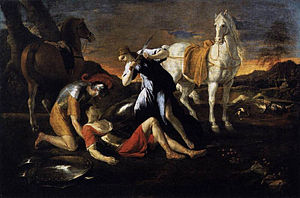
“Tankred and Herminia” is a painting by Nikola Poussin ( 1594 - 1665 ), created in the 1630s .
| ||
| Nikola Poussin | ||
| Tancred and Erminia . 1630s | ||
| fr. Tancrède et Herminie | ||
| Oil on canvas . 98.5 × 146.5 cm | ||
| State Hermitage Museum , St. Petersburg | ||
| ( inv. ) | ||
Creation History
Poussin was very attracted to the chivalrous poem of Torquato Tasso “ Liberated Jerusalem ”, full of magical adventures, unexpected and intricate collisions. Many of the artist’s canvases are inspired by Tasso’s poems. Poussin addressed twice to one of the episodes of the poem “Liberated Jerusalem”. One of the variations of the painting on the plot of “Tankred and Herminia” is kept in the Hermitage [1] . A later and more famous author’s version is at the Institute of Fine Arts at the University of Birmingham [1] .
Herminia, in love with the knight of Tancred , finds him wounded after a duel with the giant Argant. The squire Vafrin lifts Tancred’s immobile body from the ground, and Eminius, in an unbridled outburst of love and compassion, cuts off his hair with a sword to bandage the knight’s wounds.
The painting "Tancred and Herminia" was acquired for the Hermitage in 1766 from the collection of the artist Aved in Paris, at auction. Exhibited in room 279.
In 1971, the USSR Ministry of Communications issued a postage stamp with a reproduction of this painting, the face value of the stamp was 14 kopecks (No. 4022 according to the CFA catalog ).
Quotes
- “The heroic solemnity of the landscape, the monumentality of the whole make us feel that we are not ordinary people, not everyday life, but an exceptional drama of a special breed of people, with high passions and moral valor. In this, Poussin acts as a true classicist, seeking in the art of the sublime and the beautiful. But the whole atmosphere, a bit fabulous in its unusualness, and most importantly, the concentration around the image of the main character of the picture - Herminia, embodying the ideal of selfless love, gives Poussin's canvas such vivid emotionality, such authenticity of feelings that we feel here not an obvious lesson of classic dimension, but the free flight of human feelings. It is not for nothing that Poussin, this recognized head of French classicism in painting, has lived almost his whole life in Italy, away from the strict prim court of Louis XIV, all immersed in utopian dreams of a beautiful world where high human passion and genuine, unplayed heroism live ... ” [2 ] - Mikhail Alpatov .
Links
Sources
- ↑ 1 2 State Hermitage Museum. Leningrad. - M .: Fine Arts, 1975.
- ↑ Alpatov M. Studies on the History of Western European Art. - M. - L .: State Publishing House Art, 1939. - 316 p.