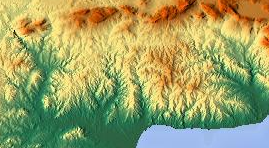
The Málaga Mountains ( Spanish: Montes de Málaga ) is a mountain range located approximately five kilometers north of the city of Malaga , Spain .
| Malaga mountains | |
|---|---|
| Spanish Montes de Málaga | |
 Malaga mountains | |
| Highest point | |
| Highest peak | Cross de la reina |
| Highest point | 1030 m |
| Location | |
| A country |
|

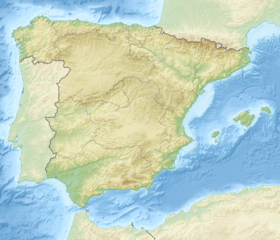

This is a chain of low and high mountains running parallel to the Mediterranean coast and rising from a height of 80 m above sea level to 1032 m of the height of the peak of the Cross de la Reina . In addition to the Mediterranean Sea, it borders on the Malaga Basin in the south. In the west it borders the mosquito Baye del Guadalors and in the east of Aharquia . In the north, the Perian Corridor separates the Malaga Mountains from the Cordillera Anterana .
Among the Málaga mountains, the Guadalmedina River flows, which over the centuries has repeatedly come out of the banks.
In July 1989, the Parliament of Andalusia passed a law establishing the Montes de Málaga Nature Reserve . The reserve has an area of about 5,000 hectares and is located mainly in the municipal boundaries of Malaga and partly in Casabermech and Colmenar . You can get to the reserve on the highway A-7000, also known as Carretera de los Montes (Mountain Road).
A natural zone was created to avoid flooding in Malaga. Work began on September 13, 1930 and continued until the 50s. Sowing was carried out mainly by the seeds of Aleppo pine .
There are several routes where you can admire the beauty of the Malaga Mountains. There are two sites where you can camp - in the park de Torrijos with an entrance through Fuente de la Reina ("Source of the Queen") and in El Serrado. The most significant of the hiking trails are El de Pikapedreros, El Serrado, Las Contadoras, Pocopane and Torrijos.
Flora
The origin of most of the woody vegetation that covers the Málaga Mountains lies in reforestation dating back to the 1930s. in order to protect Malaga from large floods, from which the city suffered from the spills of the Guadalmedina River.
For new forest plantations, species such as pine pine , Primorye pine and, above all, Aleppo pine were used . This last species perfectly adapts to poor and eroded soils, causing less oxidation than other pine species.
After the forest cover has been restored, autochthonous Mediterranean vegetation begins to grow rapidly, which grew here several centuries ago and which, due to the expansion of the cultivation zone of vineyards, as well as olive and almond groves, was pushed into the background.
Therefore, today we can observe the real natural restoration of stone oak, cork oak (a species less thermophilic and requiring more moisture than Stone oak, but which tries to displace it from silicon soil, when this is favored by temperature and humidity) and Portuguese oak . In addition to the mentioned species, there are also chestnut , walnut , poplar , ash , strawberry , myrtle , carob , various types of cistus , Erica , clamaceae , chameroops , gorse , thyme , rosemary , asparagus , etc.
Typically Mediterranean shrubberies with drought-resistant species such as Calicotome villosa , Uliteraceae , Joster evergreen and broomberry develop in the zones that are most free from pines. In the shade of these thickets or under the canopy of pine trees, kermes oak , wolfberry, cnidian juniper , juniper and Erica can be tree-like and canary oak grows in the wettest areas.
Fauna
Most of the fauna of the Malaga mountains is nightlife. The largest animal is a wild boar , whose “bathtubs” flood the areas of hiking in the rainy season. One of the most common mammals is the red fox , which is often found in the Lagar de Torrijos zone, where it prowls at night in search of birds, eggs, reptiles and small mammals, such as a field mouse . Also in areas close to Las Contadoras fireflies and wild cats live.
Other mammals, such as marten , are unsociable and live in isolated, inaccessible areas. In pine plantations, one can observe protein , woodpeckers , which are active during the day. For most of the year, many birds and small mammals such as bats , sparrows , doves , swallows and various species of birds of prey fly over the Malaga mountains.
Down below, small reptiles are found on the ground: the Iberian lizard , the eye lizard , the Andalusian lizard and the wall gecko , which have colored skin designed to mask possible predators.
It is also the habitat of the chameleon , an animal listed in the Red Book . The biggest threat to him are cars that run into chameleons crossing the road. In recent years, thanks to the Nature Conservation Service and various breeding programs, chameleons have been concentrated in areas remote from places of human activity, where they are not in danger.
Hiking trails
In the Montes de Málaga Nature Reserve, there are 5 hiking trails designated by the Environmental Council of the Junta of Andalucía .
- Trail 1. Pokopon
- Trail 2. Torrijos
- Trail 3. Contadores
- El serrado
- Pickedreros