Gendergap ( Eng. Gender gap , gender_gap ), also a gender space [1] or gender touch - in linguistics : an underscore used to indicate a space between the main part of a word and its ending, serving the purpose of equalizing all genders [2] . The use of the stroke means not only the mention of two sexes - male and female - but also all other possible gender identities that do not fit into the binary gender system - transgender and undefined sex [3] [4] [5] .
German usage
History and Usage Examples
The beginning of the use of the underscore in this meaning is considered to be an article by Steffen Kitty Hermann ( German: Steffen Kitty Herrmann ), published in 2003 in German . The very term “gender gap” to indicate such a practice appeared a little later and was copied from the English language , in which it denotes gender inequality [6] . The use of gendergap has become widespread in modern German, primarily in Germany , as well as in Austria [7] .
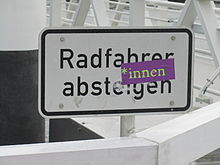
In German, gender-gap is used by attaching an additional female ending to masculine nouns and adjectives that are traditionally used for collective treatment (the so-called “general male gender” - generisches Maskulinum, used to refer to groups of people of both sexes). A variation of the genderap is the use in the same place and for the same purpose of a "gender star " ( German Gender-Star ) instead of the underscore [8] [9] .
| Gendergap | Gender asterisk | Generisches Maskulinum | Full form indicating both genera |
|---|---|---|---|
| liebe Kolleg_innen | liebe Kolleg * innen | liebe Kollegen | liebe Kollegen und Kolleginnen |
| liebe Schüler_innen | liebe Schüler * innen | liebe Schüler | liebe Schülerinnen und Schüler |
| liebe_r Mitarbeiter_in | liebe * r Mitarbeiter * in | lieber mitarbeiter | liebe Mitarbeiterin, lieber Mitarbeiter |
| liebe Teilnehmer_innen | liebe Teilnehmer * innen | liebe teilnehmer | liebe Teilnehmer und Teilnehmerinnen |
| liebe_r Student_in | liebe * r Student * in | lieber student | lieber Student, liebe Studentin |
| 300 Ärzt_innen | 300 Ärzt * innen | 300 Ärzte | 300 Ärzte und Ärztinnen |
| der_die Interviewpartner_in | der * die Interviewpartner * in | der Interviewpartner | der Interviewpartner oder die Interviewpartnerin |
| ein_e Befragte_r | ein * e Befragte * r | ein befragter | ein befragter oder eine befragte |
The use of gendergap or gender asterisk in German looks more successful when mentioning plural nouns. However, in the singular, in many cases, this form is difficult or impossible due to the specifics of the German language, for example, in the phrase “der Arzt oder die Ärztin” (in the female form the umlaut is present, but in the male form not) [10] . As a possible solution, it is also proposed to use an asterisk or underscore after the letter accepting the umlaut in the feminine gender, for example der_die A_rtz_in or der * die A * rzt * in .
Official Use
In practice, gender gaps and gender stars are used primarily in feminist , queer or university settings. In this case, we are mainly talking about written language. When reading or pronouncing a word with a genderap or gender asterisk, it is recommended to take a short pause in its place so that the spoken word is not perceived as a female form [11] [12] .
In November 2015, the German Green Party became the first party to vote at its official party meeting at the official level for the mandatory use of the gender asterisk in all cases where it is possible, urging in other cases to resort to other descriptive terms without indicating sex [13 ] [14] . The use of a gender asterisk was also, for example, introduced into the official language of office work in the administration of the Berlin district Friedrichshain-Kreuzberg [15] . Since April 2016, the gender gap has been mandatory for use in office work in the administration of the Tempelhof-Schöneberg district of Berlin [16] . Also, in other districts of the capital, it is soon planned to introduce the use of a gender asterisk or gender gap, despite the confrontation between the CDU and ADG , which appeal to the fact that such practice contradicts the existing rules of German grammar and complicates the perception of texts [17] .
Linguistic criticism
In July 2014, more than 800 professors, teachers and journalists from Austria (among them Rudolf Taschner , Chris Loner and Konrad Liesmann and others) signed an open letter addressed to Vice Chancellor Reinhold Mitterlener and Minister of Education Gabriele Heinisch-Hosek , in which they called for a return to the "language norm" and the cessation of the imposition of formulations imposed from above, which are spread in laws, official documents and school textbooks [18] .
A well-known critic of the use of gender gap and gender asterisk is a German linguist and specialist in the field of German grammar Peter Eisenberg , who calls this practice ideological language manipulations. According to him, the German language provides a sufficient number of possibilities for mentioning women in speech without the use of artificial structures [19] [20] . Eisenberg gives examples in which following the rules of gender strokes or asterisks leads to absurd constructions like Bäcker * innenauszubildende * r. In his opinion, such artificial changes in the natural language are akin to genetic engineering [21] [22] .
In the German language, there are many other examples in which the use of gender strokes or asterisks leads to the fact that the text becomes unreadable [23] :
| Gendergap | Gender asterisk | Full form |
|---|---|---|
| jede_r Anwa̲lt_in | jede * r Anwa * lt * in | jeder Anwalt und jede Anwältin |
| ein_e Beamt_er_in | ein * e Beamt * er * in | ein beamter oder eine beamtin |
| die_der Zeug_in_e | der * die Zeug * e * in | der Zeuge oder die Zeugin |
In 2016, the German magazine named a Berlin student Sebastian Zidek ( German Sebastian Zidek ) the winner in the category "Keeper of the German language" ( German Sprachwahrer des Jahres ). Readers of the magazine voted for a student at Berlin Technical University , who refused to use gender touches and stars in their work, despite the threat of his teacher to lower his grade for this. The young man had to contact the legal department of the university, in which he was assured that the university had no requirements for the mandatory use of a gender-neutral language and promised to consult his teacher [24] [25] .
Use in Russian
In the Russian language the gender gap was borrowed from the German language. Moreover, due to differences in the grammatical education of the female form of the word ( feminatives ) in German and Russian, gender- specific constructions in the Russian language sometimes look strange and even bizarre when the part of the word before the gender-gap does not coincide with the masculine form. Discussions about the introduction of such forms in the Russian language at the present stage are not conducted at the level of linguists, but take place on social networks and among activists [26] :
| Gendergap | Gender asterisk | Full form |
|---|---|---|
| student_ka | student * ka | student and student |
| reader_nitsa | reader * nice | reader and reader |
| party_za | participants | participant and participant |
| actress | actress | actor and actress |
| Count_inya | count * yin | count and countess |
See also
- Feminatives
- Gender linguistics
- Snake case
- Camelcase
- Sjw
Notes
- ↑ Lukicheva M.V. Political Correctness in German
- ↑ Gendergap // Duden (German)
- ↑ Josefine Janert. Gender-Deutsch an Unis: Professx trifft Student * innen (German) . FAZ (15. November 2016). Date of treatment May 5, 2017.
- ↑ Ingrid Thurner. Der Gender-Krampf verhunzt die deutsche Sprache (German) . Die Welt (2. Februar 2013). Date of treatment May 5, 2017.
- ↑ Gender-Sternchen und Gender-Gap (German) . Queer Amnesty Schweiz. Date of treatment May 5, 2017.
- ↑ Heide Oestreich. Gegen den Strich (German) . taz (8. August 2015). Date of treatment May 5, 2017.
- ↑ Persson Perry Baumgartinger. Lieb [schtean] Les [schtean], [schtean] du das gerade liest ... - Von Emanzipation und Pathologisierung, Ermächtigung und Sprachveränderungen : [ him. ] : [ arch. March 3, 2016 ] // Liminalis - Zeitschrift für geschlechtliche Emanzipation. - 2008. - No. 2. - S. 24—39.
- ↑ Leitfaden für einen geschlechtergerechten Sprachgebrauch (German)
- ↑ Merkblatt zu geschlechtersensibler Sprache (German)
- ↑ Matthias Klaus. Geschlechtergerechte Sprache: Gender Star und Binnen-I (German) . Deutsche Welle (7. September 2016). Date of treatment May 5, 2017.
- ↑ Beate Hausbichler. Raum für _! (German) . DerStandard (26. Oktober 2008). Date of treatment May 5, 2017.
- ↑ Anna Dombrowsky. Gender und Sprache: Sternchensammler * innen (German) . Der Tagesspiegel (29. Oktober 2015). Date of treatment May 5, 2017.
- ↑ Matthias Kohlmaier. Gendern in der Sprache: Ein Sternchen für alle (German) . Süddeutsche Zeitung (22. November 2015). Date of treatment May 5, 2017.
- ↑ Cordula Eubel. Vor dem Parteitag: Die Grünen führen den Gender-Star ein (German) . Der Tagesspiegel (22. November 2015). Date of treatment May 5, 2017.
- ↑ Stephan Wiehler. Zwist um das Gender-Sternchen: Von Demokrat zu Demokrat * in (German) . Der Tagesspiegel (2. Juni 2016). Date of treatment May 5, 2017.
- ↑ Gunnar Schupelius. In Tempelhof-Schöneberg ist der Gender-Unterstrich jetzt amtlich (German) . bz (5. April 2016). Date of treatment May 6, 2017.
- ↑ Wie Berliner Bezirke auf gendergerechter Sprache bestehen (German) . Berliner Zeitung (25. Februar 2017). Date of treatment May 6, 2017.
- ↑ Offener Brief: Absage an "Gender-Wildwuchs" (German) (14. Juli 2014). Date of treatment May 5, 2017.
- ↑ Linguist kritisiert geschlechtergerechte Sprache (German) . Deutschlandfunk (8. März 2017). Date of treatment May 6, 2017.
- ↑ Sprachwissenschaftler kritisiert "Gender-Gaga" (German)
- ↑ Das missbrauchte Geschlecht (German)
- ↑ Aus den Feuilletons: Wie gefährlich sind Gender-Sternchen? (German)
- ↑ Leitfaden für eine gerechte und diskriminierungsfreie Sprache , S. 18 (German)
- ↑ Student für Kampf gegen Gender-Sprache ausgezeichnet (German)
- ↑ Berliner wehrt sich erfolgreich gegen “Student * innen” (German)
- ↑ Alexander Pershay. Gender-neutral language and non-binary identities: how to reform the language? Talking Olga Andreevsky, Alexander Pershay and Yana Sitnikova [How to Change Language: Gender-Neutral and Non-Binary Options in Russian] . Academia.edu .