Ronald C. Spears ( Eng. Ronald C. Speirs ; April 20, 1920 , Edinburgh , Scotland , UK - April 11, 2007 , Saint Marie , Montana , USA ) [1] - American officer, participant in the Second World War as part of the 2nd battalion , 506th Parachute Regiment, 101st Airborne Division. He also served in Korea, where he commanded a rifle company, and then became an American liaison officer at Spandau Prison in Berlin. Gained wide popularity thanks to the television series " Brothers in Arms ".
| Ronald spears | |||||||||||
|---|---|---|---|---|---|---|---|---|---|---|---|
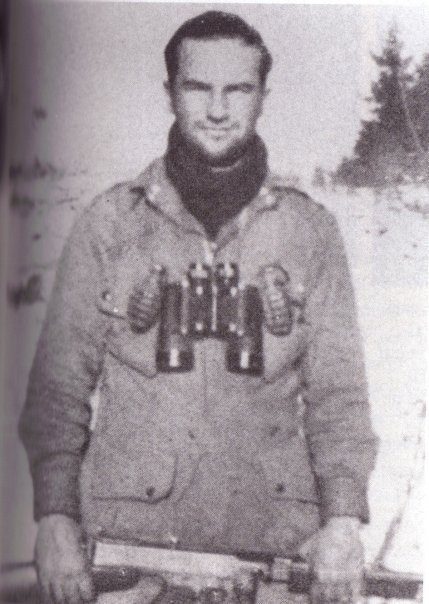 1944 year | |||||||||||
| Nickname | Sparky, Killer, Blood Spears | ||||||||||
| Date of Birth | April 20, 1920 | ||||||||||
| Place of Birth | Edinburgh , Scotland , UK | ||||||||||
| Date of death | April 11, 2007 (86 years old) | ||||||||||
| Place of death | Saint Marie , Montana , USA | ||||||||||
| Affiliation |  USA USA | ||||||||||
| Type of army |  U.S. Army U.S. Army | ||||||||||
| Years of service | 1942 - 1964 | ||||||||||
| Rank |  Lieutenant colonel Lieutenant colonel | ||||||||||
| Part | Rota D / Rota E, 2nd Battalion, 506th Parachute Regiment, 101st Airborne Division | ||||||||||
| Battles / wars | The Second World War
Korean war
Laos Civil War
| ||||||||||
| Awards and prizes |
| ||||||||||
| Retired | Red Army Liaison Officer in Spandau Prison | ||||||||||


Content
Biography
The early years
Ronald Spears was born on April 20, 1920 in Edinburgh , Scotland , UK , where he spent only four years. On December 25, 1924, he emigrated with his family to the United States , namely to Boston , Massachusetts . He went through military training in high school, which led him to the military commission as a second lieutenant . After the United States entered the war with Japan, Spears volunteered for a parachute assault and was sent to the Taccoa camp, platoon commander of the Dog Company, 2nd Battalion, 506th Parachute Regiment , which later joined the 101st Airborne Division. At the end of 1943, together with the division, he was transferred to England to undergo preparations for the invasion of France.
Invasion of France
June 6, 1944, together with the company "D" landed on the territory of Normandy , where after landing and quickly found other fighters of the company. Gathering a small group, he assisted the group of Lieutenant Richard Winters during the assault on the Brekur estate , where he alone captured the fourth 105-mm howitzer. [2] [3] [4]
Operation Market Garden and the Battle of Baston
After landing in Normandy, Spears with company “D” were sent to Holland to support company “E” (Easy) in the Dutch operation . After the failure of the operation in Holland, Spears participated in the siege of the city of Bastogne , where, during the storming of the city of Foy, he commanded the company "E" due to the poor leadership of Lieutenant Norman Dyke. During the assault, Spears not only led the company “E” to victory, but also gave the order to the company “I” (Item), which were located in the rear of the city, while directly ran across German positions and returned back the same way.
Winters later rated Spears as one of the best combat officers in the battalion. In his memoirs, he wrote that Spears worked hard to earn the reputation of a killer and often killed fighters for shock. Winters stated that Spears once claimed to have killed six German prisoners of war with a Thompson submachine gun , and that the battalion’s leadership should be aware of these allegations, but chose to ignore it because of the urgent need to retain skilled combat leaders. Winters concluded that in today's army, Spears would have been accused of atrocities by the Military Tribunal, but at that time officers like Spears were too valuable because they were not afraid to attack the enemy.
Despite the fact that Spears after the victory over Germany could go home, he chose to stay with company "E". But after the atomic bombings of Hiroshima and Nagasaki, Japan surrendered before Spears could be handed over to the Pacific Theater.
Korean War
Spears returned to the United States and decided to remain in the army. Serving during the Korean War, he made one combat leap and commanded a rifle company until the end of the war. On March 23, 1951, he participated in Operation Tomahawk, during which he parachuted to Munsan (known as Munsan-ni during the war) with other soldiers in his unit (187th Regiment Combat Group). The initial mission of his battalion was to provide a fall zone, which was achieved by killing 40 or 50 enemy soldiers. [6]
Spandau Prison Service
After the war in Korea, Spears attended Russian language courses and was appointed liaison officer with the Red Army , which was located in Potsdam. In 1958 he became the head of the Spandau prison in Berlin, where prominent Nazis, such as Rudolf Hess , were serving their sentences. [7] Prisoner Albert Speer mentions Spears in his book Spandau: The Secret Diaries, as "a stubborn, annoying American commandant." This man was later identified as Spears.
Laos Civil War
In 1962, Spears was a member of the US mission in the Royal Laos Army [7] , where he served as a training officer in the Mobile Training Unit (MTT) for Operation White Star, which was then led by the Laos Military Assistance Advisory Group (MAAG) Laos).
Later years
His last assignment in the army was as an officer of plans at the Pentagon . He retired as a lieutenant colonel in 1964.
Family
On May 20, 1944, Spears married a girl whom he met while in Wiltshire , England . She was a member of the British Women's Supporting Territorial Service. In their marriage, a son was born, Robert, who grew up and became a lieutenant colonel in the British army. They later divorced in 1946.
Rewards
| Battle infantry badge |
| Skydiver Badge with 3 Combat Jumps |
| Silver Star [8] | |
| Legion of Honor Order [8] | |
| Bronze star with two oak leaves | |
| Purple heart with three oak leaves | |
| Medal of Praise | |
| Presidential medal with one oak leaf | |
| Campaign Medal | |
| Medal For the European-African-Middle Eastern Campaign with three service stars and arrowhead | |
| Medal of Victory in World War II | |
| Medal "For service in the occupying army" | |
| Medal "For the service of national defense" with a star of service | |
| Military cross with a palm branch | |
| Medal of Liberated France | |
| Medal "For Service in Korea" | |
| Korean Military Service Medal | |
| United Nations Medal in Korea | |
| Thanks from the President of the Republic of Korea |
Notes
- ↑ Ronald C Speirs . United States Social Security Death Index (FamilySearch Historical Records) .
- ↑ Ambrose, p.83
- ↑ Winters, p.88
- ↑ Guarnere and Heffron, p.69
- ↑ Winters, p.187
- ↑ Bowers, William T. Striking Back: Combat in Korea, March-April 1951 . - KY: The University Press of Kentucky, 2009. - P. 106–107. - ISBN 0813125642 .
- ↑ 1 2 Ambrose, p. 301
- ↑ 1 2 Ronald C. Speirs . Hall of Valor . Military Times.
Literature
- Ambrose, Stephen E. Band of Brothers: Easy Company, 506th Regiment, 101st Airborne from Normandy to Hitler's Eagle's Nest. - Simon & Schuster, 1992. - ISBN 978-0-7434-6411-6 .
- Winters, Richard D., with Cole C. Kingseed. Beyond Band of Brothers: The War Memoirs of Major Dick Winters. - St. Martin's Press, 2006 .-- ISBN 0-425-20813-3 .
- Guarnere, William J., and Edward J. Heffron, with Robyn Post. Brothers in Battle, Best of Friends: Two WWII Paratroopers from the Original Band of Brothers Tell Their Story. - Berkley Caliber, 2007 .-- ISBN 978-0-425-21970-6 .
- Brotherton, Marcus. A Company of Heroes: Personal Memories about the Real Band of Brothers and the Legacy They Left Us. - Berkley Caliber, 2010 .-- ISBN 9780425234204 .
Links
- Biography on Heroes Forever
- Spears, Ronald on the Find a Grave website
- RonaldSpeirs.com