
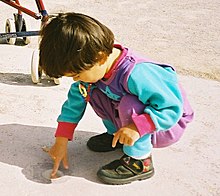
Early age is a period in the development of a person between infancy and preschool age .
Content
The place of young age in age periods
In Soviet psychology, the first age periodization of mental development was developed by L.S. Vygotsky [1] was further studied by D. B. Elkonin [2] . L. S. Vygotsky determined the chronological boundaries of an early age - from 1 year to 3 years, and D. B. Elkonin carried it along with infancy to the era of early childhood. The early age begins after the crisis of the first year of life and ends with the crisis of three years .
In Western psychology, the following age periodizations can be distinguished:
In the concept of psychosexual development of Z. Freud, an early age falls on the anal phase , when the child is taught to cleanliness and use the toilet.
In E. Erickson's psychosocial theory , early age corresponds to the anal phase in the concept of Z. Freud, but the author adds that during this period the child overcomes the crisis either in favor of choosing autonomy or a sense of shame / doubt.
In the theory of cognitive development, J. Piaget associates early age with the end of the sensorimotor intelligence stage and the beginning of the preoperative stage .
Physical development at an early age
Physical development in early childhood is characterized by intense growth and weight gain. The chest grows, the diaphragm lowers and its muscles become stronger. The respiratory system also develops (due to an increase in lungs and respiratory volume, the respiratory rate decreases), immune (resistance to adverse environmental conditions increases), circulatory (heart grows), digestive ( digestive organs can already digest different foods), nervous (development of cortical nerve cells brain ).
From about 1 year to 2 years, the motor skills of the child are improved. He can already walk for a long time, change position, step over low obstacles. Despite the active development of the nervous system, during this period there is a low limit of working capacity of nerve cells in the cerebral cortex, which leads to rapid fatigue of the child.
From 2 years, the body's resistance to infections increases markedly, that is, the immune system, as well as the thermoregulation system, is actively developing. The efficiency of the nervous system is significantly increased, however, the increased excitability of the subcortical departments leads to the fact that all the reactions of the child are accompanied by strong emotions .
In the third year of life, long-term memory begins to function. The second signaling system is being actively developed: the child's vocabulary is expanding, he better understands adult speech . By the end of the year, fluency in speech reaches a degree of automatism. The development of fine motor skills also takes place, and it affects the development of the speech center and articulation apparatus . By the end of an early age, teething of all deciduous teeth ends.
Social situation and development
The social situation of development is characterized by the collapse of the system of close relations with a significant adult and the emergence of a new opportunity for the child to interact directly with the subject, where the sample of the ways of dealing with it belongs to the adult. In collaboration with an adult, a new social situation of development is being built, the content of which is the assimilation of socially developed ways of dealing with objects (that is, the scheme of the social situation of development "child - subject - adult"). In addition, the child begins to master the speech, as the old means of communication do not allow to master new subjects. A certain level of autonomy of the child, along with the emergence of a need for the development of the objective world, gives rise to a new type of leading activity - the subject-tool. The following stages of mastering a child’s logic of tools at an early age were distinguished [3] :
- Nonspecific use of the tool (for example, when mastering a spoon, the child tries to use it in various functions unsuitable for food (knocking, reaching out with a spoon to other objects));
- The child already highlights the function of the tool (a spoon is needed in order to eat), but does not yet identify the mode of action (for example, the child can turn the spoon over with the other end and try to scoop up food for it);
- The child already identifies a way to act with a spoon, but there are still no coordinated hand movements;
- The child masters the adequate system of movement of the hand and, thus, at the last stage, the mastery of the logic of the gun is complete.
Early communication form
A typical form of communication at an early age is situational-business communication with a significant adult . M. I. Lisina [4] identified 4 signs when a child shows a need for cooperation with an adult:
- The child is trying to draw the attention of an adult to his activities;
- The child is waiting for an adult's assessment if successful;
- The child is waiting for support from the adult in case of failure;
- The child avoids the “pure” affection, but accepts it with pleasure as an encouragement of success and achievements.
Subject Game Development
Due to the fact that objective-instrumental activity at an early age acquires the character of leading activity, then with its appearance the objective game begins to develop. F. I. Fradkina identified 3 stages of the development of the objective game:
- The game consists in narrowly imitative manipulation of an object on the model of an adult (this stage appears at the beginning of the second year of life);
- The child’s objective actions are expanding, the adult can create complex chains of actions for the child, and they can be performed by him (this stage appears from about 1.6 years to 3 years);
- Elements of an imaginary situation arise (namely, a child can replace one object with another) and the role first appears.
The development of the objective game in the future forms the prerequisites for the development of role-playing games .
Major psychological neoplasms
Speech development is the central line of development at an early age. Russian psychologists distinguish 2 main periods of speech development at an early age [3] :
- from 1 to 1.8 years - a transition period, which is characterized by the following features: passive speech develops faster than active; the child’s active speech is ambiguous in semantics (by a single word a child can understand several objects), it is peculiar in sound composition (violation of the pronunciation of phonemes ) and syntax (in this period, the child speaks mostly with one-word sentences).
- from 1.8 years to 3 years - practical mastery of speech. The volume of the active dictionary increases, and the child begins to ask questions about the names of objects ("Who is this?", "What is this?").
In the field of perception at an early age, the formation of constancy of perception occurs. As you master the speech, perception becomes arbitrary (the word begins to coordinate the perception of the child). In the field of thinking, a child at an early age begins to discover hidden essential connections between objects, that is, visual-effective thinking is formed. L. S. Vygotsky revealed that at an early age, depending on the nature of generalization, the level of development of thinking is characterized by syncretes and complexes. Syncretes - a generalization of purely subjective relationships - are characteristic of the first phase of an early age (1 - 1.6 years), complexes - a generalization of specific actual, but random relationships - are typical of the second phase of an early age (1.6 - 3 years).
Emotional and personal development
At an early age, a type of attachment to a close adult occurs. J. Bowlby defined attachment as a model of behavior that ensures maintaining contact with a close adult and satisfies the child's need for safety. Around the age of 2-3 years, a stable type of attachment is formed, evidence of this is the child’s reaction to separation from a close adult (the reaction may be different depending on the type of attachment formed; in the case of reliable attachment, the child quickly calms down when separated from a close adult and enjoys his return) . Also in this age period, initial forms of social emotions arise. These include aesthetic, moral feelings (a sense of shame, guilt, pride), empathy and empathy for another person.
Notes
- ↑ L. S. Vygotsky. The problem of age-related periodization of child development. - Questions of psychology. - Moscow, 1972. - S. 114 - 123.
- ↑ D. B. Elkonin. Selected psychological works. - Moscow: Pedagogy, 1989.
- ↑ 1 2 O.A. Karabanova. Age-related psychology. - Moscow: Iris Press, 2005.
- ↑ M.I. Lisina. Problems of ontogenesis of communication. - Moscow, 1986.
See also
- Anal stage
- The crisis of three years
- Preschool age
- Childhood
- Age periodization
- Age
- Psychosocial development
- Psychosexual development