Finsler geometry is one of the generalizations of Riemannian geometry . In Finsler geometry, manifolds with a Finsler metric are considered; that is, by choosing a norm on each tangent space that varies smoothly from point to point.
Basic Concepts
Let be 


Finsler metric on 
-
;
-
positive homogeneous first degree in
, i.e
for any pair
and numbers
;
- For any pair
-
- positively defined.
-


Remarks
If we put
-
,
that form 

For any nonzero vector field 


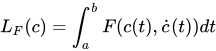
For a smooth curve ![{\displaystyle c:[a,b]\rightarrow M^{n}}](https://wikimedia.org/api/rest_v1/media/math/render/svg/a764c349bcbd2acc7806edca72772bf805ab3cb2)
Chern (or Runda) covariant differentiation operator 



![{\displaystyle N_{j}^{i}(x,y)={\frac {\partial }{\partial y^{j}}}\left[{\frac {1}{4}}g^{il}(x,y)\left\{2{\frac {\partial g_{ml}}{\partial x^{k}}}(x,y)-{\frac {\partial g_{mk}}{\partial x^{l}}}(x,y)\right\}y^{m}y^{k}\right].}](https://wikimedia.org/api/rest_v1/media/math/render/svg/5057b9a755bf8beead87ec1872378c82ccb06a8b)
A connection thus introduced on a manifold is not, generally speaking, an affine connection. Connectivity will be affine if and only if the Finsler metric is a Berwald metric [ clarify ] . By definition, this means that the equations of geodesics have the same form as in Riemannian geometry, or geodesic coefficients
representable as
For vector consider the functions . Then the transformation family called the Riemannian curvature. Let be tangent 2-dimensional plane. For vector define Where such a vector that . independent of choice . Number called flag curvature of the flag at .
History
The idea of the Finsler space can be seen already in the lecture of Riemann "On the hypotheses that lie in the foundations of geometry" (1854). Along with the metric defined by the positive square root of a positive definite quadratic differential form ( Riemannian metric ), Riemann also considers the metric defined by a positive root of the fourth degree from a fourth-order differential form. The Finsler metric is the following natural generalization.
A systematic study of varieties with such a metric began with the dissertation of Paul Finsler , Published in 1918 , therefore the name of such metric spaces is associated with his name. The introduction of Caratheodory of new geometric methods in the calculus of variations to study problems in a parametric form is considered to be the factor that initiated the research activity in this direction. The core of these methods is the concept of indicatrix , and the property of the convexity of the indicatrix plays an important role in these methods, since it ensures the fulfillment of the necessary minimum conditions in the variational problem for stationary curves.
A few years later, in the general development of Finsler geometry, there is a turn from Finsler's original point of view to new theoretical methods. Finsler, guided mainly by the concepts of the variational calculus, did not use tensor analysis methods . In 1925, tensor analysis was applied to the theory almost simultaneously by Sing , Taylor ( Eng. JH Taylor ) and Berwald ( German L. Berwald ). In 1927, Berwald proposed a generalization in which the condition of positive definiteness of the metric, later known as the Berwald-Moore space , is not satisfied.
The next turn in the development of the theory occurred in 1934, when Cartan published a treatise on Finsler spaces. The Cartan approach prevailed in almost all subsequent studies of the geometry of Finsler spaces, and several mathematicians expressed the opinion that, as a result, the theory reached its final form. The Cartan method led to the development of Finsler geometry through the direct development of Riemannian geometry methods.
Several geometers independently expressed criticism of Cartan’s methods, in particular, Wagner , Busemann and Rund . They emphasized that the natural local metric of a Finsler space is the Minkowski metric , while an arbitrary imposition of the Euclidean metric leads to the loss of the most interesting characteristics of Finsler spaces. For these reasons, further theories were put forward in the early 1950s, as a result of which considerable difficulties arose, Busemann noted on this occasion: “The Finsler geometry from the outside is a forest in which all vegetation consists of tensors ” .
Literature
- In Russian
- G.S. Asanov. Finsler space with an algebraic metric defined by a field of frames - Itogi Nauki i Tekhn. Ser. Prob. Geom., 8, VINITI, M. , 1977, 67-87.
- IN AND. Bliznikas. Finsler spaces and their generalizations - Results of science. Ser. Mat. Algebra. Topol Geom. 1967, VINITI, Moscow , 1969, 73-125.
- V.G. Zhotikov. Introduction to Finsler's geometry and its generalization (for physicists) - Moscow : MIPT , 2014. ISBN 978-5-7417-0462-2 .
- PC. Rashevsky. Polymetric geometry, - Proceedings of the seminar on vector and tensor analysis with their applications to geometry, mechanics and physics. Issue 5. OGIZ, 1941.
- PC. Rashevsky. Geometric Theory of Partial Differential Equations, - Any edition.
- H. Rund. Differential geometry of Finsler spaces, - M .: "Science", 1981.
- In English
- PL Antonelli. Handbook of Finsler geometry, - Kluwer Academic Publishers, Dordrecht, 2003.
- D. Bao, SS Chern and Z. Shen. An Introduction to Riemann-Finsler Geometry, - Springer-Verlag, 2000. ISBN 0-387-98948-X .
- SS Chern. Finsler geometry is not the Riemannian geometry without quadratic restriction - Notices AMS, 43, September 1996.
- Z. Shen. Lectures on Finsler Geometry, - World Scientific Publishers, 2001. ISBN 981-02-4531-9 .
- Z. Shen. Kluwer Academic Publishers, Dordrecht, 2001.
Links
- Home Page of Finsler Geometry - Zhongmin Shen website about Finsler geometry. (eng.)
- Non-profit Foundation for the development of research on Finsler geometry.
- Chris Moseley (Calvin College), "Finsler and sub-Finsler geometries" (2013 presentation of the report) (English)
- V. G. Zhotikov . “What is Finsler geometry and why do physicists need to understand it” (presentation of the report)