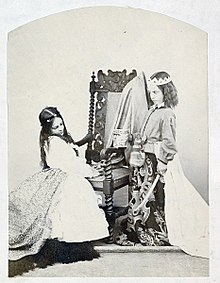
Lewis Carroll and photography is a topic of research by contemporary literary scholars , art historians and Victorian England , psychologists and sociologists from various countries. For a long time, Carroll was known mainly as a writer, but is now rightly regarded as one of the largest photographers of his era. Carroll for a long time considered his most important occupation; he treated her as a vocation, entertainment, and "the only life's pleasure", devoted more time to her, as some researchers of his work, more than to literature or teaching mathematics [1] . Sketches from the life of photographers also became the subjects of Carroll’s short stories and poems [2] .
Carroll's introduction to photography and his enthusiasm

Carroll was interested in the technical innovations of his era: he became one of the first passengers of the train, greeted the first phonographs (in his diary he wrote: “It’s a pity we are not allowed to run fifty years ahead and learn this amazing invention in its perfect form. Now it’s even in the diapers, this is a newly emerging miracle, like a photograph, as I remember it in 1850 ” [3] ), one of the first writers began to type on a typewriter [4] .
Carroll got acquainted with photography (with the most promising method of calotypy of his time) in 1855, during his summer vacation, watching the photographing of his uncle Robert Wilfrid Skeffington Lutwich [5] . In January 1856, he wrote: "He wrote to Uncle Skeffington, asking me to get a photographic apparatus, because I want to find something for myself, in addition to reading and writing." On March 18, 1856, Carroll purchased a set of equipment in London ( camera , lenses , tripod and other items) for the wet collodion process . Carroll chose T. Ottivella's store on Charlotte Street and paid 15 pounds for the purchase [6] . Carroll purchased the camera , taking with him his friend Reginald Southey as a companion. Southey already had a camera, was considered an experienced photographer, so he acted as a consultant at the time of purchase. Under the leadership of Southey, the writer made his first photographs, he soon became so carried away by a new occupation that he began to devote almost all his free time to it [5] . He wrote: “This is my only fun, and, I believe, it deserves a serious attitude” [6] . He took his first photographs in Christ Church , in his apartment or in the dean’s apartment [7] .
Southey had a strong influence on Carroll from 1855 to 1857. Carroll shot Southey many times, and Southey photographed Carroll, together they shot common acquaintances, worked on making positives . Carroll wrote in his diaries that Southy, being familiar with chemistry , helped him work on this process. Sometimes, Southy recommended Carroll his own fashion models. So, he advised the writer to get acquainted with Henry Ackland who had a “beautiful family” with six children whom he could photograph. Carroll also collaborated with Southey on photographs of the Liddell family daughters. Sauti also expressed an “opinion on the negatives ” of the photographs of the writer. Carroll visited Southey’s house to see his new photographs. [8] [9] [10]
Carroll's notes of this time indicate that he viewed this activity as a possible way to earn money. However, for Carroll over the next twenty-four years (from May 1856 to July 1880), photography was only a hobby , although he became a well-known amateur photographer. Carroll began with photographs of detached buildings, statues , samples from museum anatomical collections, gardens and still lifes . Only later did he turn to the portrait , which later became the central genre in his work [11] .
He worked as Carroll in the morning, and was preparing for classes in the evening, while daytime he gave out photographs: shooting, developing and printing pictures, searching for subjects and sitters [12] .
Carroll initially worked on photographs in his own living rooms, and later equipped a glazed studio in the dean’s building. In 1872, Carroll already had its own attic studio in Oxford , designed so that he could take pictures even in rainy and cloudy weather. He rented a lot of toys and costumes from the Drury Lane Theater (although the writer himself created some of the costumes and borrowed some from the Ashmolean Museum in Oxford for a while [13] ). A collection of clockwork toys was hidden in a massive closet: bears , rabbits , frogs , clockwork mice , a crooked mirror, about twenty music boxes and barrel-organs , which performed strange, in the opinion of others, music. The bat was made by Carroll himself, she could flap wings and even fly. He also used a rented studio, but only in case of emergency. Carroll usually filmed in Oxford, occasionally traveling outside it (for example, to the Lake District for photographing the family of poet Alfred Tennyson ). Model writer Ethel Hatch said that Carroll carried with him a suitcase full of toys, which he opened at the right time, and sometimes used Alice in Wonderland as a bait. Ella, another of his models, the daughter of one of the Oxford professors, recalled that Carroll tried to photograph her in a bed frightened by a ghost “with the help of my father’s electric machine , but did not succeed in this ...” [14] . Some of the photographs were taken by him in the lap of nature, most often this happened in the garden of the dean’s office [11] .
Carroll was never a member of professional photographic clubs or societies. The only professional exhibition (V annual exhibition of the London Photographic Society ), in which four of his portraits were exhibited (the name of only one photograph presented there, “ Little Red Riding Hood ” is known), was held in 1858 [15] . The main form of exhibiting his photographs, he made a personal album, which was shown to guests. There are several such albums to our time. In twenty-four years, he created about 3,000 images, of which less than a thousand have survived [11] .
In 1880, Carroll ceases photography. The reasons for this decision are unknown. According to one hypothesis , he reacted negatively to dry plates, which replaced the wet collodion process . On the other - he decided from now on to concentrate on literature. A year later, he refused to teach. John Padney in his book “Lewis Carroll and his world” suggests that the motives were a chain of unfortunate accidents and psychological breakdown of the writer himself. Not understanding the age of the co-worker’s daughter, Sidney James Owen (she was seventeen years old), Carroll kissed the girl goodbye, which made an unpleasant impression on her mother. Gossip began. Perhaps Carroll himself doubted the naturalness of his impulse and decided to leave a photograph. At the same time, he broke up with many Oxford friends and colleagues [16] .
Carroll's child portraits, according to his will, were transferred to the model families. These photos of Carroll were scattered and forgotten, a significant part of them were not even signed by the author [17] .
Lewis Carroll. Skeleton of fish from Madeira island, 1857
Lewis Carroll. Reginald Southey and the skeletons , 1858
Lewis Carroll. Alice Liddell , 1858
Lewis Carroll. Alice Liddell in profile, summer 1858
Lewis Carroll. Exy Kitchin in the guise of a Chinese woman, 1873
Carroll's Artistic Features
Currently, according to the biographer of the writer John Padney, Lewis Carroll is recognized as the best photographer of the XIX century, who shot children [18] . In a letter of 1877, Carroll himself writes to his correspondent that he considers himself to be an "amateur photographer whose specialty is children." He well understood the peculiarities of child psychology and considered it necessary to prepare the child for photographing. He often calls himself not a photographer, but an artist. In the same letter, he offers the correspondent to bring the children to his studio, but not with the goal of “taking pictures right away (I never succeed with strangers), but to get to know the place and the artist and see how much they like the idea of coming up another time, to be photographed ” [11] .
Carroll wrote: “I adore children, but with the exception of boys. To my taste, they are by no means an attractive genus of creatures ... It always seemed to me that they needed clothes, while ... the pretty forms of girls are rarely worth hiding ” [11] . When filming, the writer adhered to strict rules:
“If the most beautiful child in the world is at my disposal for the purpose of drawing or photographing it, and I find that the girl is at least slightly compressed (no matter how insignificant her embarrassment and no matter how easy it is to overcome) from the thought of acting naked, I would considered it his sacred duty before God himself to abort his request completely ”
- Vladimir Levashov. Lectures on the history of photography [11]
.
For a long time it was believed that Carroll's nude images of children were lost, but six of them are currently discovered and published [19] . The most famous among them is the attributed to the writer photograph of the older sister Alice Liddell - Lorina [20] . Other similar photographs were taken in the second half of the 70s and captured the Hutch sisters: Beatrice, Evelyn and Ethel [21] . Carroll took all necessary precautions to prevent these photos from falling into the wrong hands - he destroyed copies of prints and negatives. Pictures were taken each time with the knowledge and consent of the parents. Photos of the Hutch sisters are hand-painted [22] .
Levashov writes:
“Carroll’s enthusiasm for little girls, coupled with a clear, as it is believed, lack of interest in romantic relationships with adult women, a psychoanalytic reading of his work and especially photographs of naked and half-naked girls lead to speculation about the pedophilia of the photographer, though not physically realized, and sublimated in the form of literature and photography. These assumptions arise many years after his death amid the destruction of the Carroll family (in order to preserve the reputation of the deceased) evidence of his friendship with older ladies, which may give the impression that he was interested in exclusively little girls. "
- Levashov V. Lewis Carroll and Pictorialism [23]
There is no direct evidence of his actions that could be considered pedophilic. Carroll himself insisted on a purely aesthetic interest in the problem. This version is reflected in a study by Caroline Leach “In the shadow of a miracle child” ( Eng. “In the Shadow of the Dreamchild” , 1999). Leach claims that Carroll looked after adult women, and that many of his “girlfriend-children” were actually far from adolescence . Some historians specializing in the Victorian era indicate that Carroll’s perception of children was within the traditions, laws and morality of the time, as well as related to the specific circumstances of the writer's biography [11] . At the same time, Carroll himself was largely disappointed with his experience with children. He wrote: “I think nine out of ten cases of my friendship with children were wrecked ... and child-friends , once so tender, became uninteresting acquaintances with whom I no longer had the desire to meet” [24] . Other researchers see his interest in children as a tendency for the photographer to create a fabulous atmosphere, play, and improvisation that are characteristic of children but alien to the adult world. Children-models made it possible to overcome the ceremonial nature of photography of this time: exposure duration, stillness in front of the camera, deep silence [11] . The process of making photographs they perceived as a rite. After decades, Alice Liddell wrote to her son: “It was much more interesting than taking pictures, getting admission to a dark room and watching how he displays large glass plates” [7] . Carroll American researcher Morton N. Cohen published a small monograph on nude -style photographs of a writer [25] .
Researchers pay attention to the photographer’s ability to make children posing for him to remain motionless in front of the camera (the minimum exposure time was 40 seconds). Due to the long exposure, Carroll’s characters rarely see a smile, but Levashov believes that the goal of the writer was not “to penetrate the hearts of his models”, but “to create a harmonious image”. He himself wrote that he was most attracted to photography by the poses of models (especially their hands) and the composition of the picture [14] . Evelyn Hatch recalled: “almost a prayer ritual for choosing a pose, which received great attention ...” [7] .
Carroll actively maintained relations with amateur photographers and was accepted among professionals who had already established themselves; Levashov suggested that he used photography as a way to enter a higher social stratum than the one to which he belonged. Thanks to photographs, Carroll became close to the Pre-Raphaelites . In 1857, he met with the theoretician of this field, John Ruskin , who was actively interested in photography, and then with the pre-Raphaelite artists Dante Gabriel Rossetti , William Holman Hunt , John Everett Millet , Arthur Hughes [14] . Along with the works of Henry Pich Robinson and Oscar Gustave Reilander, Carroll’s photographs are attributed to pictorialism , which is characterized by the staged nature of the filming and the installation of negatives . Carroll was personally acquainted with Reylander, took several lessons from him, and acquired from him a collection of staged children's photographs. A photograph of the writer, made by Reilander, is considered a classic portrait of the mid-60s of the XIX century. The writer also had a collection of 37 photographs of Clementine Gavarden (all about 198 by 144 millimeters in size), the second most numerous photograph after the collection of her family [26] [27] .
The writer was closely acquainted with many large photographers of his time and peculiarly appreciated their work. Carroll did not like photographs of Julia Margaret Cameron due to the lack of focus on them (her blurry image was associated with a subtle mental movement). Cameron preferred an extremely close-up , and Carroll - a full-length image, since it was the figure that seemed to him the most expressive [14] . Rare evidence has survived that Carroll, in his work on photographs, used the advice of professional artists, who sometimes even made sketches for his pictures: artist Henry Holiday “showed the drawings that he does for me (sketches of compositions with two naked children - for my photos from nature) , they turned out to be excellent ” [28] .
Lewis Carroll. Alfred Tennyson, 1857
Lewis Carroll. Alice Liddell in the image of a beggar , 1858
Lewis Carroll. Dressed in her best clothes, 1858. Pair photo for “Alice Liddell in the image of a beggar”
Lewis Carroll. Dante Gabriel Rossetti Family, 1863
Lewis Carroll. Family of John Everett Millet, July 21, 1865
Lewis Carroll. Achilles in his tent (Brooke Taylor Kitchen), June 26, 1875
Carroll Fashion Models
Contemporaries claimed that Lewis Carroll as an photographer was unbearable, he did not realize how chaos he arranged in a strange house. He did not stop at anything, pursuing two goals: to get a celebrity or beautiful children as sitters.He tried to get permission to photograph Queen Victoria and the heir to the throne - the future king Edward VII , but to no avail [12] . For a long time Carroll persecuted Tennyson and his family, seeking the right to photograph them, the result was that Tennyson saw the young teacher primarily as a photographer and refused to recognize his literary talents [29] . A major event for Carroll was the queen's praise conveyed to him:
«Получил письмо от миссис Рид, в которое вложена записка от леди А. Стенли (жены настоятеля Вестминстерского аббатства ) к леди А. М. Доусон, где та рассказывает, что показывала мои фотографии королеве и ей было поручено передать, что „Её величество ими восхищается. Такие снимки во вкусе принца-консорта и доставили бы ему огромное удовольствие“»
- John Padney. Lewis Carroll and his world [30]
Carroll's largest trophy among statesmen was the photo of Robert Gascoigne-Cecil Marquis of Salisbury , in the future - the Prime Minister of Great Britain, and at that time - Chancellor of Oxford University [31] .
Carroll's social circle was limited to his own family, members of the Oxford academic community, and their children. It was these people who he made models of his portraits [11] . More than half of the surviving Carroll photos depict girls (although, according to experts, the real proportion, taking into account the lost photos, could be completely different). In the March 1863 entry in his diary, he lists in alphabetical order one hundred and three girls whom he would like to photograph. He shot them both in clothes (historical, ethnic and fairy-tale costumes, usually staged photographs), and without it [11] .
Carroll called his little friends, whom he used as fashion models, “child-friend” ( English “child-friend” ). Some researchers believe that this term did not indicate age, but the type of relationship, that in Victorian England this expression was quite common and reflected the nature of the relationship between people of different social status. There are other interpretations of this term [32] . Among Carroll's most famous and frequent photo models were:
- Alexandra Roda Kitchin (nicknamed "Exi", English Alexandra "Xie" Rhoda Kitchin , 1864-1925) - a muse and fashion model of the writer since 1868. Carroll photographed her more often than any other of his models. Alexandra Kitchin was the daughter of Rev. George William Kitchin (1827–1912), who was Carroll’s colleague in the Cathedral of Christ at Oxford , later the dean of the cathedral in Winchester , and later at Durham [33] [34] . Her godmother is Alexandra of Denmark , the future Queen Consort of Great Britain and Ireland , who was her mother’s childhood friend [35] . In 1890, Alexandra married Arthur Cardew, a civil servant and amateur musician. They had six children. Unlike Alice Liddell , Isa Bowman, and Carroll's other friends, Xie never published memories of him [36] .
- Alice Liddell was the daughter of Henry Liddell , a classical philologist , dean of one of the colleges in Oxford , co-author of the Greek dictionary Liddell-Scott , and his wives - Lorina Hannah Liddell (née Reeve). She is captured in 20 photos of the writer. The manuscript “Alice in Wonderland” (and her original version, “The Adventures of Alice Underground”) is dedicated to her, suggest that Carroll was in love with her and even made her an offer [37] .
- Agnes Grace Weld ( English Agnes Grace Weld , 1849-1915) - niece of the poet Alfred Tennyson, was the daughter of Charles Richard Weld (1813-1869), a writer who served as assistant secretary and librarian to the Royal Society of London for sixteen years, and Anne Weld (nee Selwood). As a child, she repeatedly posed for photographs of Lewis Carroll, Julia Margaret Cameron [38] and Oscar Gustav Reilander . Her aunt (mother's sister) became the wife of Alfred Tennyson, with this family the girl and her parents maintained a close relationship. Agnes Weld never married, devoting her life to charity and spending almost all her inheritance on her. She was a well-known publicist at the time, having published four books on religion during her lifetime or containing memories of Alfred Tennyson [39] .
- Annie Rogers (1856-1937) repeatedly posed for photographs of Lewis Carroll, gained fame later as an active supporter of female education. She grew up in Oxford in an academic family, was the daughter of professor and economist Thorold Rogers , in 1873 successfully passed exams at Balliol College and Worcester , but a boy who showed a lower result was enrolled, and Annie Rogers received four volumes of Homer as a gift from Balliol College. In connection with this widely acclaimed story, separate courses for women were created, Rogers finished them with the best result and with honors in Latin and Ancient Greek (1877). Later, she became secretary of the Association for the Education of Women and one of the founders of the Society of Oxford Home-Students at St. Anna's College [40] .
Lewis Carroll. The Rossetti Family for Chess, 1863
Lewis Carroll. Agnes Grace Weld ( Z-PH-LCA-II.72 )
Lewis Carroll. Exy Kitchin in Penelope Boothby's Dress, 1875-1876
Lewis Carroll. Lorina, Alice and Edith Liddell in the photo "Open your mouth ...", July 1860
Lewis Carroll. Annie and Frances Hendersons, 07.1879
Chess in Lewis Carroll's photos
A series of photographs of Carroll captured characters playing chess. The writer was actively interested in the events of the chess life of Great Britain, he played chess himself, taught to play children’s chess. The plot of the tale " Alice through the Looking Glass " is based on a chess game, which the writer himself invented [41] .
Carroll's Literary Work on Photography
Carroll created several literary works of various genres on the theme of photography: short stories “Unusual Photography” ( Eng. “Photography Extraordinary” ), “Scottish Legend” ( Eng. “The Legend of Scotland” ), “Weekend of a Photographer” (another translation - A Photographer's Day Out ), the poem Hiawatha Photographer (in other translations Hiawatha behind the Camera, Hiawatha's Photographing ). The most famous among his literary works on photography is a poem - a parody of a poem by Henry Longfellow . It was completed on November 13, 1857, and printed on The Train in December of that year. Later it was reprinted during the author’s lifetime in the collections Phantasmagoria and Other Poems ( Eng. “Phantasmagoria and Other Poem” , 1869) and “Rhyme and Reason” ( Eng. “Rhyme and Reason” , 1883). This is a parody of “The Song of Hiawatha”, where Carroll describes the excitement and difficulties of the photographer, probably based on his own experience [1] . The author preceded the poem with a small introduction, which is written by the same meter, but not broken into lines, as in verses:
“In the age of fakes, I have no claim to merit for trying to do what everyone knows and is not difficult. After all, any writer, to a certain extent, sensitive to rhythm, could compose for hours in the easy and reverent size of the glorious lines about Hiawatha. Therefore, it’s not worthwhile, right, to turn your attention to the form of a small poem, to the harmonies contained in it - let the impartial reader unbiasedly judge only the topic that has been raised ”
- Lewis Carroll. Hiawatha taking pictures [42]
.
In the story “Photographer's Day Off,” the protagonist must arrange a family photo session. The family consists of a father, mother, two sons, schoolchildren, a large number of kids, but the eldest daughter Amelia makes the strongest impression on him, the beauty of which he tries to capture in the picture, and which he can achieve sympathy for. However, having photographed her entire family, he finds out that she is engaged and that his hopes are not destined to come true. The story " Scottish Legend" takes place in a medieval castle, the ghost of a certain Lady from the future that appeared here tells about the unsuccessful attempts of an inept photographer to take her to full height (each time only a part of her body appears on the photo). “Extraordinary Photography” - Carroll’s second most prosaic text; it described a “newest method of photographing,” which allows literary texts to be “brought to a proper state.” According to the author, the experiment on the poem by William Wordsworth gave him “amazing energy”, and during a similar experiment on the poem by George Gordon Byron, the paper “became smokey and charred” [2] .
Lewis Carroll. Skull and fins of cod and human skull, 1857
Lewis Carroll. Window view of Reginald Southey, June 1857
Lewis Carroll. Little Red Riding Hood , 1857
Lewis Carroll. St. George and the Dragon , 1857
Lewis Carroll. Alice Jane Donkin, 1862, Z-PH-LCA-II.120
Carroll and his imitators photo collections
In the era of modernism, Carroll's photos did not find understanding and did not cause much interest, but then his reputation as one of the best Victorian photographers began to recover [11] .
In 1945, collector, historian and photographer Helmut Gernsheim carried away by Victorian photography. No special literature on it at that time existed. A London-based second-hand book dealer offered Guernsheim an album with children's photographs (as he claimed, these photographs were “extracted from a pile of books in the basement”). Their author could be, according to the second-hand book writer , Lewis Carroll. No evidence of this existed, but Guernsheim at the British Museum compared photographs with Carroll’s well-known autographs and made sure they belonged to the writer [43] .
Lewis Carroll's photographic equipment has survived to our time, it is stored in the Museum of Oxford [44] . Large collections of photographs of the writer belong to the Princeton University Library [45] and the National Portrait Gallery in London [46] , the Harry Ransom Center [47] , they are in the collection of the Metropolitan Museum [48] , the Victoria and Albert Museum [49] and other collections.
In 1998, Carroll’s major photography exhibition, Reflections in the Looking Glass: Lewis Carroll’s Centenary Exhibition ( Reflections in a Looking Glass: A Lewis Carroll Centenary Exhibition ), was held in New York and California, as well as at the University of Texas at Austin , at the Harry Ransom Research Center, from which most of the photographs were provided for the exhibition. An exhibition catalog was published [50] . One of the writer's photographs was included in 1955 in the international exhibition "The Human Race" ( Eng. "The Family of Man" ) at the New York Museum of Modern Art . The curator of the project was Edward Styhen . The exhibition featured 503 photographs from 68 countries, which were represented by 273 photographers. Victorian Britain was represented by Carroll's Queen of May (1860) photograph of Alice Liddell [51] . The exhibition has toured the world for eight years and has been shown in thirty-seven countries on six continents. These photographs are currently on display in a special exhibition hall in Clervaux [52] .
Cycles of photographs, which were imitations or rethinking of Lewis Carroll's photographic images, were created by modern Greek photographer Polikseni Papapetru (author of the Dreamchild photo album, 2003, where the plots of Carroll's most famous photographs are reproduced by the photographer’s daughter) [53] and Japanese photographer Hajime Savatari (author of the albums “ Alice ”and“ Alice from the Sea ”, English “ Alice from the Sea ” , which is a continuation of the English “ Alice ” ) [54] [55] [56] .
See also
- Tales of Alice Lewis Carroll in a Book Illustration
Notes
- ↑ 1 2 Levashov, 2014 , p. 36.
- ↑ 1 2 Demurova, 2013 , p. 99, 128.
- ↑ Padni, 1982 , p. 52.
- ↑ Padni, 1982 , p. ten.
- ↑ 1 2 Demurova, 2013 , p. 126.
- ↑ 1 2 Padni, 1982 , p. 65.
- ↑ 1 2 3 Padni, 1982 , p. 66.
- ↑ Ford, Colin. Julia Margaret Cameron: A Critical Biography . - J. Paul Getty Museum, 2003 .-- S. 38 .-- 212 p. - (Getty Museum Studies on Art. Photographs Series). - ISBN 9-780-8923-6707-8. Archived April 7, 2017 on Wayback Machine
- ↑ Cox, Julian; Ford, Colin. Julia Margaret Cameron: The Complete Photographs . - Getty Trust Publications: J. Paul Getty Museum, 2003 .-- S. 41. - 566 p. - (Getty Publications virtual library. Getty Trust Publications). - ISBN 9-780-8923-6681-1. Archived April 7, 2017 on Wayback Machine
- ↑ Marsh, Jan Reginald Southey . National Portrait Gallery, London. Date of treatment February 20, 2017. Archived on April 7, 2017.
- ↑ 1 2 3 4 5 6 7 8 9 10 11 Levashov, 2014 , p. 37.
- ↑ 1 2 Padni, 1982 , p. 71.
- ↑ Tolkacheva, 2010 , p. 63.
- ↑ 1 2 3 4 Levashov, 2014 , p. 38.
- ↑ Smith, Lindsay. Lewis Carroll: Photography on the Move . - Reaktion Books, 2015 .-- 336 p. - ISBN 9-781-7802-3545-5. Archived April 5, 2017 on the Wayback Machine
- ↑ Padni, 1982 , p. 119.
- ↑ Brosalina, Love. Lewis Carroll: storyteller of photography // Russian photo. Archived January 16, 2017.
- ↑ Padni, 1982 , p. 64.
- ↑ An example of such a publication is a photograph attributed to Carroll, which allegedly depicts his model Florence Bickerstet - Lewis Carroll Dodgson. N ° 831 . Galerie Opus Mirabilis. Date of treatment April 6, 2017.
- ↑ Furness, Hannah. BBC investigates whether Lewis Carroll was 'repressed paedophile' after nude photo discovery (Eng.) // The Telegraph: Newspaper. - 2015 .-- 26 January. Archived on May 20, 2017.
- ↑ Lyndall, Gordon. Lewis Carroll and his “child-friends”: revelations about Alice and her wonderland (Eng.) // New Statesman: Newspaper. - 2015 .-- April 1. Archived on April 8, 2017.
- ↑ Ranson-Polizzotti, Sadi. Next: 42 Seconds Under Ground: The Photography of Lewis Carroll. Review of two books on Lewis Carroll // Blogcritics Magazine: Journal. - 2004. - 27 May. Archived December 8, 2015.
- ↑ Levashov, 2014 , p. 31.
- ↑ Levashov, 2014 .
- ↑ Cohen, Morton N. Lewis Carroll, Photographer of Children: Four Nude Studies. - New York: Clarkson N. Potter / Crown, 1979.- 32 s.
- ↑ Artistic photography . The history of photography. Date of treatment February 20, 2017. Archived on April 19, 2017.
- ↑ Pictures of Lady Clementia Gavarden will go under the hammer . LibyMax (Feb. 20, 2013). Date of treatment February 20, 2017. Archived July 13, 2014.
- ↑ Padni, 1982 , p. 96.
- ↑ Padni, 1982 , p. 72-74.
- ↑ Padni, 1982 , p. 79.
- ↑ Padni, 1982 , p. 120.
- ↑ Borisenko A., Demurova N. Lewis Carroll: myths and metamorphoses // Foreign Literature: Journal. - 2003. - No. 7 . - S. 195-207 . Archived January 23, 2017.
- ↑ Photographs of Children (link unavailable) . Harry Ransom Center. Date of treatment January 14, 2017. Archived January 16, 2017.
- ↑ Hambourg, 1993 , p. 276.
- ↑ Curthoys, MC Kitchin, George William (1827–1912), scholar and dean of Durham . Oxford Dictionary of National Biography. Date of treatment January 14, 2017.
- ↑ Alexandra 'Xie' Kitchin: la prima musa di Lewis Carroll . Carrollpedia. Date of treatment January 14, 2017. Archived January 18, 2017.
- ↑ McCrum, Robert. The Story of Alice review - the worrying, winding road to Wonderland // The Guardian: Newspaper. - 2015. - March 1. Archived on April 2, 2017.
- ↑ Cox, Julian; Ford, Colin. Julia Margaret Cameron: The Complete Photographs . - Getty Publications, 2003 .-- S. 520. - 556 p. - ISBN 9-780-8923-6681-1. Archived April 5, 2017 on the Wayback Machine
- ↑ Wakeling, 2014 , p. 335-336.
- ↑ Annie Rogers (1856-1937) . St Anne's College, Oxford. Date of treatment January 29, 2017. Archived on October 10, 2016.
- ↑ Charles Dodgson and Chess . The Lewis Carroll Society. Date of treatment April 30, 2017. Archived May 11, 2017.
- ↑ Carroll, Lewis. Hiawatha photographs // Complete illustrated works in one volume. - M: Alpha book, 2016 .-- S. 787. - 941 p. - ISBN 78-5-9922-0672-2.
- ↑ Tolkacheva, 2010 , p. 58.
- ↑ Padni, 1982 , p. eleven.
- ↑ Lewis Carroll . Princeton University Library. Department of Rare Books and Special Collections. Date of treatment April 6, 2017. Archived June 4, 2017.
- ↑ Lewis Carroll (Charles Lutwidge Dodgson) . National Portrait Gallery, St Martin's Place, London. Date of treatment April 6, 2017. Archived on August 21, 2017.
- ↑ Carroll the Photographer . The Harry Ransom Center. Date of treatment April 6, 2017. Archived on April 7, 2017.
- ↑ St. George and the Dragon . The Metropolitan Museum of Art. Date of treatment January 14, 2017. Archived on April 7, 2017.
- ↑ Carroll, Lewis . Victoria and Albert Museum, London. Date of treatment January 14, 2017. Archived on April 7, 2017.
- ↑ "Reflections in a Looking Glass: A Lewis Carroll Centenary Exhibition" to Open September 14, 1998 . The Harry Ransom Center (August 22, 1998). Date of treatment April 6, 2017. Archived December 24, 2015.
- ↑ The Family of Man: The greatest photographic exhibition of all time - 503 pictures from 68 countries — created by Edward Steichen for the Museum of Modern Art. - New York: Museum of Modern Art, Maco Magazine Corporation, 1955. - S. 193. - 196 p.
- ↑ Bikmurzina, Ella. Mind games give birth to Lewis Carroll. Scientists decipher the tales of an eccentric mathematician about Alice to this day // Around the World: Journal. - 2006. - December. Archived on May 6, 2017.
- ↑ Papapetrou, Polixeni. Lewis Carroll . Polixeni Papapetrou. Date of treatment April 6, 2017. Archived March 4, 2017.
- ↑ Photo exhibition features Hajime Sawatari's "Alice" // Japan Today: Magazine. - 2014 .-- 10 Octobre. Archived on November 4, 2016.
- ↑ Alice Special Edition . 写 々 者. Date of treatment November 10, 2016. Archived November 4, 2016.
- ↑ Hajime Sawatari "Alice from the Sea" 1979 (inaccessible link) . Mikitimi Books & Prints. Date of treatment November 10, 2016. Archived November 11, 2016.
Literature
- Demurova N.M. Lewis Carroll. - M: Young Guard, 2013 .-- 416 p. - (The life of wonderful people). - ISBN 978-5-235-03568-3 .
- Levashov V. Lewis Carroll and Pictorialism // Lectures on the History of Photography . - 2014 .-- 31 p. - ISBN 978-5-903788-63-7 .
- Padney J. Lewis Carroll and his world. - M: Rainbow, 1982.
- Tolkacheva I. Photographer Lewis Carroll // Photo Workshop: Journal. - 2010. - March ( No. 3 ). - S. 58-64 . - ISSN 7082-3907 .
- Douglas-Fairhurst, Robert. The Story of Alice: Lewis Carroll and The Secret History of Wonderland . - Random House, 2015 .-- 496 p. - ISBN 9-781-4735-1099-9.
- Hambourg, Maria Morris. The Waking Dream: Photography's First Century: Selections from the Gilman Paper Company Collection . - New York: Metropolitan Museum of Art, 1993 .-- 384 p.
- Heller, Erga. From Street Girl to Roman Goddess: The Creation of Multiple Visual Alices from 1858 to 1872 (Eng.) // Libri & Liberi: Journal. - 2015. - No. 4 (2) . - P. 263-265 .
- Lewis Carroll and Alice: The Private Collection of Justin G. Schiller . Christie's. Date of treatment February 14, 2017.
- Murdoch, Lydia. The Age of Alice: Fairy Tales, Fantasy, and Nonsense in Victorian England. Alice and the Question of Victorian Childhood // Archives & Special Collections Library at Vassar College: Online Edition. - 2006 .-- 23 July.
- Marsh, Jan Reginald Southey . National Portrait Gallery, London. Date of treatment February 20, 2017.
- Kerchy, Anna. Alice in Transmedia Wonderland: Curiouser and Curiouser New Forms of a Children's Classic. — McFarland, 2016. — 268 с. — ISBN 9-781-4766-2616-1.
- The Other Side of the Lens: Lewis Carroll and the Art of Photography during the 19th Century (англ.) . — Oxford: Christ Church Library Special Collections, 2015. — С. 19—20. — 28 с.
- Wakeling, Edward. Carroll lewis: of The Man and a His Circle (Eng.) . - IB Tauris , 2014 .-- S. 335—336. - 496 p. - ISBN 9-780-8577-3851-6.
- Wood, Michael. Story of by Alice of The: Lewis Carroll and the Secret History of Wonderland (Eng.) // of The the New York Times : newspaper. - 2015. - 1 June.