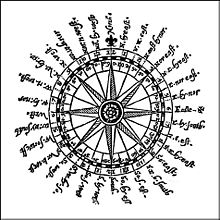
Compass card , degrees and rumba, XVI — XVII centuries
The course of the vessel is the angle, in the plane of the true horizon, between the bow of the diametrical plane of the vessel and the direction to the north ( N , north ) [1] .
It is measured in degrees clockwise from 0 ° (the so-called "pure north") to 359 °. Until the middle of the XIX century. a measurement was taken in rhubes from 0 (north, N ) clockwise to 31 (north-ten-west, NbW ). Depending on the measurement method, they distinguish:
- The true course is the angle relative to the true (geographical) north.
- Magnetic heading - angle relative to the magnetic north. Since the Earth’s magnetic pole does not coincide with the geographical one, the magnetic course differs by the magnitude of the magnetic declination at the measurement site.
- Compass heading - angle relative to the compass head. The compass, regardless of principle, does not indicate a true or magnetic north, but somewhat to the side. The compass heading differs from the true one by the magnitude of the compass correction .
See also
- Wind course
- Deviation
- Track angle
- Heading angle
Notes
- ↑ Dictionary, 1990 , p. 214.
Literature
- Nathaniel Bowditch. The American Practical Navigator. 2002 Bicentennial Edition, the US Department of Defense, 2002. ISBN 0-16-051125-9
- Ch. ed. Commander-in-Chief of the Navy Admiral of the Fleet V.N. Chernavin . Naval Dictionary. - M .: Military Publishing House, 1990 .-- 511 p. - 100,000 copies. - ISBN 5-203-00174-x .