Pinzgau ( it. Pinzgauer ) - breed of cattle of the dairy and meat direction. It was bred in the Austrian Alps at the end of the 17th century in the Pinzgau area (today it is Zell am See district) by crossing the red Bavarian, Tuk and Tsilertal cattle breeds.
| Pinzgau | |
|---|---|
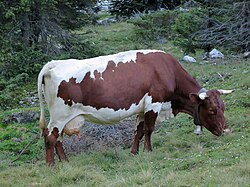 Pinzgau breed cow | |
| Productivity | meat and dairy |
The color of animals is predominantly red (of various shades) with a characteristic white stripe on the back and along the abdomen. Animals have a proportional physique, strong bones, thick elastic skin. The live weight of bulls is 750–1,000 kg, cows — 450–500 and up to 650 kg. Cows and bulls pinzgau sent for slaughter in the age from nine months to a year. The average annual milk yield is 2,000–3,000 kg with fat content of 3.7–3.8%. Some cows produce 5,000–5,800 kg of milk with 3.9–4.2% fat. The Pinzgau animal breeds also have good meat and fattening qualities: the slaughter yield is 55–57%.
Pinzgau is bred in Austria , Germany , Italy , Romania (where there is even a kind of “Transylvanian Pinzgau”) and Ukraine ; in the latter, mainly in the mountainous regions of Chernivtsi , Ivano-Frankivsk and Transcarpathian regions .
History
According to genetic and morphological studies, pinzgau breeds are most closely associated with North German lowland cattle breeds. Pinzgau first received its modern name in 1846 - before that it was called Pinzgauer Fasel or Pinzgauer Schlag. In the 19th century, Pinzgau cows were raised to work on farms, breweries and in areas where sugar beet was grown. During its heyday, the breed became the most popular among the cattle of Austria-Hungary , and later - in Eastern Europe . In 1896 the Bavarian Pinzgau breeding association was founded. By December 1890, the Pinzgau number was up to 101,880 only in Bavaria . But in the end, the prevalence of the breed has fallen dramatically as a result of industrialization that occurred after the First World War . The demand for cattle has noticeably decreased, and the pinzgau has been replaced by milder breeds: such as Fleckvieh. By 1930, only 85,000 Pinzgau were left in Bavaria. In 2001, there were 36,000 animals of this breed in Germany , and there were about 1.3 million around the world; in Austria in 1995 there were only incomplete 54,000, of which 8883 were registered in the stud books.
In Italy, the breed is present mainly in the autonomous province of Bolzano : moreover, mainly in two valleys - the commune of Valle-Aurin and the German-speaking region of Pustertal . The number of local herds experienced a sharp decline in between 1980 and 1990: from 8500 animals in 1983 to one thousand in 2000. As a result, the authorities and local farmers were forced to take protective measures in order to stabilize their numbers: it managed to restore up to 2,000 individuals and maintain it at this level.
In Austria itself, since 1969, the Holstein breed was crossed with pinzgau to increase milk productivity. This crossbreeding - especially what was carried out between 1982 and 1995 in Canada and the USA - caused a negative reaction from a number of farmers, which, in turn, led to the creation of associations of livestock breeders breeding exclusively “original” breed: today owned The members of such an association include about 5,000 animals.
There are now less than 50 hornless pinzgau units ( it. Jochberger Hummel ) in the world - so they are endangered. Since 1988, there were only two bulls at the insemination station near Salzburg . The Association of German Breeders considered the Pinzgau breed to be "the most beautiful breed of cattle" in the world. Animals of rare, black color are especially highly valued: there is a belief that they bring good luck to those farmers who grow them.
Pinzgau is considered a “reliable, rural” breed. Animals possess a number of skills related to their origin from the mountainous region: they easily endure harsh climatic conditions, which allows them to be bred in “difficult” regions in terms of animal husbandry . Sturdy legs of Pinzgau cows with hard hooves are designed to search for food in mountainous terrain. Their cold resistance allows them to live in the open air all summer long (preferably on mountain pastures). They are able to digest hard herbs and effectively convert them into meat and milk. Pinzgau cows are hardy, prolific, have good temperament, are caring parents and adapt well to a wide variety of conditions and situations.
Notes
Literature
- Antje Elfrich, Elisabeth Roesicke. Rinderrassen (= AID. 1548). aid-infodienst Verbraucherschutz. - Bonn: Landwirtschaft eV, 2009. - ISBN 978-3-8308-0819-0 .
- Hans Hinrich Sambraus. Gefährdete Nutztierrassen. Ihre Zuchtgeschichte, Nutzung und Bewahrung. - Stuttgart: Ulmer, 1994. - ISBN 3-8001-4099-3 .