Morskie Oko ( Polish Morskie Oko ) is a lake in the Tatra district of the Lesser Poland Voivodeship of Poland . It is the largest and fourth deepest lake in the Tatra Mountains . It is located in the Tatra National Park , in the valley of the Fish Stream ridge High Tatras at the foot of the Mengushovets peaks.
| Lake | |
| Morske Oko | |
|---|---|
| polish Morskie oko | |
| Morphometry | |
| Dimensions | 0.862 × 0.566 km |
| Area | 0.3493 km² |
| Volume | 0.009935 km³ |
| Coastline | 2.45 km |
| Deepest | 50.8 m |
| Swimming pool | |
| Flowing river | Fish stream |
| Location | |
| A country |
|
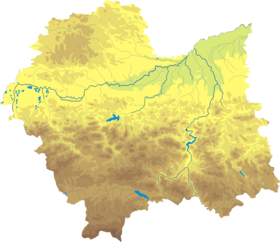
| Voivodship | Lesser Poland Voivodeship |
| County | Tatra District |


Content
- 1 Description
- 2 History
- 3 Gallery
- 4 notes
- 5 Literature
Description
The mountains surrounding the lake rise about 1000 m above its surface; one of them is Rysy (2499 m), the highest peak of the Polish Tatras. Near the Mengushovetsky peaks (including the Mengushovetsky Shield of Velka, 2438 m), farther and slightly to the left, the slender Mnikh (2068 m) rises. Around the lake, European cedar pines grow in large numbers [1] .
In the past, Morskie Oko was called the “ Fish Lake ” because of its natural fish stocks, which was rare for the Tatra Lakes and ponds. In clear waters you can easily spot trout . The name " Sea Eye " comes from an old legend, according to which the lake was connected to the sea through an underground channel [2] .
The hut of the Polish Tourism and Local Lore Society stands on a moraine off the northern shore of the lake. It is located at an altitude of 1405 m above sea level and is one of the oldest chalets in the Tatra Mountains. The hut bears the name of Stanislav Stasz , who explored the lake in 1805. This house is a starting point for trips to Mount Rysy and to the Shpiglyasov pass. Nearby is the "Stare Schronishko" ("Old Shelter"), originally a horse carriage . Both buildings are historical monuments.
The Sea Eye is one of the most popular attractions in the Tatras, often visited by more than 50,000 tourists during the holiday season. The path to the lake takes about 2 hours on foot from the nearest road, which can be reached by road. Many tourists choose horse-drawn carts for travel, the local goralies provide the services of cab drivers . In winter, a small stretch of the path passes through the avalanche - hazardous zone, this section remains cold even in summer. Swimming in the lake and feeding trout is prohibited.
History
The earliest documents mentioning Morske Oko date back to 1575. At the end of the 19th century, a dispute arose between Galicia and Hungary over the ownership of the lake and the adjacent territory. The Graz City Court ruled in favor of the Polish side. This decision was made thanks to Oswald Balcer , representing the interests of Galicia.
Morske Oko was "rediscovered" for tourism by Dr. Titus Halubinsky in the middle of the 19th century; the first hut was built here in 1836, but in 1865 it burned down. The second hut, built in 1874, burned down in 1898. In 1902, a road was laid from Zakopane, dubbed the “ Oswald Balzer Road ”. Since 1933, after the return of sovereignty , the lake belongs to the Polish state.
Morske-Oko was a source of inspiration for many artists, including artists ( Valerie Eliash-Radzikovsky , Leon Vychulkovsky , Stanislav Galek), poets ( Vincent Paul , Adam Asnyk , Kazimierz Pserv-Tetmeyer , Franciszek Novitsky , Jan Kasprowich ), and composers ( Zigmun Noskovsky ).
Gallery
Panoramic view of Morskie Oko
Morske Oko - view from the hut
West side, lake view
View from the trail
Morske Oko in April
Lake Chalet
Notes
Literature
- Grzegorz Barczyk, Ryszard Jakubowski (red.), Adam Piechowski, Grażyna Żurawska: Bedeker tatrzański. Warszawa: Wydawnictwo Naukowe PWN, 2000. ISBN 83-01-13184-5 .
- Józef Nyka: Tatry polskie. Przewodnik. Wyd. Xv. Latchorzew: Trawers, 2007. ISBN 978-83-60078-04-4 .