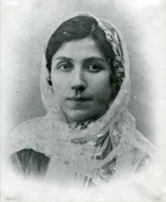
Sakina Mirza Eibat kizi Akhundzade ( azerb. Səkinə Mirzə Heybət qızı Axundzadə ; 1865, Cuba - 1927, ibid.) - the first Azerbaijani woman playwright [1] [2] and novelist [1] [3] , public figure, teacher, author textbooks in the Azerbaijani language [1] , an active member of the Muslim Women's Charitable Society in Baku [4] .
| Sakina Akhundzade | |
|---|---|
| azerb. Səkinə Axundzadə | |
 | |
| Date of Birth | |
| Place of Birth | |
| Date of death | |
| Place of death | |
| Citizenship (citizenship) | |
| Occupation | playwright , translator , teacher |
| Genre | drama , tragedy , comedy , romance |
| Language of Works | |
| Debut | "The benefits of science" |
Biography
Early years. Life in Cuba
Sakina Akhundzade was born in 1865 in the city of Cuba in a noble family. Her father Mirza Heybat He was an active member of the literary society " Gulistan ”, Created by a prominent Azerbaijani scholar and enlightener Abbaskuli-aga Bakikhanov , as well as a poet who wrote under the pseudonym“ Feda ”. Thanks to upbringing in such a cultural environment, Sakina’s love for literature, theater, and art was awakened from childhood [1] .
At a young age in Cuba, she married a man named Talib. In marriage, the daughter of Okumahanum was born. Talib openly spoke out in support of his wife, a girl educator in Cuba. Conservative residents did not like this, and in the end, Talib was killed by a gachag named Ali. Later Sakina Akhundzade married Mohammed Aghabekov, a teacher of Russian in Cuba. Over the years, married to Agabekov, Sakina Akhundzade opened a free school for girls in her house. Soon, the couple Yusif was born to the couple, later known as professor and associate professor of the Ganja University, Yusif Agabekov (subjected to repression in 1937 and executed). A little time passes and the second husband, Akhundzade Muhammad Agabekov, dies [5] .
Transfer to Baku. First Pieces
In 1900, Sakina Akhundzadeh was invited to Baku [1] by the oil industrialist and millionaire Haji Zeynalabdin Tagiyev , who learned about her educational activities in Cuba [5] . For some time, Akhundzadeh taught sharia and literature at the Baku Muslim School of Tagiyev for girls. As theater critic Gulam Mammadli Noted , while Sakina Akhundzadeh began to teach, performances with the participation of Jahangir Zeynalov , Abulfat Veli were staged on the stages of Baku , Mirza Aga Aliyev , Huseyn Arablinsky , male roles were played by women, and women, including Sakin Akhundzade, could watch performances only when they were in the veil and in a special box for women [1] .
According to the memoirs of Akhundzade, she tried to find a way to attract women to the theater and force the men playing their roles not to dress in women's clothing. The first play written by Akhundzade was “The Benefits of Science” (or “On the Benefits of Science”). After she created the play "The Word of Truth Can Be Bitter." There were a lot of female images in these dramas. The directing of both performances was dealt with by Sakina Akhundzade herself. She distributed all roles to fellow teachers and students. On the day of the performance, there were also some women among the audience [1] . The main male role in the play "The Benefits of Science" was played by Fatima Gadzhinsky [6] . According to Mammadli, “this is how Azerbaijani women grasped the taste of stage art” [1] . Pupil Sakina Akhundzade, Fatima Sultanova-Gadzhinsky later said:
| We heard about the theater, but never saw the play. We wanted to see him. Our teacher Sakina Khanum fulfilled our dream. She herself wrote the play Elmin Bahrasy. She read us a play. Assigned roles. The main role of the play, the role of Sarvar Khan, entrusted me. After class, she rehearsed with us. When the performance was ready, we showed it on December 2, 1904 in Baku at a Russian-Muslim school. Sakina Khanum handed out tickets to us in advance so that we could invite our friends, mothers and sisters to the show. Thus, the author of the play, the director of the play was a woman, the performers were girls, the audience was also girls and women. The performance was a great success. [7] |
Further Creativity
Sakina Akhundzadeh also translated some works from Turkish literature into the Azerbaijani language and helped put them on stage. Her drama “The fruits of violence”, written on the basis of the opera “ Lakme ” by French composer Leo Delib [8] , and “The Unfortunate Child” from the works of Namyk Kemal , were staged for many years on the Azerbaijani stage with the participation of Huseyn Arablinsky, Abbas Mirza Sharifzade [1] . So, in 1914, “The fruits of violence” was first staged in Tiflis by Huseyn Arablinsky, and in 1917 and 1922. in Baku, Abbas Mirza Sharifzade [9] . In the early 1920s “The fruits of violence” was staged by the troupe of the Nijat Society, on the stage of the Azerbaijan Drama Theater [10] [8] . Akhundzadeh also wrote the comedy “Daughter and In-Law” [10] .
Sakina Akhundzadeh played a significant role in attracting Azerbaijani girls to the theater [2] . In the newspaper “ Basirat »Of January 9, 1916 wrote:
| On Monday and Tuesday, at 5 o’clock, the operetta “ Arshin mal alan ” will be given only to ladies, performed by girls in favor of the “Muslim Sorority” ... We are grateful to note that the significant role of Muslim women, especially Sakina Khanum, is here. She worked hard to attract women to the theater, and this is very important and at the same time dangerous in our time! [eleven] |
The tragedy “Fruits of Violence” written by her was staged on the stage of the Haji Zeynalabdin Tagiyev Theater in Baku [11] . Theater critic Kyazimoglu (Seyid Huseyn) in an article that was published in the newspaper Yeni Igbal ”, Noted:
| In our new literature, women begin to occupy a certain place. One of them is Sakina Khanum Akhundzade, whose tragedy “Fruits of Violence” was played on Friday at the Tagiyev Theater. [eleven] |
In the newspaper Caspian »Of January 16, 1917 it was noted:
| Sakina Khanum is one of the activists who love our scene infinitely and who do a lot for the Muslim scene. We can say that in this area she is perhaps the only woman. And if our social conditions were different, she would undoubtedly be an outstanding and prolific writer. Even now, Sakina Khanum finds an opportunity to replenish our not very rich stage repertoire. [eleven] |
The newspaper Basirat of January 27, 1917 wrote:
| Sakina Khanum is one of the first intelligent women in the Caucasus, she serves the Muslim scene, writes for her ... [11] |
Sakina Akhundzadeh was fluent in Arabic and Persian , was well acquainted with oriental literature. In her works, she tried to spread the idea of freedom of Azerbaijani girls, to awaken their love of knowledge and science. However, the activities of Sakina Akhundzade in the field of education of Muslim girls often created certain difficulties for her. Conservative people were opposed to girls playing on stage. Sometimes the parents of the girls taught by Akhundzade attacked her, saying: “You tell the girls about Sharia, and then force them to go on stage like clowns” [1] .
Sakina Akhundzadeh was also the first Azerbaijani female author of the novel. In her novel “Prince Abulfaz and Rena”, written on the basis of a folklore plot [10] in 1918 [3] , the author puts forward the idea of finding a way out of prejudice in the lives of Azerbaijani women. In literary form, she depicted the spirit of freedom in her work [1] . In total, Sakina Akhundzadeh wrote five plays and one novel [1] . The actor and director Huseyn Arablinsky in an interview with her said:
| Sakina Khanum, a theater without women is like spring without flowers. Is there spring without flowers ?! How many women, girls cannot approach the theater because of ignorance. You are doing a great job. Light the sparks of the theater in the hearts of our girls. The time will come and these sparks will turn into a torch. [one] |
Sakina Akhundzadeh was also a co-author published in 1922-1923. “The New Turkic Alphabet ” [1] .
Recent years
In the last years of her life, Sakina Akhundzade suffered from a long and serious illness. In this regard, she was forced to leave Baku back to her native Cuba. Famous Azerbaijani actors of that time often traveled to Cuba to visit Sakin Akhundzade [1] . So, once when the actor and director Abbas Mirza Sharifzade arrived in Cuba, he visited Sakina Akhundzade. Sakina Khanum made a dinner in honor of Sharifzade. According to the memoirs of Akhundzade’s granddaughter Masma Mammadova, Akhundzade asked Sharifzade to read an excerpt from the Iblis monologue that evening, while Abbas Mirza fulfilled Sakina Akhundzade’s last wish and recited the entire monologue [5] .
Akhundzadeh died in 1927 in her native city [1] . In the house in Cuba, where she lived (along Istiglal Street, formerly Krupskaya 14), her descendants live [5] .
Family
- The first husband is Talib.
- Daughter - Okumahanum.
- The second husband is Muhammad Agabekov, a teacher of Russian in Cuba.
- Son - Yusif Agabekov, professor and associate professor of Ganja University.
- Brother - Ibrahim Akhundov.
- Niece - Reikhan Topchibasheva [5] , artist, Honored Art Worker of the Azerbaijan SSR.
Notes
- ↑ 1 2 3 4 5 6 7 8 9 10 11 12 13 14 15 16 Xəlilzadə F. Zülmətdə parlayan işıq (azerb.) // Mədəniyyət: newspaper. - 2011 .-- 13 may. - S. 13 .
- ↑ 1 2 Kerimov, 1991 , p. 168.
- ↑ 1 2 Aliyev H. History of art - history of character // Literary Azerbaijan: journal. - 1974. - Vol. 1st . - S. 128 .
- ↑ Faizov S.F. The Movement of Muslim Women of Russia for Women's Rights in 1917: Pages of History / Editor-in-Chief D.V. - Nizhny Novgorod: NIM "Makhinur", 2005. - S. 86. - 106 p.
- ↑ 1 2 3 4 5 Şıxverdiyeva Ç. Əri qətlə yetirilən, oğlu güllələnən Azərbaycanın ilk qadın dramaturqunun film kimi həyatı (azerb.) // news.lent.az.
- ↑ Eva-Maria AUH. Between adaptation and self-affirmation // Azerbaijan and Russia: societies and states / Edited by D. E. Furman . - M .: Summer Garden, 2001 .-- S. 86 .
- ↑ Karimov, 1991 , p. 102.
- ↑ 1 2 3 Sarıyeva İ. Bir səmanın üç ulduzu - Ulduz Əliyeva, Səkinə Axundzadə və Göyərçin xanım ... (Azeri) // Bakı xəbər. - 2015 .-- 4 sentyabr. - S. 15 .
- ↑ Səkinə Axundzadə (azerb.) // kepeztv.az. - 2014 .-- 13 noyabr.
- ↑ 1 2 3 Səkinə Axundzadə (azerb.) // Musiqi Dünyası.
- ↑ 1 2 3 4 5 Kerimov, 1991 , p. 169.
Literature
- Kerimov I.S. . The formation and development of the Azerbaijani theater: The end of the XIX - beginning of XX century .. - B .: Elm, 1991. - 292 p.
- Mamedli G.M. . Sakina khanum Akhunzade // Kobustan: almanac. - 1978. - No. 1 .