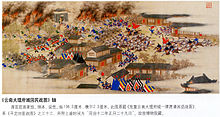
The Pantai Uprising (1856–1873), also known as the Du Wenxi Uprising , is an uprising of Chinese Hui and other Muslim ethnic minorities against the Manchu Qing dynasty in Yunnan in southwestern China, which was one of the many riots in Hui and neighboring peoples against Qing authorities.
The word “Pantai” (or “Panthai”) is Burmese in its origin: in Burma they called the Chinese Muslim (Hui) merchants who came to Burma with caravans from the Chinese province of Yunnan. In Yunnan itself this name was not known, however, in historiography, this name was assigned to the Yunnan uprising [1] .
By the 1840s, the confrontation between the two ethnic groups of the Chinese sharply intensified in Yunnan: the Han Chinese and the Hui professing Islam. Disputes over the control of gold, silver and lead mines in the central part of the province led to bloody clashes with thousands of victims in many villages and several cities (in Talan in 1850, in Shiyan in 1854, in Malun in 1855), The Qing government could not or did not want to stop it. In May 1856, the situation in the province escalated to the limit when the Qing official Qingsheng initiated a massacre of Han and Hui in Kunming, which killed more than 2,000 people, and then carried out massacre of Muslims in the city. After this event, the Han and Hui began to create large armed units in various cities and villages of the province.
The most prominent leader of the uprising was Du Wenshu (1828–1873), a Muslim of Han origin (from a Han family who converted to Islam), who had a classical Chinese education. In September 1856, he and his supporters occupied the city of Dali, where he proclaimed himself commander-in-chief and sultan, and also formed his own government, which included both the Hui and the Han Chinese; people practicing Islam, Confucianism, and traditional religions enjoyed equal rights in the rebel state. By the end of the 1860s, rebels controlled all of eastern Yunnan with approximately 50 cities. Du Wenxiu tried to establish contacts with the leaders of the Taiping uprising , which took place in those same years, and in 1863 his troops invaded Sichuan [2] .
The south of Yunnan was controlled by another Hui leader, Ma Tszyu Lun (1832-1891). Being a rival to Du Wensu, he also initially opposed the Qing authorities and even tried to take Kunming, but in 1862 he joined the government, promising him the rank of general, and then fought in the ranks of the Qing army against his former supporters and forces of Du Wensu. His position was supported by another rebel leader, Ma Dae Sin (1794-1874), a respected religious leader among the Hui who initially expressed strong support for the uprising, and then called for peace.
The rebels led by Du Wenxu did not succeed or only for a very short time managed to occupy the main city of Kunming province. In 1871, the Qing army, led by Governor Yunnan Tseng Yu In, launched an offensive against the rebels in order to restore Chinese power throughout the province. Government forces, which have received more modern weapons over the past decade and trained by French instructors, have won city after city from the rebels. Du Wenxiu tried to get help from the UK and in 1871 sent an embassy to the British headed by his adoptive son Liu Daohen, but this mission, like the previous rebel embassies to the British and French in 1868, ended to no avail. In January 1873, Du Wensu, besieged by the Chinese in Dali, committed suicide with his family. After the surrender of Dali, the Muslim population of the city was almost completely exterminated, in other places the uprising was also crushed with great cruelty.
Between 1855 and 1884, the settlement of Yunnan in connection with the uprising and its consequences (famine, epidemics, flight of residents) was more than halved.
Notes
- ↑ "Problems of Oriental Studies", 1960.
- ↑ Vgl. Bruce A. Elleman: Modern Chinese Warfare 1795-1989 (Warfare and History). Routledge, London 2001, ISBN 0-415-21473-4 , P. 64.
Bibliography
- David G. Atwill: The Chinese Sultanate. Islam, Ethnicity, and the Panthay Rebellion in Southwest China, 1856-1873. Stanford University Press, Stanford CA 2005, ISBN 0-8047-5159-5 .
- John K. Fairbank , Kwang-ching Liu (Hrsg.): The Cambridge History of China. Band 11: Late Ch'ing, 1800-1911. Part 2. Cambridge University Press, Cambridge ua 1980, ISBN 0-521-22029-7 .
- Mary Clabaugh Wright: The Last Stand of Chinese Conservatism. The T'ung-Chih Restoration, 1862-1874 (= Stanford Studies in History, Economics, and Political Science. Vol. 13, ZDB-ID 302432-5 ). Stanford University Press, Stanford CA 1957 (2nd printing, with additional notes. Ebenda 1991, ISBN 0-8047-0476-7 ).