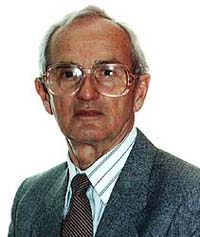
Victor Varfolomeevich Polishchuk ( Ukrainian: Victor Varfolomyevich Polischuk ; English; Wiktor Poliszczuk ; October 10, 1925 , Dubno - November 17, 2008 , Toronto [1] ) - Canadian publicist [2] [3] [4] , political scientist [5] , doctor of political Sciences [6] , who wrote on the topics of Ukrainian nationalism and Polish-Ukrainian relations during the Second World War.
| Victor Varfolomeevich Polishchuk | |
|---|---|
| Ukrainian Viktor Varfolomіyovich Polіshchuk | |
 | |
| Date of Birth | |
| Place of Birth | Dubno ( Polish Republic (1918-1939) ) |
| Date of death | |
| Place of death | |
| A country | |
| Scientific field | political science |
| Alma mater | |
| Academic degree | |
Content
Biography
Born on October 10, 1925 in the city of Dubno in Volhynia in a mixed Ukrainian - Polish [7] family, he was brought up as an Orthodox and identified himself as a Ukrainian. His father, Bartholomew Polishchuk, a Ukrainian, at the time when Western Ukraine was part of Poland , was a senior official of the Polish administration - the town of Dubno. After the entry of Western Ukraine into the USSR in 1939, Bartholomew was arrested and executed. [8] Together with a Polish mother and two sisters, 14-year-old Viktor Polishchuk was evicted to Kazakhstan in April 1940 when the Soviet government massively evicted Poles from Volyn. From November 1944 to March 1946 he lived with his family in the Dnipropetrovsk region .
In 1946, at the request of a mother of Polish nationality, he went to Poland according to documents as a Pole, although, as he himself claims in his publications, he considered himself a Ukrainian. In the same year he began his studies at the Polish Lyceum, later entered the University of Wroclaw at the Faculty of Law; at that time he learned about the ongoing Ukrainian-Polish massacre in Volyn and in Galicia , before that, in his own words, he did not know at all about Ukrainian-Polish enmity [7] . Upon graduation, according to Polishchuk himself, he worked for three years as an employee of the Jawor prosecutor’s office on the orders of the Wroclaw University administration: first, an expert appraiser, then an investigator and prosecutor of the district prosecutor’s office (later he was often called the “prosecutor”), then he worked as a lawyer in the city of Jawor [9 ] . During this period, he wrote three works on the topic of jurisprudence: “Human rights in the theory and practice of the USSR”, “Rights of peoples in the theory and practice of the USSR”, “Essay on the anatomy of Bolshevism”, which remained unpublished [7] In the last work, in his own words, Polishchuk, Based on an analysis of published documentary works, he argued that "the evil of Bolshevism began already with Lenin, and not as it was then shown, with Stalin" [10] .
In 1981, he emigrated to Canada with his wife and children; for 7 years he worked in Toronto as a technical corrector on the weekly New Slag, which was released by supporters of the OUN (m) [11] [12] . According to him, there he encountered representatives of Ukrainian nationalism , including professing, “hatred of everything Polish and Russian”, which prompted him to study the foundations of Ukrainian nationalism [13] . The main work on this topic was the five-volume work “Integrated Ukrainian Nationalism as a Type of Fascism”, which examines the history and ideology of the OUN and UPA and contains a large selection of documents. [7] .
In 1994, he received a doctorate in philosophy , the theme of the work is “The ideology of Ukrainian nationalism according to Dmitry Dontsov ” [6] [14] .
Victor Polishchuk considered Ukrainian integral nationalism a kind of fascism. [15] The work of Victor Polishchuk proved the cooperation of the OUN of both factions with the German occupiers (except for the period from March to December 1943 , when such a collaboration of the Nazis and the OUN (b) , according to the historian, did not exist). Victor Polishchuk also investigated the theme of the Ukrainian-Polish massacre of 1944-1945.
In 1998, he was awarded the Congress of Poles of Canada for his services to the Polish culture with a gold medal.
Assessment by other researchers
Negative and Critical
Polish scientist and employee of the Institute of National Remembrance Rafal Vnuk considers Polishchuk to be “non-scientists”, in particular, in his opinion, Polishchuk deliberately ignores the attempts of the Polish and Ukrainian sides to come to an agreement during the Second World War and overestimates the number of Poles and Ukrainians who died in the result of the actions of the UPA [16] .
Ukrainian historian, academician of the National Academy of Sciences of Ukraine Yaroslav Isaevich believed that Viktor Polishchuk’s two-volume work “Ukrainian Integral Nationalism as a Variety of Fascism” contains “borrowings from the statements of Soviet official propaganda and assessments of KGB experts”; in his opinion, the author also ignores the “analogies of Ukrainian integral nationalism with Polish” and does not cover the issue of objective prerequisites for the emergence of national movements [17] . Isaevich also called Polishchuk “the main“ specialist “in anti-Ukrainian hysteria” [18] .
A professor at the Institute of History of the Polish Academy of Sciences Ryszard Tozhecki in an interview in 2001 called Polishchuk not worthy of discussion, since he, in his opinion, is a Soviet agent and prosecutor of the NKVD [19] .
According to the head of the Department of Contemporary History and Politics at the Institute of History of Ukraine of the National Academy of Sciences of Ukraine, Professor Georgy Kasyanov , the “popular books” of Victor Polishchuk contained “exclusively accusatory rhetoric and correspondingly selected factography” [20] .
Russian historian Alexander Gogun attributes the work of Polishchuk to historical-journalistic and aimed at “accusing the UPA” [4] .
Canadian political scientist David Marplez believes that Polishchuk’s work is closer to Soviet in terms of a one-sided approach and relates them to the Soviet historiographic tradition; he also points to the openly hostile attitude towards the OUN and UPA of Polishchuk's books [21] .
Ukrainian historian professor Vladimir Sergiychuk stated that Polishchuk never worked with archives [22] .
The German historian Frank Grelka considers Polishchuk to be the author of "popular science, biased anti-Ukrainian publications of a legal rather than historical nature, who want to suggest the completely criminal character of the OUN-UPA" [23] .
The Ukrainian historian Igor Ilyushin stated that the works of Polishchuk are mostly journalistic in nature and that they are written in an easy-to-read and understandable way by average citizens and are not based on a documentary basis, although they have influenced some historians, especially Polish ones; The main drawback of the works of the Canadian author, Ilyushin, considers the predisposition of his concept, and the only desire of Polishchuk, according to Ilyushin, is to prove the ideology and practice of the OUN-UPA, and not to understand objectively the motives of the participants in the Ukrainian-Polish conflict [3] .
Polish researcher Tomasz Striek characterizes Polishchuk’s interpretations, in particular, regarding the ideology of the OUN, as “expressed in an oversimplified form”, saying that they “did not affect the world historiography of Eastern Europe of the 20th century” [24] ; Polishchuk’s assessments of Dmitry Dontsov’s views, Strike regarded as “simplified” and aimed at tying Dontsov to crimes of the OUN and UPA [25] .
Polish historian Michal Klimetsky described the publications of Polishchuk as follows: “I respect the many hours of work of Mr. Polishchuk, but his work is of little value, this is not subject to the slightest doubt” [26] .
The Ukrainian historian, a specialist in Ukrainian nationalism, Alexander Zaitsev, believes that most of the arguments used by Polishchuk have been known since the 1920–30s, his interpretations of the sources are often quite arbitrary, and some judgments contradict formal logic [27] .
The Polish historian and employee of the Institute of National Memory Grzegorz Motyka believes that the content of the works of Polishchuk "is very close to the extra-scientific current" [28] . He also believes that Viktor Polishchuk gravitates towards communist rhetoric (asserting along the way that his books in Ukraine were published by the Communist Party of Ukraine ), and his style works are closer to political pamphlets; According to Motyka, Ukrainian authors of this direction are characterized by the presence of political motivation in scientific activity [29] .
American historian Timothy Snyder believes that Polishchuk was “one of the most important supporters of Polish myths about the UPA and World War II,” and his book “The Bitter Truth” reinforces the “Polish stereotype that Ukrainian military actions were fascist and the Poles held a defensive position " [30] .
Positive
Polish historian and professor of the Jagiellonian University Bohumil Grott calls Viktor Polishchuk "an outstanding historian and political scientist", as well as "a distinguished advocate of Polish-Ukrainian reconciliation." According to Grott, Polishchuk conducted a multidimensional study of Ukrainian nationalism and in his works provides a complete image of this phenomenon. Grott writes about Polishchuk’s use of modern methodology and an interdisciplinary approach and claims his negative attitude to both “Darwinian radical Ukrainian nationalism” and “totalitarian communism” [7] .
The Ukrainian historian professor Vitaliy Maslovsky believed that Polishchuk’s arguments are weighty, and the information he provides on the creation of collaborationist units and UPA is significant [31] .
Works in Polish, English, Russian
- (English) Legal and political assessment of the OUN and UPA, Toronto, 1997, 173 pages, ISBN 0-9699444-4-6
- (English) “Bitter truth”: The criminality of the Organization of Ukrainian Nationalists (OUN) and the Ukrainian Insurgent Army (UPA), the testimony of a Ukrainian, 403 pages, ISBN 0-9699444-9-7
- (Polish) " Dowody zbrodni OUN i UPA "
- (Polish) "Gorzka prawda"
- (Polish) “Ideologia nacjonalizmu ukraińskiego”
- (Polish) “Apokalipsa według Wiktora Ukrainca”
- (Polish) “Fałszowanie historii najnowszej Ukrainy”
- (Polish) “Ocena polityczna i prawna OUN i UPA”
- (Polish) “Akcja Wisła - próba oceny”
- (Polish) "Zginęli z rąk ukraińskich"
- (Polish) "Pojęcie integralnego nacjonalizmu ukraińskiego"
- (Polish) “Ukraińskie ofiary OUN-UPA” Ukrainian victims of the OUN-UPA (in English, chapters)
- (Polish) "Integralny nacjonalizm ukraiński jako odmiana faszyzmu"
- Legal and political assessment of the OUN and UPA
- "Bitter truth. Crimes of the OUN-UPA (Ukrainian Confession) "
- “The mountain gave birth to a mouse. Bandera
- "There is no conscience, no honor, everything ..."
- “To Taras Chornovil - in response”
- “Confrontation of ideas in Ukraine”
Interview by Victor Polishchuk
- “Ukrainian integral nationalism is a form of fascism”
- “Without overcoming Ukrainian nationalism, the people of Ukraine will face the threat of degeneration”
- “Dozens of women and children were laid on the ground and shot at the back of their head”
- “Viktor Yushchenko, initiating the recognition of the OUN-UPA, is acting immorally”
- The "heroism" of the OUN-UPA is another myth of Bandera propaganda!
Notes
- ↑ Zmarł prof. Wiktor Poliszczuk (Polish)
- ↑ A. Dukov. Secondary Enemy. OUN, UPA and the solution of the "Jewish question" / Foundation "Historical memory". - 2nd ed., Rev. and add. - M., 2009 .-- 176 p. - C. 34.
- ↑ 1 2 Igor Ilyushin. Ukrainian Insurgent Army and Army of Craiova: Protestation in Western Ukraine (1939-1945 r.) - Kiev: Vidavnichy dime “Kyiv-Mohyla Academy”, 2009. - P. 39–41.
- ↑ 1 2 Gogun A. S. Activity of armed nationalist groups in the western regions of the Ukrainian SSR: 1943-1949. Diss. for a job. Cand. East. sciences. Scientific hands. Doctor of History, prof. S.N. Poltorak. - St. Petersburg: North-West Academy of Public Administration, 2005. - 211 p. - S. 12.
- ↑ Polytex Magazine, 2006, N 2, Editor-in-chief page
- ↑ 1 2 Bazy danych - Nauka Polska (unavailable link) . Date of treatment April 10, 2015. Archived April 2, 2015.
- ↑ 1 2 3 4 5 Bogumił Grott . Wiktor Poliszczuk - historyk przemilczanych zbrodni (Polish) (December 5, 2008). Date accessed August 18, 2015.
- ↑ Criticism of the “Report of the working group of historians under the Government Commission for the Study of the Activities of the OUN and the UPA” (inaccessible link) . Date of treatment June 6, 2007. Archived June 30, 2007.
- ↑ List otwarty Wiktora Poliszczuka do docenta Ryszarda Torzeckiego czsopismo historyczno-publicystyczne „Na Rubieży” nr 55/2001
- ↑ V. Polishchuk. Bitter truth.
- ↑ Victor Polishchuk: “Ukrainian integral nationalism is a form of fascism”
- ↑ Sergey Grabovsky. The border that they can’t cross // Day, January 19, 2012
- ↑ V. V. Polishchuk: Without overcoming Ukrainian nationalism, the people of Ukraine will face the threat of degeneration // Journal of Theory and Practice of Eurasianism. - number 11
- ↑ Bandera criminals: Roman Shukhevych (part 1) (unavailable link from 18-08-2015 [1461 days])
- ↑ Polishchuk V.V. Ukrainian integral nationalism as a form of fascism. Feedback on the work of R. V. Manekin “National Identity and Nationalism”. - The Eurasian Bulletin. Journal of Theory and Practice of Eurasianism, No. 16, M., 2002
- ↑ Rafal Grandson “The Latest Polish Historiography on Polish-Ukrainian Relations during and after the Second World War” // Institute of National Memory, Lublin, Poland (English)
- ↑ Yaroslav Isaevich. Kholmsko-Volinsk tragedy, перед перед change your mind, rebuff, extra money // Volyn ’Kholmshchina 1938-1947 pp.: Polish-Ukrainian protest war and this war . Docs, documents, guess what / Head of the editorial board Yaroslav Isaevich. (Ukraine: cultural decline, national independence, statehood, 10.) - Lviv: Institute of Ukrainian Studies im. І. Krip'yakevich National Academy of Sciences of Ukraine, 2003 .-- S. 50-51.
- ↑ Yaroslav Isaevich. Before 1943 rock boom 1938: Tragedy at the memory of the Poles and Ukrainians // The Independent Cultural Chronicle “Ї”. - Number 28/2003: Wolin 1943. Struggle for the land
- ↑ "Mav I to dila with the Endure Moore": Intervyu prof. Richard Tozhetsky // Freedom. - Rik CVIII (2001). - Number 12. - S. 9.
- ↑ George Kasyanov. How the “common” history shares: the politics of memory in Ukraine, Poland, Russia in the 1990s - 2000s // Crossroads: Journal of East European Borderland Studies. - 2011. - No. 3-4. - S. 158-184. - S. 165.
- ↑ Marples, David R. Heroes and villains: creating national history in contemporary Ukraine. - Budapest: Central European University Press, 2007 .-- PP. 131, 207-208, 228.
- ↑ V. Sergiychuk. Our blood is on our land (Ukrainian) // Visvolny shly. - National University "Kyiv-Mohyla Academy" . - No. 4, 5, 6 (2.2006) . - ISSN 0042-9422 .
- ↑ Frank Grelka. Die ukrainische Nationalbewegung unter deutscher Besatzungsherrschaft 1918 und 1941/42. - Wiesbaden: Harrassowitz Verlag, 2006 .-- 507 S. - S. 43, Anm. 98.
- ↑ Tomas Strik. Fascism Chi Integral Nationalism? OUN in historical and political perspectives (auth. Translated from Polish by Andriy Pavlishin and Volodimira Sklokina) // Yog. Nevlovny categories: draw on humanities, history and politics in the current Ukraine, Poland and Russia. - Kyiv: “Nika-Center”, 2015. - S. 264-265.
- ↑ Tomasz Stryjek. Europejskość Dmytra Doncowa, czyli o cechach szczególnych ideologii ukraińskiego nacjonalizmu // Antypolska akcja OUN-UPA 1943-1944: fakty i interpretacje. Redakcja naukowa: Grzegorz Motyka i Dariusz Libionka. (Seria "Konferencje IPN": tom 4.) Archived on August 19, 2014. - Warszawa: Instytut Pamięci Narodowej, 2002 .-- S. 19, pr. one.
- ↑ Ukraine - Poland: important nutrition. - T. 10: Materials of the XI International Seminar History “Ukrainian-Polish Weekly Other Hour”, Warsaw, 26–28 Quarter 2005 2005 / Volinsky State University. Forests of Ukraine; per. V. Ґrondzka, I. Kozlovsky; ed. І. Galaida. - Warsaw: Tirsa, 2006 .-- S. 329.
- ↑ Olexander Zaitsev. Ukrainian National Nationalism (1920s - 1930s). Narisi intellectually istorії. - Kyiv: Criticism, 2013 .-- S. 38-39.
- ↑ Grzegorz Motyka. Problematyka stosunków polsko-ukraińskich w latach 1939-1948 w polskiej historiografii po roku 1989 // Historycy polscy i ukraińscy wobec problemów XX wieku / Pod red. P. Kosiewskiego i G. Motyki. - Kraków: Universitas, 2000 .-- S. 172-173.
- ↑ Grzegorz Motyka. Antypolska akcja OUN-UPA w ukraińskiej historiografii // Antypolska akcja OUN-UPA 1943-1944: fakty i interpretacje. Redakcja naukowa: Grzegorz Motyka i Dariusz Libionka. (Seria "Konferencje IPN": tom 4.) Archived on August 19, 2014. - Warszawa: Instytut Pamięci Narodowej, 2002 .-- S. 145.
- ↑ Timothy Snyder. Die Heimatarmee aus ukrainischer Perspektive // Die polnische Heimatarmee: Geschichte und Mythos der Armia Krajowa seit dem Zweiten Weltkrieg. Hrsg. von Bernhard Chiari. - Oldenburg: Oldenbourg Wissenschaftsverlag, 2003 .-- S. 560, Anm. 22.
- ↑ V. Maslovsky. For the sake of whom the Ukrainian national war fought against the fate of the Other World War. The UPA and División SS SS “Galichina” - M.: Slavic dialogue, 1999. - (With whom and against whom did Ukrainian nationalists fight during the Second World War)
Links
- Dr Wiktor Poliszczuk (Polish)