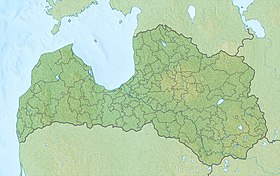
Teiču ( Latvian: Teiču dabas rezervāts ) is a specially protected natural area (nature reserve) located in the east of Latvia . It is located on the territory of Madona , Varaklyansky and Krustpils regions [2] . It includes the territory of the largest in the country of the Teichu bog ( Latvian. Teiču purvs ). The swamp is also part of the Natura 2000 network of nature protection zones and, together with the ( Latvian: Lielais Pelečāres purvs ), is a wetland of international importance protected by the Ramsar Convention [3] .
| Teichi Nature Reserve | |
|---|---|
| Latvian. Teiču dabas rezervāts | |
 | |
| IUCN Category - Ia (Strict Nature Reserve) | |
| basic information | |
| Area | 19779 ha [1] |
| Average height | 105 m |
| Established | 1982 year |
| Location | |
teici.lv | |

Content
- 1 History
- 2 Geography
- 3 Flora and fauna
- 4 notes
- 5 Links
History
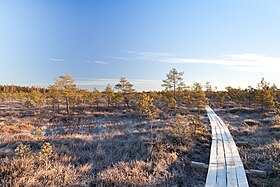
The reserve was created on May 26, 1982 [4] to protect the Teichi swamp . The reserve covers an area of 19,779 ha, of which 13,681 ha are marshes [1] . In wetlands 18 clean reservoirs (lakes) stand out, there are also elevated areas with solid soil.
About 3729 hectares of the reserve is occupied by forests [2] . Teici is one of the largest ecosystems of this type in the Baltic region, and the swamp itself is one of the largest in Latvia and the Baltic states (according to the administration of the Madona Territory it is the largest) [2] [1] .
The territory of the reserve has been preserved almost untouched. Attempts to drain it were undertaken at the beginning of the 20th century; Currently, drainage ditches overlap, both by humans and animals to preserve waterlogging of the territory [5] .
On one of the islands of the reserve, Siksala, a small group of Old Believers live. They belong to ethnic Russians and ended up here in the 17th century, fleeing religious persecution [2] .
Geography
This natural area is endowed with an unusually high degree of protection: a strict reserve. There are only four such territories in Latvia among 683 specially protected natural territories [6] [7] . In accordance with the status, almost any economic activity is prohibited in the reserve, and its visit is limited [6] . Since 2004, the Teichi Nature Reserve has been part of the European 2000 Nature Protection Network [5] .
There are two zones in the reserve: with controlled access and limited access. The last zone is allowed to be visited only for scientific purposes and with appropriate justification from the organization. Access to the rest of the reserve is possible for a limited time during the year, from June 1 to October 31, provided that visitors are accompanied by an official guide [2] . An observation tower has been built in the Krustpils region on the territory of the reserve, access to which is free [1] .
Flora and Fauna
688 species of vascular plants were recorded in the reserve, of which 37 are listed in the and 6 species of plants are mentioned in the . This is a hairy replica ( Agrimonia pilosa ), broad-leaved cinnamon ( Cinna latifolia ), real slipper ( Cypripedium calceolus ), Lozel’s calf ( Liparis loeselii ), open lumbago ( Pulsatilla patens ), and unadorned loaf ( Thesium ebracteatum ). Famous mosses are represented by 212 species, 16 of them are Red Book (very rare are Sphagnum molle , Splachnum sphaericum and Andreaea rupestris ), and shiny hamatocaulis ( Hamatocaulis vernicosus ) is contained in the Habitat Directive [3] .
The reserve is also an important habitat for animals, including invertebrates, and is of international importance as a place of residence for migratory and settled birds. Here you can find most of the representatives of birds inhabiting Latvian swamps, some in large numbers, for example, cranes and geese [2] .
Notes
- ↑ 1 2 3 4 “Teiču Nature Reserve” - the largest moss marsh in the Baltics . Madona Municipality . Date of treatment May 21, 2015.
- ↑ 1 2 3 4 5 6 Teici Nature Reserve (unavailable link) . Visit Latvia. Date of treatment May 21, 2015. Archived November 3, 2012.
- ↑ 1 2 Uģis Bergmanis. Teici and Pelecare bogs . Ramsar Sites Information Service . Ramsar Secretariat (January 1, 2008). Date of treatment March 23, 2017.
- ↑ Teiču dabas rezervāts (neopr.) . Latvian Nature Conservation Agency. Date of treatment May 21, 2015.
- ↑ 1 2 Teichu Nature Reserve Teicu dabas rezervats , Pribalt.info . Date of treatment March 23, 2017.
- ↑ 1 2 Protected areas . Latvian Nature Conservation Agency. Date of treatment May 21, 2015.
- ↑ Specially Protected Nature Territories . Ministry of Environmental Protection and Regional Development of the Republic of Latvia. Date of treatment May 21, 2015.