Small drum (also a military drum , snare drum, snare , Italian tamburo or tamburo militare , French caisse claire , German kleine Trommel , English snare drum ) - a percussion musical instrument belonging to membranophones with an undefined pitch [1] [ 2] . One of the main percussion instruments of the symphony orchestra , as well as jazz and other genres, where it is part of the drum set (often in several instances of different sizes).
| Drum set |
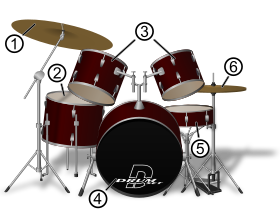 |
1. Plates | 2. Outdoor tom tom | 3. Tom-tom |
| Other |
Ryde | China | Splash | Sizzle |
 Files on Wikimedia Commons Files on Wikimedia Commons |
It is a metal, plastic or wooden cylinder , tightened on both sides with leathers (in modern form, instead of leather, a membrane made of polymeric compounds is colloquially called “plastic”), on the outside of one of which are stringed or metal springs, giving the sound of the instrument a rattling shade . On modern instruments, these strings can be removed using a special lever from the membrane, thus removing the characteristic rattling sound of the instrument
Content
Snare Drum Technique
They play on the snare drum with two wooden sticks , their mass depends on the acoustics of the room (street) and the style of the musical piece being performed (heavy sticks produce a stronger sound). During execution, the drum is placed on a special tripod (stand) or belt over the shoulder (on the march). The basis of the technique of playing the snare drum is the shot - tremolo of great swiftness, merging almost into a continuous rumble. Fraction can be performed from barely audible rustling in pianissimo to fortissimo . Also, complex rhythmic formulas ( rudiments ) and individual beats are well obtained on the snare drum.
To muffle the sound of a snare drum, a piece of ordinary fabric is used, which is placed on the membrane, or special accessories that are placed, glued or screwed on.
When performing slow compositions in jazz, in addition to sticks, sometimes a pair of special brushes are used, with which the musician makes circular movements, creating a slight “rustling” that serves as a sound background for a solo instrument or voice.
Using Snare Drum in Music
The snare drum became part of the opera and symphony orchestras at the end of the 18th - beginning of the 19th centuries, although episodic appearances in musical scores of instruments similar in construction can be found earlier: for example, in 1706, Maren Mare ordered the use of Provencal tambourine in the opera Alcyone, similar to the snare drum in structure. Handel used the snare drum in “ Music to the Royal Fireworks ” in 1749, and Gluck in the opera “ Iphigenia in Tauris ” (1779). Beethoven, in the overture of “Wellington's Victory, or Battle of Vittoria,” written in 1813, introduced drums of varying pitch to the score for the English and French armies. Widely used the snare drum in his compositions by Joacchino Rossini , including in the famous introductory solo from the overture to the opera The Forty-Thief . For this unusual use of the snare drum at the time, the composer received the nickname "Tamburossini" (from tamburo - "snare drum") [3] .
The reformer of the symphonic score, Hector Berlioz, in his treatise The Art of Instrumentation, argued [4] that several snare drums that sound in unison are preferable to one. He followed this principle in his compositions: for example, in the Funeral March to the final scene of Hamlet, Berlioz used six snare drums with a muffled sound.
In the XIX century, the snare drum was often used in military scenes of opera performances, such as Wagner 's Rienzi (1836) and Meyerbeer 's Huguenots (1840). The snare drum plays an important role in the compositions of Rimsky-Korsakov , Elgar , Ravel , Nielsen , Shostakovich , Britten , Sessions . In Ravel ’s Bolero , the snare drum in continuously increasing dynamics sounds throughout the entire composition, repeating a two-beat rhythmic figure 169 times. Dmitry Shostakovich subsequently applied the same trick when writing the Seventh Symphony ("episode of the invasion" - the middle section of the first part). Karl Nielsen in the Fifth Symphony instructed the snare drum with a voluminous episode during which the performer should “improvise, trying his best to stop the orchestra” [5] . In the Concerto for clarinet and orchestra of the same author, the snare drum is the only percussion instrument included in the score, which, taking into account its responsible part and the compact composition of the orchestra, brings it almost to the level of the second soloist along with the clarinet.
With the development of composer technique in the 20th century, the snare drum gradually ceased to be interpreted as an exclusively rhythmic instrument: composers began to use it for special timbre effects, for which the use of sticks from different materials or “jazz” brushes was prescribed, blows to different places of the membrane or hoop, etc. One of the first authors to discover new timbre features of the snare drum was Bela Bartok : this instrument is widely used in his First Piano Concerto (1926), Sonata for Two Pianos Iano and percussion (1937) and other works.
In the score of the symphony orchestra, the snare part is written on a string (a horizontal line on which only the rhythm is indicated) under the tambourine part , above the cymbal part .
Notes
- ↑ Kupinsky K. M. School of playing the percussion instruments. - M .: Music, 1981
- ↑ Agafonnikov N.N. Symphonic score. - L .: Music, 1981
- ↑ VIENNA ACADEMY> Percussion> Drums> Tenor drum> HISTORY
- ↑ Treatise on Instrumentation by Hector Berlioz enlarged and revised by Richard Strauss. - Edwin Kalmus publisher of music, New York, 1948.
- ↑ Robert Simpson . Carl Nielsen, Symphonist, 1865-1931. USA: Hyperion. ISBN 0-88355-715-0