Arenny forests in the Rostov region are forests growing in closed depressions of low places, temporarily or permanently filled with water. Sandy terraces of large rivers and their tributaries — arians forming sandy massifs — serve as places for the arena forests. The main areas of the sand massifs are concentrated in the middle reaches of the Don . In the Cossacks, the arena forests are called "eNdovas" in the image of the ancient Russian wide bowl.
 External images
Arenny forest Description
Arenny forests consist of birch forests, oak forests , aspen forests , and alders. On sands more cultivated pine . There are arena forests on all large sand massifs, forming part of complex sand vegetation.
A large Peskovatinsky sand massif stretches along the Peskovatka River (the left tributary of the Don ) in the Verkhnedonsky district . In the Sholokhov district there is an extensive Vyoshensky sandy massif. These two massifs make up the Srednedonskoy sand massif (with the Panic tract). The peculiarity of afforestation lies in the fact that forest communities do not form solid areas here, they are concentrated only in various types of depressions, often rounded and saucer-shaped, as a result of which such forests are often called “kolamos”.
[Zozulin, 1992, p.90]  Chir River
Sandy arrays in the lower reaches of the Don less. The largest of them is the southeast Dono-Tsimlyansky sandy massif (with the Kuchugury boundary) located on the right bank of the Don . The tributaries of the Don are accompanied by smaller sandy massifs. The most notable of them are: Nizhnekundryuchensky (located between the Seversky Donets River and the Kundryuchya River flowing into it), Mityakinsky (occupies the left bank of the Derkul River), Oblivsky (with Chernyshevsky Sands, Saneyevsky Sands, Oblivsky Sands) located on the left bank of the Chir River. There are smaller sandy massifs, for example, Romanovsky, located below the Tsimlyansk reservoir . The flora of arena forests is poorer than the flora of bayrochnyh and floodplain , it has 383 species, of which 210 are forest and 94 are actually forest.
Gm Zozulin identifies 4 main, widespread and 5 minor, less common formations. The main ones are oak forests , birch forests, aspen forests and alders, the secondary ones include white poles, blackthorns, birch bark, elm trees and willow trees. The oak forests are the main formation in the Srednedonsky sandy massif, less often it is found in arenas of the Seversky Donets and Kalitva and on the Nizhnekundryuchensky sandy massif. On loose low-glue sands with elevated groundwater levels, birch forests are located. Aspen forests occupy depressions with markedly saline soils and a groundwater level not less than 1 m. There are pure aspen and pure birch pegs, but more often they are mixed - birch-aspen or aspen-birch. Birch and aspen groves are characteristic of all sandy arenas, but most of them are on the Don-Tsimlyansk sand massif. Olshans develop in deep wet depressions with meadow-marsh soils and with a high groundwater storage. They are found in almost all sandy massifs, there are a lot of them in the valley of the Seversky Donets , in the Nizhnekundryuchensky and Mityakinsky sandy massifs.
On sandy arenas dominate willow trees , consisting of shrub willows . On the Peskovatinsky sandy massif and on the Oblivsky sands junipers are found - with the Cossack juniper .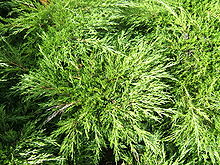 Juniper Cossack
The great interest is caused by the stanzas of the distant, once existing northern flora, which have come down to us from the depth of ages and survived from the times of the ice age. These "living minerals" are called the P e l and k t and m and [from Lat. relictum - the remnant], that is, the remnants of the flora of past geological eras. The remains of moss , moss , ferns and some flowering plants could survive here, among the sands, only due to the moisture and leaching of sandy soils. Many of them are listed in the Red Books . From green mosses : polytricum ordinary ( kukushkin flax ) is found on the Vyoshensky and Don-Tsimlyansky sandy massifs. From white moss there are several species of the sphagnum genus: the Magellan sphagnum found on the Don-Tsimlyansky sandy massif, the sphagnum marsh and the sphagnum sticking out are noted on the Don-Tsimlyansky and Nizhnekundryuchensky sandy massifs; Sphagnum sinuous is found only on the Nizhnekunduchensky sandy massif. From moons : moss -shaped and lycopodiella poured on the Don-Tsimlyansky sandy massif. From ferns : common grass with a single location on the Don-Tsimlyansky sand massif, female nomadic ( female fern ) was found on the Vyoshensky and Nizhnekundryuchensky sand massifs, crescent moth and telipteris marsh are marked on many sand massifs. From flowering plants on the Nizhnekundryuchensky sandy massif, northern species of orchids , northern sedges , and mountain bugs were discovered.
The rarest orchids of the RSFSR entered in the Red Book are the orchards : the marsh orchid, the marsh orchid, the orchard, the dresser . Impatiens ordinary
From the Orchid Red Data Book of the Rostov Region [1] on the sandy massifs one can find: the cavernous snake and the marsh dremlik , Lyubka two-leaved , the finger stump meat and red , and from the balsamic family, the impatiens are ordinary .
Monuments of Nature
Many areas of the Rostov region occupied by arena forests are classified as natural monuments [2] .
In Verkhnedonsky district , natural monuments occupied by arena forests include:
- The tract “Kalinov bush” is an arena birch-aspen forest on the plot of a floodplain.
In Ust-Donetsk region, monuments of nature include:
- Kundryuchensky sands are inter-river sandy massif, including oak, alder and birch pegs, sandy steppes and meadows, fragments of sand dunes.
In the Sholokhov District , monuments of nature include:
- The giant oak is a unique object of nature - a long-lived tree that is more than 400 years old. Next to the "oak-patriarch" two more "oak-heroes" grow. All of them are remnants of an ancient arena oakwood. The boundaries of the monument include the adjacent territory as a protective zone around the oak, where there are amphibian alders, meadow and sand-steppe vegetation.
- The “Panic” tract is a stretch of forb-grass sandy steppe in combination with birch and aspen spikes of arena forests (growing on sandy tracts). The standard of nature on the second sandy terrace above the floodplain on the left bank of the Middle Don.
Literature
- Nagorny B. A. Geography of the Rostov region. Rostov-on-Don, 1985.-96 p.
- Burkina TM The plant world of the Don region. Rostov-on-Don: Tera Print LLC, 2008.-160 p., Il. ISBN 978-5-903286-25-6
Notes
- ↑ Red Book (inaccessible link) . The appeal date is July 17, 2019. Archived on October 7, 2018.
- ↑ About nature monuments of the Rostov Region
Links
 External images


