The qualification badge "Shooter and flight attendant" ( German: Fliegerschützenabzeichen für Bordfunke ) was established on August 12, 1936 by the Reich Minister Luftfaff Reich Marshal Herman Velgelm Goering . Graduates of aviation schools who have successfully completed training in the specialization of flight gunners, flight engineers (flight mechanics), and airborne bombers were awarded the qualification mark. To pass qualification requirements for the badge, candidates were given the opportunity to complete a two-month standard training course or take part in five sorties. If during the operational (combat) departure of gunners, the flight mechanic, the flight engineer was injured, then the rewarding with a qualification mark took place ahead of schedule. There were miniatures of the qualification mark, and fabric versions of the award were established for the officer and lower-level military personnel. On June 22, 1942, a new qualification badge for the shooter and flight mechanic was established (almost identical to the previous version, except for the absence of lightning in the legs of the eagle, since the emblem of crossed lightning belonged to radio operators).
| Qualification badge of the shooter and Luradwaffe radar operator. | ||
|---|---|---|
| ||
| A country | Third Reich | |
| Type of | badge of distinction | |
| To whom is awarded | Luftwaffe aviation personnel | |
| Award Basis | Aviation school graduation, training and combat missions | |
| Status | not handed over (denazified version of the 1957 sample is allowed to be worn). | |
| Statistics | ||
| Established | March 26, 1936 | |
| First award | March 26, 1936 | |
| Last reward | May 1945 | |
Description of qualification mark, delivery and wearing rule
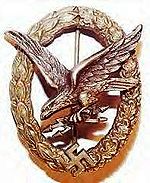
The qualification mark of the shooter and the flight attendant is oval with a wreath of oak and laurel leaves (symbol of winners), in the center of the composition is a diving eagle holding crossed lightning in its claws, and a swastika in the lower part. Fastening to the uniform was carried out using a vertical clamp pin. At the beginning, the award was issued from “nickel silver” ( nickel silver ), at the end of World War II, due to the shortage and saving of resources it began to be produced from zinc and its alloys. Marking of the sign was carried out on the back side of the award (non-branded samples could also exist), as a rule, produced by the Berlin firms Karl Erich Junker and Berg and Nolte, Wilhelm Doymer from the city of Ludenscheid, and others. A qualification mark was worn on the left side of the full dress uniform or casual uniform. The sign was usually handed over in a blue box, in a festive atmosphere, with the delivery of the relevant documents, as well as notes to them in the soldier’s book.
Current status of the award
In accordance with the law of the Federal Republic of Germany on the status of orders and medals, as well as their name, issue 1933-1945. dated July 26, 1957, the Luftwaffe qualification badge “Shooter and Flight Radarist” was produced in a denazified version without a swastika.
Literature
- Ailsby, Christopher. Combat Medals of the Third Reich. - Harpercollins, 1987. - ISBN 978-0850598223 .
- Angolia, John. For Führer and Fatherland: Military Awards of the Third Reich. - R. James Bender Publishing, 1987 .-- ISBN 0912138149 .
- Previtera, Steven. Combat Badges of the Third Reich (Volume 2 Luftwaffe). - Winidore Publishing, 2008 .-- ISBN 978-0967307046 .