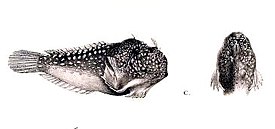
Tetrabrachium ocellatum (lat.) Is a species of ray-finned fish from the monotypic genus Tetrabrachium of the tetrabrachium family (Tetrabrachiidae). Before isolating new genus and species, he was the only representative of the family. It differs from the closely related species Dibrachichthys melanurus by the pectoral fin divided into two parts, which is integral in D. melanurus [1] .
| Tetrabrachium ocellatum |
 |
| Scientific classification |
|---|
| No rank : | Bilateral symmetrical |
| Gender: | Tetrabrachium Günther , 1880 |
| View: | Tetrabrachium ocellatum |
|
| International scientific name |
|---|
Tetrabrachium ocellatum Günther , 1880 |
|
The name of the genus comes from other Greek. τέσσερα - four and lat. brachium is the part of the arm from the elbow to the hand, which reflects the presence of two pectoral fins in representatives of this genus, each of which is divided into two parts, i.e., when the fish moves, it seems that it moves on four limbs. The specific name comes from lat. ocellus - an eye that pays attention to eye-like spots on the body.
The body is strongly compressed laterally. The mouth is small. Small eyes are located on the top of the head. There is a pronounced hump on the back of the head. The swim bladder is absent. In the dorsal fin 16-17 soft rays, and in the anal 11-12 soft rays. The pectoral fin with 9 rays is divided into two parts. There are no teeth on the palate. The maximum body length is 7 cm [2] [3] [4] .
In the western part of the Pacific Ocean, they are found in coastal waters from Indonesia and the south of New Guinea to the Arafura Sea , in the eastern part of the Indian Ocean - off the coast of northern and western Australia . They live in the coastal and on the continental shelf to a depth of 50 m above soft soils [4] .
