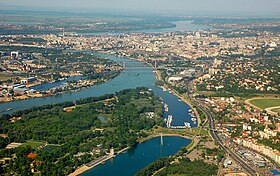
The history of Belgrade - the capital of Serbia - has more than two thousand years. The first permanent settlements on its territory appeared in the Neolithic era. Then these lands belonged to the Thracians , Cimmerians , Scythians , etc. A city called Singidunum was founded by the Celts in the III century BC, a few centuries later it was conquered by the Romans . It was an important border fortress of the Empire. During the Great Migration of Peoples, Belgrade repeatedly changed owners. In the VI century, the surroundings of the city were settled by the Slavs.
In the Middle Ages, the city belonged to Byzantium , the Avar Kaganate , Bulgaria , Hungary , Serbia . In 1427, Serbia was ceded to the Hungarian kingdom. In 1521, Ottoman troops captured Belgrade, after which, with a number of short breaks, until 1878 it was part of the Ottoman Empire .
After Serbia gained independence, Belgrade became its capital. Between the two world wars was the capital of the Kingdom of Serbs, Croats and Slovenes and the Kingdom of Yugoslavia . During the Second World War, it was occupied by the Wehrmacht , liberated in 1944 by the joint efforts of the Red Army and the Yugoslav partisans . From 1945 to 1991, the city was the capital of socialist Yugoslavia , from 1992 to 2003. - The Federal Republic of Yugoslavia , in 2003-2006. - Serbia and Montenegro . Since 2006, it has been the capital of Serbia, its economic and cultural center.
History
Prehistoric Age

The most ancient signs of a person's presence on the territory of modern Belgrade are stone tools related to the Mousterian archaeological culture . Artifacts belonging to Aurignac and Gravettian cultures were also found. At this time, tribes of hunters and gatherers lived here. In addition to tools in the vicinity of Belgrade, bones of people living in the Stone Age were found. They were found in a quarry near Leštan, in a cave in Chukaritsa and in the Stari Grad community at the site of the modern Bayloni market [1] [2] .
Permanent settlements on the territory of the city appeared in the Neolithic era and belong to the Starchevo-Krish and Vincan cultures , their inhabitants were engaged in agriculture and various crafts [1] [2] .
Starchevo-Krish culture dates back to the 7th – 5th millennia BC. e. The tribes of this culture were engaged in cattle breeding, hunting and fishing. They settled in clay-coated wicker houses near rivers. Artifacts are represented by polished stone axes and rough kitchen ceramics. The bearers of the culture belonged to the Mediterranean race, which sharply distinguished them from the local Mesolithic Cro-Magnons, descendants of the Lepenski-Vira culture. Starchevo-Krish culture was supplanted by a wave of Anatolian farmers belonging to the Vinca culture [3] .
The lifetime of Vinca culture is not precisely defined. The earliest moment of occurrence is considered the VI millennium BC. e., its extinction dates from the middle of the V millennium BC. e. or the beginning of the IV millennium BC. e. Settlements are represented by dugouts with clay stoves, later huts with gable roofs began to be built. They totaled up to five rooms, the floors were wooden. The bull’s head was reinforced above the entrance to the house. The culture is also characterized by a large number of found clay figurines of men and women [4] .
Antiquity
About 600 years BC e. Thracians , Cimmerians , then Scythians lived on the banks of the Sava and Danube . At the beginning of the III century BC. e. Celts invaded the Balkans and the Celtic tribe of Scordiski settled on the territory of modern Belgrade. Their fortified settlement was called Singidunum . According to one version, the name means "round city". According to another version, during the arrival of the Celts this land was occupied by the Thracian tribe Singi, by whose name the Celts named the new city. Apart from the necropolises found in Karaburm and Rospa-Chupria from that period, there is no other information about Singidunum under the Celts [2] [5] .
In the 1st century BC e. the Romans launched an attack on the Illyrian tribes and Scordisk from the territory of Macedonia . Guy Scribonius Kourion , proconsul of Macedonia, traveled deep into the peninsula, reaching the Danube. Little is known about the conquests of this part of the Balkans, but for a few more years the local population tried to fight Rome. Proconsul of Macedonia Mark Licinius Crassus in 29 BC e. suppressed the resistance of the Bastarn here [6] . It is not known exactly when these lands were transformed into the Roman province of Moesia . According to Dion Cassius , Moesia as a province existed already at the very beginning of the 1st century and at that time it was ruled by Cecina Sever [7] .
In 86, the city became the site of the permanent deployment of the IV Happy Flavian Legion . The presence of legionaries, the allocation of land to veterans, etc. contributed to the growth of the city. Around the stone castrum constructed by the legionaries (on the site of modern Kalemegdan), city blocks began to be built. In place of the modern Student Square there was a forum , terms were built around it. In the same period, the settlement of Taurunum began to develop, built on the site of the former Celtic fortification on the left bank of the Sava (modern Zemun ). Between him and Singidunum there was a bridge over Sava [5] . The importance of Singidunum as a military center of the region increased in the III century , when the Romans left Dacia due to the invasions of the Goths and other barbarian tribes and the border lay along the Danube. Singidunum thus again became a fortress on the border of the Empire. The famous Via militaris road also ran through the city along which a series of fortifications were built. After the division of the Roman Empire in 395, Singidunum became part of the Eastern Roman Empire [2] [5] .
Middle Ages
The division of the empire occurred during the Great Migration . Once a border fortress, Singidunum became the target of many tribes that invaded the Eastern Roman Empire. In the first half of the 5th century, he repeatedly withstood the siege, but in 441 the Huns managed to storm it, after which the city was burned. In 454, the troops of Byzantium (Eastern Roman Empire) managed to return it, but soon it was captured by the Sarmatians . In 470, Singidunum was captured by the Ostrogoths . In 488, hepids seized it, but in 504 the Ostrogoths recaptured the city. A few years later, according to the peace treaty, they returned it to Byzantium. In 512, the emperor decided to resettle the merulov in him, so that they protect the empire’s border from attacks by gepids from the other side of the Danube [2] [8] .
Under Justinian I, powerful stone fortifications were erected around Singidunum. In 584, the city was captured and plundered by Avars and Slavs , who, however, soon left it and Singidunum was again occupied by the Byzantine garrison. At the turn of the VI — VII centuries. the city was a stronghold of the Byzantines during the campaigns of the emperor of Mauritius against the Slavs and Avars. In 602, the Avars again stormed the Singidunum and plundered it. Around 630, Serbs settled in its vicinity. It should be noted that the repeatedly destroyed city by that time had already lost its military significance. After that, for more than two centuries, it is not mentioned in the sources. Only in 878 in a letter from the pope of Bulgaria to Bulgarian prince Vladimir-Mikhail again was the city mentioned, but under its Slavic name Belgrade [2] [8] .
After the army of Charles the Great defeated the Avars in Pannonia, the Franks in the place of Taurunum established the settlement of Malevila. After its settlement by the Slavs, it began to be called Zemun. When the Franks left the Belgrade region, in 827 the city became part of Bulgaria. He was repulsed by the Hungarians from the Bulgarians, but after some time Bulgaria managed to return the city. In 1018, the city became part of Byzantium and again began to play the role of an important border fortress of the empire [2] [8] .
In 1040, an anti-Byzantine revolt broke out in Pomorie led by Peter Delyan [9] . Among the cities captured by the rebellion was Belgrade, where Delyan declared himself the grandson of the Bulgarian king Samuel and was proclaimed Bulgarian king under the name of Peter II. In 1041, the revolt was crushed by the Byzantines. During the XI-XII centuries. the city was the scene of a fierce struggle between Byzantium and Hungary. In addition to the armies of these powers, it was several times devastated by the crusaders who marched through this area to Palestine [2] [8] .
The first crusaders who appeared near Belgrade were commoners who spoke on the Peasant Crusade . Under the leadership of Walter "Golyak" (Gauthier the Pauper), they moved through Hungary and Byzantium, collecting alms, robbing the local population, ruining the settlements. In June 1096, they appeared at Zemun, where there was a clash with the local population. Residents of Zemun in response robbed part of the crusaders. After some time, the crusaders crossed the Sava, but the ruler of Belgrade did not let them into the city, and they camped near its walls. There they continued to conflict with local residents and steal their cattle, after which 60 of them were killed in a skirmish. Then the army of commoners moved south, in the direction of Nis . A few days later, Zemun appeared another group of commoners, led by Peter the Hermit . The city was stormed and completely plundered. From the other side of the Sava, the Byzantine garrison of Belgrade watched it, but the ruler of the city found it impossible to resist the crusaders and went to Nis, and the inhabitants hid in the surrounding forests. Peter the Hermit with his supporters stayed in Zemun for some time, but when rumors reached him that the Hungarian king had sent an army to avenge the ruin of the city, he led his people to the Byzantine coast of Sava. Seeing the abandoned city, the crusaders plundered the abandoned property and went further south [10] .
In the fall of 1096, French knights passed under the command of Gottfried of Bouillon and his brother Baldwin . They knew about skirmishes of commoners with the local population and behaved carefully. Gottfried presumably spent the night in Belgrade. Having a rest near the city, he led his army south. After them, several more small groups of crusaders passed by the city, but they are practically not mentioned in the sources. In 1147, during the Second Crusade , German and French knights marched near the city, but they did not leave any notes about the city. In 1189, during the Third Crusade , the German emperor Frederick I Barbarossa also crossed the Sava at Belgrade and remained for some time in the city. He previously saw a powerful fortress in poor condition, some of the fortifications were dilapidated [10] .
In 1284, the King of Serbia Dragutin from the Hungarian King Laszlo IV took control of the Machva region with Belgrade [11] . Stefan intensively populated it with Serbs, the influence of the Serbian Orthodox Church grew in the city. Actively conducted new construction. In 1319, a few years after the death of Dragutin, the Hungarian army captured and destroyed the city, after which it became part of the Machwan banovina. For the 14th century, it was a border outpost, which the Hungarian kings regarded as an obstacle that prevented Serbia from expanding north [2] [12] .
After the appearance of the Turks in the Balkans and the battle on the Kosovo Field, the Hungarians, trying to protect the Danube with the wrong hands, transferred Belgrade to the Serbian despot Stefan Lazarevich [13] . He rebuilt the city and erected powerful fortifications there. The reign of despot Stefan became the heyday of medieval Belgrade. The city, being the capital of Serbian despotism , has become the main economic, cultural and religious center of the country. He was among the cities that received privileges from the despot, in particular, his inhabitants did not pay customs duties [14] . According to historians, its population reached 40-50 thousand people. Heir to Stefan Juraj (George) Brankovich was forced to return the city of Hungary [15] . On the model of the Belgrade fortress, he built fortifications in Smederev . Meanwhile, Belgrade itself, under Hungarian rule, quickly lost its economic and cultural role. In addition, Hungarian national politics had a negative effect - King Sigismund populated the city with Hungarians, and the Serbs were forbidden to enter its central part [2] [12] .
Ottoman rule
For the Ottoman Empire, the capture of Belgrade was an important task, since the fortress covered the way to Hungary and did not allow the Turks to conduct their offensive campaigns. In 1440, Belgrade was besieged by the Turkish army of 100,000 men under the command of Sultan Murad II . She did not manage to take the city, but on the top of Avala , on the site of the Serbian fortification рrnov, the Turks built a fortress and placed a large garrison in it, which became a stronghold for subsequent attacks on Belgrade. In 1456, the Turks launched another unsuccessful siege of the city. Until the end of the century, fierce battles were fought around him. In 1521, Sultan Suleiman captured Belgrade [2] [16] .
The Turks were able to quickly expand their possessions to the north and west (modern Hungary , Bosnia and Herzegovina and Croatia ) and for the next more than 150 years Belgrade did not know major battles. Having become the center of the sanjak , the city soon turned into a large trade and transport center, the main support of the Turks on the Danube [17] . Intensive construction changed its architectural style to the characteristic of Ottoman cities. About 40 mosques, six caravanserais, seven hammams , two bezistan (indoor shopping complexes), several schools, etc. were built. Belgrade gradually expanded along the main trade routes and after some time went beyond the fortifications. A significant part of its population was merchants from Venice , Greece, Dubrovnik , the Austrian Empire and artisans from among the Turks, Armenians, Gypsies and Serbs. In the 17th century , up to 100,000 people lived in Belgrade [2] [16] .
In the second half of the 17th century Belgrade gradually fell into decay. The reasons for this were the plague epidemic, several fires and the Janissaries' revolt. After the defeat near Vienna in 1683, the Turks began to lose their European possessions, and in 1688 the city was captured by the Austrians [18] . Two years later, the Ottomans repelled him [19] , for helping the Austrians, the population of the city was repressed, many Belgrade fled to the territory controlled by the Austrians . For several years the city was a Turkish border fortress, and in 1717 the troops of the Austrian empire again captured it. The fortress was rebuilt according to the modern design, in addition, the fortifications encircled the whole city. Under Austrian rule, Belgrade again experienced a brief heyday. Many new buildings were built, trade revived [20] . Hungarians, Germans, French, Czechs and others appeared in large numbers among its inhabitants. As a result of another war with Turkey, Austria was forced to cede Belgrade after the peace treaty concluded in it in 1739. The Turkish garrison demolished external fortifications, barracks and other buildings built by the Austrians. A number of Christian churches were turned into mosques [2] [16] .
At the same time, Zemun, who was in the Austrian possessions, began to develop vigorously. The city received a special status within the military border , after which an influx of residents began. Trade and crafts were on the rise, new buildings were actively being built. In 1745, a Serbian school opened in the city [2] [16] .
During the next war with the Ottoman Empire, the Austrians captured the city in 1789, but left it after the signing of the Sist peace treaty . Meanwhile, Belgrade was closed to the Janissaries, they were forbidden to visit him. After the death of Mustafa Pasha in 1801, the Janissaries managed to seize power in the city and its environs. The lawlessness and terror [21] arranged by them led to the First Serbian uprising [2] [16] .
The uprising that began in 1804 was one of the goals of the liberation of Belgrade. In 1807, the Serbian army under the leadership of Karageorgi managed to drive the Turks out of the city. The rebels found it in poor condition, the city was in decline, many buildings were completely or partially destroyed. Karageorgii proclaimed Belgrade the capital of the country and proceeded to its restoration. The Government Council and the first ministries elected him his residence. Prominent figures of Serbian culture began to move from Austrian possessions to the city, among them were Sima Milutinovic and Dositey Obradovic , who founded the Higher School in 1808. The development of the capital was interrupted by the defeat of the uprising in 1813. The Turkish garrison occupying Belgrade conducted repressions [22] , which led to the Second Serbian Uprising , which began in 1815. With the support of Russia, its leader Milos Obrenovic managed to achieve autonomy for Serbia within the framework of the Ottoman Empire [2] [23] .
The capital of the country was Kragujevac , but Belgrade again showed rapid growth. The main part of the city was under the control of the Serbs, the Turkish garrison was located only in the fortress. In 1830, a sultanic hutt was granted in Belgrade on the granting of autonomy to Serbia. In 1836, the Austrian consulate was opened in it, and in 1837 - the British. In 1838, the Russian consulate, formerly in Orshov, was transferred to Belgrade [24] . The Turkish population gradually began to leave the city, selling housing to Serbian immigrants. In 1834-1846, the population of the city doubled [25] . Belgrade produced 30% of all handicraft products in Serbia [25] . During this period Konak was built by Princess Lyubitsa , the Cathedral Church , the palace complex in Topchidera. In 1835, the printing house was transferred from Kragujevac to Belgrade, and it also became the center of Serbian culture. The newspaper Novine Srbske (Serbian News) began to be published. In 1840, the first post office in Belgrade began work. In 1844, the National Museum was opened. A theological seminary and the first gymnasium in the city were also opened. In the 1850s There were three permanent markets in the city [26] . On April 18, 1867, after lengthy negotiations, the Turkish garrison left Belgrade and the city again became the capital of Serbia. Soon he was largely Europeanized - instead of the old craft workshops, factories and manufactories were opened, electricity and trams appeared, water supply was laid, a shipping company was opened, etc. [2] [23] .
Independent Serbia
With Serbia gaining independence in 1878, the city continued to expand and build up. After the construction of the railway station and piers on the Sava River, the center of Belgrade shifted to the area between the fortress and the station, and the former main district of Dorchol, built up with Ottoman-style buildings, lost its former significance [2] [27] . In 1910, there were 28 enterprises in the Serbian capital [28] .
At the turn of the XIX-XX centuries. Belgrade saw an increase in socialist sentiment. Several workers' societies were founded, and meetings were held [29] .
In 1914, the First World War began . Belgrade was located on the border with Austria-Hungary and for almost four months, Austrian troops fired at it. On December 2, 1914, they managed to capture the city, but on December 15, the Serbian army returned it. The next attack began on the night of October 6-7, 1915, and after seven days of fighting, German troops under the command of von Mackensen occupied Belgrade. On November 1, 1918, the Serbian First Army, led by Petar Boyovic, liberated the capital [2] [27] .
The capital of Yugoslavia
After liberation from occupation, Belgrade became the capital of the Kingdom of Serbs, Croats and Slovenes, in 1929 renamed the Kingdom of Yugoslavia . Zemun and settlements on the left bank of the Danube were annexed to Belgrade. A new wave of expansion and development further Europeanized the urban look. Among the new districts of the city stood Koshutnyak, Chukaritsa. Also, the buildings covered the banks of the Danube and the lands adjacent to Aval. The unstable economic situation and multiple political crises led to numerous rallies and strikes in Belgrade, some of which were dispersed by the gendarmerie [30] .
On March 27, 1941, a coup d'etat took place in the country, General Simovich seized power, speaking out against the rapprochement of Yugoslavia in Germany . Belgrade was rallied by mass anti-German rallies. On April 6, the Third Reich launched an invasion of Yugoslavia. On the same day, there was a massive bombardment of Belgrade by German aircraft, repeated on April 7. 2274 people died from them, several thousand more were injured. Thousands of buildings were destroyed or damaged, the People's Library was completely destroyed. On April 12, the Yugoslav capital was surrendered without a fight to the Wehrmacht soldiers and after occupation and partition of the country became the center of the German military administration in Serbia. Already on April 22, the first executions of civilians accused of assaulting a German patrol took place [31] .
In the spring and autumn of 1944, Belgrade was repeatedly subjected to allied air raids, which killed 1,160 residents of the city, and all bridges across the Danube and Sava were destroyed. On October 20 of the same year, after bloody battles, the city was liberated by units of the Red Army and Yugoslav partisans [2] [27] .
After the liberation, the partisans arrested their political opponents and those whom they considered unreliable in the city. The population was mobilized to replenish the units leading the battles on the Sremsky front. After the proclamation of the Federal People's Republic of Yugoslavia (later the Socialist Federal Republic of Yugoslavia ) on November 29, 1945 and the adoption of the Constitution on January 31, 1946, Belgrade became the capital of the new socialist republic. Factories and plants owned by private individuals were nationalized. In parallel with this, the construction of new enterprises was carried out, primarily in the metallurgical, chemical and electrical industries. Yugoslavia was a member of the Non-Aligned Movement , and the First Conference of Leaders of the Movement's Member Countries was held in Belgrade. In addition, it also hosted the Conference on Security and Cooperation in Europe, the UNESCO Conference and other international meetings and forums. In the late 1940s, the construction of Novi Beograd blocks on the left bank of the Sava River began. In 1968, a wave of student rallies swept across Belgrade [2] [27] .
After the death of the Yugoslav leader Josip Broz Tito in 1980, nationalism began to grow in the country, and the economic situation worsened. Intense international relations and the desire of a number of republics for independence led to the collapse of Yugoslavia . On March 9, 1991, mass protests were held in Belgrade against Slobodan Milosevic , led by one of the prominent opposition leaders Vuk Draskovic . In the spring of 1992, Serbia and Montenegro formed the Federal Republic of Yugoslavia . She was under international economic, cultural and other sanctions that seriously affected the standard of living. Belgrade, as the country's economic center, also experienced a serious financial and industrial crisis, weighed down by prolonged hyperinflation.
In 1999, during the bombing of Yugoslavia by NATO aircraft, the city suffered . Many buildings were destroyed or damaged, bombing was also accompanied by casualties among the inhabitants of the city. The bombs damaged several ministries, the General Staff , the Aval TV Tower , the Radio and Television Building of Serbia , military facilities, as well as the Chinese Embassy , many schools, hospitals, residential buildings and infrastructure [32] .
On October 5, 2000, large-scale demonstrations of the Yugoslav opposition took place in Belgrade, accusing Slobodan Milosevic of falsifying the results of the presidential election. As a result, Milosevic resigned as president and power passed to the opposition leader Vojislav Kostunica [2] [33] .
Modernity
In 2003, the Federal Republic of Yugoslavia was transformed into the State Union of Serbia and Montenegro. In 2006, after Montenegro declared independence, Belgrade again became the capital of Serbia. Today it is the largest city in the country, its cultural and economic center [34] .
Since the beginning of the 2000s, a number of major infrastructure projects have been implemented in Belgrade, the most significant of which was the construction of a bridge over Ada . Its construction began in December 2008, and it was opened on the night of January 1, 2012 [35] . In 2014, the implementation of the Belgrade on the Water project began - a large-scale reconstruction and development of the Sava embankment in the historical center of the city. It provides for the construction of several dozen buildings, including several skyscrapers, on the site of modern railway and bus stations, which will be moved to other areas. The Government of Serbia and private investors from the United Arab Emirates finance the construction. The project received a lot of negative reviews in Serbian society, a number of architects pointed out that the infrastructure existing in this part of the city was not designed for such a dense development, and the project itself would radically change the face of the historical center of Belgrade [36] . However, in September 2015, the construction of the first buildings within the framework of the project began [37] .
See also
- History of Serbia
Notes
- ↑ 1 2 History (Serb.) . Date of treatment February 21, 2017.
- ↑ 1 2 3 4 5 6 7 8 9 10 11 12 13 14 15 16 17 18 19 20 21 22 Istorija Beograda (Serbian) . Date of treatment February 21, 2017.
- ↑ Vinciansko pismo, put izmishљene tradition (Serb.) . Date of treatment February 21, 2017.
- ↑ Vinca (Serb.) . Date of treatment February 21, 2017.
- ↑ 1 2 3 Antichka period (Serb.) . Date of treatment February 21, 2017.
- ↑ Parfyonov V.N., 2001 , p. thirty.
- ↑ Parfyonov V.N., 2001 , p. 182.
- ↑ 1 2 3 4 Byzantine (Serb.) . Date of treatment February 21, 2017.
- ↑ History of Yugoslavia, 1963 , p. 74.
- ↑ 1 2 Krstashi before Beograd (Serb.) . Date of treatment March 8, 2017.
- ↑ History of Yugoslavia, 1963 , p. 92.
- ↑ 1 2 Middle Ages: Beograd (Serb.) . Date of treatment February 21, 2017.
- ↑ History of Yugoslavia, 1963 , p. 111.
- ↑ History of Yugoslavia, 1963 , p. 112.
- ↑ History of Yugoslavia, 1963 , p. 113.
- ↑ 1 2 3 4 5 Tursk and Austriјsk of Vladavin (Serb.) . Date of treatment February 21, 2017.
- ↑ History of Yugoslavia, 1963 , p. 196.
- ↑ History of Yugoslavia, 1963 , p. 210.
- ↑ History of Yugoslavia, 1963 , p. 211.
- ↑ History of Yugoslavia, 1963 , p. 214.
- ↑ History of Yugoslavia, 1963 , p. 310.
- ↑ History of Yugoslavia, 1963 , p. 325.
- ↑ 1 2 Especially Beograd (Serb.) . Date of treatment February 21, 2017.
- ↑ History of Yugoslavia, 1963 , p. 337.
- ↑ 1 2 History of Yugoslavia, 1963 , p. 332.
- ↑ History of Yugoslavia, 1963 , p. 334.
- ↑ 1 2 3 4 The perpetrator SrbiЈe and Kugoslavia (Serb.) . Date of treatment February 21, 2017.
- ↑ History of Yugoslavia, 1963 , p. 474.
- ↑ History of Yugoslavia, 1963 , p. 506.
- ↑ History of Yugoslavia. Volume 2, 1963 , p. 173.
- ↑ History of Yugoslavia. Volume 2, 1963 , p. 188.
- ↑ NATO aggression 1999. (Serb.) . Date of treatment February 21, 2017.
- ↑ 5.Octobar 2000. (Serb.) . Date of treatment February 21, 2017.
- ↑ Privreda Beograda (Serbian) . Date of treatment February 21, 2017.
- ↑ Večeras otvaranje Mosta na Adi (Serbian) . Date of treatment February 21, 2017.
- ↑ Declaration on "Beograd on a Drive" (Serb.) . Date of treatment February 21, 2017.
- ↑ Postavljen kamen temeljac za "Beograd na vodi" (Serbian) . Date of treatment February 21, 2017.
Literature
- Parfyonov V.N. Emperor Caesar Augustus: Army. War. Politics. - St. Petersburg: Aletheya, 2001 .-- 278 p. - ISBN 5-89329-396-7 .
- Chirkovich Sim. History of the Serbs. - M .: The whole world, 2009 .-- 448 p. - ISBN 978-5-7777-0431-3 .
- History of Yugoslavia. - M .: Publishing House of the Academy of Sciences of the USSR, 1963. - T. 1. - 736 p.
- History of Yugoslavia. - M .: Publishing House of the Academy of Sciences of the USSR, 1963. - T. 2. - 438 p.
- Leafing through the pages of Serbian history / Ed. ed. E. Yu. Guskova. - M .: Indrik, 2014 .-- 368 p. - ISBN 978-5-91674-301-2 .
- Beograd at the dividend of the European copywriter / Љubinko Radenkovi. - Beograd: Srpska Academy of Science and Faculty. Balkanoloshki Institute, 2003 .-- 280 p. - ISBN 86-7179-034-7 .
- History of Beograd / Chubrilovi V. - Beograd: Enlightenment, 1974. - V. 3. - 700 p.
Links
- Predrag Popovћ. Hail on the eternal blow. Ovagachi and the rulers of Beograd (Serb.) . “Odbrana” (magazine of the Ministry of Defense of Serbia). Date of appeal September 3, 2018.