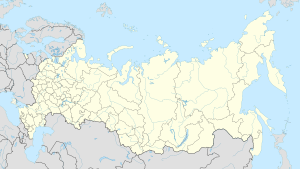
Shakhaevskaya II is a barrow group located on the right bank of the Manych River in the Rostov Region , near the central estate of the Vesyolovsky grain farm. The archaeological complex stretched 4 km southeast of the state farm reservoir and consisted of 27 embankments with a height of 0.3 to 2.9 m, some of which were on the edge of the washed estuary , others were at some distance from it. Shakhaevskaya II was investigated by the Bagaev detachment of the Don expedition of the Institute of Archeology of the USSR Academy of Sciences in 1972 [1] .
| Mounds Shakhaevskaya II | |
|---|---|
| A country: | Russia |
| Height: | from 0.3 to 2.9 m |
| Build Date: | Middle Bronze Age |
| Artifacts: | dishes, decorations |
| Coordinates | |

Content
Description
Barrow 1
The first mound was located on the edge of the coast in the southeastern part of the burial ground, had a height of 2.2 m and a diameter of about 50 m. The embankment did not have any later fillings and was clearly separated from the buried soil. Eight burials were discovered in the mound. The poses of the buried were very different.
The first burial was in a brow at a distance of 0.65 m northwest of the center of the mound. At a depth of 0.4 m, the skeleton of an adult was found in an elongated position on the back. During plowing, the burial site was damaged, so small fragments were preserved. There were no things during the burial.
The second was next to the first at a depth of 0.35 m. The contour of the grave pit was not traced. The bones of an adult were in a mess, only the tibia, a fragment of the thigh and the foot of one leg remained undisturbed. Apparently, the buried man lay on his right side with his legs bent to the north-east. Fragments of the skull and fragments of the stucco pot were located 0.6 m northeast of the leg bones.
Burial 3 was located in the embankment at a distance of 6 m south-west of the center of the mound, at a depth of 1.07 m. The skeleton of an adult lay in a crouched position on the left side with strongly bent legs and arms bent at the elbows. The heel bones were located near the pelvis, the hands in front of the face (the remains of the child were found in the same position). There, a stucco jugular vessel with a bent nimbus was found, decorated along the edge and at the bottom with an ornament in the form of oblique and vertical notches, oblique dashed lines along the neck, impressions of the toothed stamp along the edge. A bone tube broken off at one end was found in the pot. Pottery and its fragments were also found in the northwestern sector of the mound. Under the skull of the fourth deceased, archaeologists discovered a small copper binding, and fragments of a censer without ornament in the grave pit.
The seventh burial found was located in a catacomb 13 m south-east of the center of the mound. In the southwestern part of the entrance pit was an empty niche - a lining. The entrance to the catacomb in the shape of a narrow oval opened in the north wall. One steep step 13 cm high led into the catacomb. The burial chamber had an oval shape and a flat bottom, the height of the flattened vault was 0.35 m. A flat-bottomed vessel with a rounded body, a high neck and slightly bent edge was located at the western wall of the burial chamber. Fragments of a skull and several bones of a child were found east of the pot. Similarly, the eighth burial catacomb was made, in which the remains of two people were discovered.
Of the eight burial sites discovered in the mound, four belong to the catacomb culture (burial 5, 6, 7, 8), two to the carcass culture (burial 2, 3), two are late, without accompanying equipment (burial 1, 4), whose cultural affiliation remained unclear [2] .
Barrow 2
The mound was located on the edge of the cliff. The western floor crawled into the floodplain, the eastern one was plowed up, the rest of it was sod. Its greatest height from the sole is 1.22 m, length 32 m, width 28 m. The embankment was removed with a scraper with preservation of the edge that went parallel to the cliff
The continent was discovered at a depth of 1.85 - 1.9 m. 11 burials and two clusters of animal bones, which were the remains of a trisen, were found in the mound. The preservation of the remains, in general, is the same as in the first mound . A fragment of the neck of a red clay amphora was found in the sod layer north of the center of the mound. At the bottom of the grave of the third burial, two children's bones were found, which were facing each other, touching their foreheads, in a crouched position. Under the right temporal bone of the second skeleton there were two whole bone figured piercings and one fragment of the same piercing.
Burial 5, 1.6 m deep, was located in the embankment at a distance of 2.25 m west of the center of the mound. The backbone of an adult lay in an elongated position on his back. The bones of the right arm, foot and lower leg of the right leg were not preserved. The length of the bone is 1.5 m. Three small paste beads 2 mm in diameter were found on the left shoulder and on the right side of the chest, a fragment of the tip of an iron single-blade knife was found under the occipital bone, a half of the clay spindle truncated biconical shape between the knee joints.
The Eighth Burial was located 5 m south of the center of the mound. The grave pit in the plan had an irregular five-petalled shape. The remains of four large wooden wheels from a cart were found in the corner recesses. Clear prints of the ends of the wheels in the places where they were delivered are preserved. At a depth of 0.4 m from the edge of the pit appeared wood dust mixed with chalk and the remains of reeds. Some of the logs were slightly charred. Apparently, the grave had a wooden ceiling. In the filling of the pit were found: a fragment of the wall of a stucco pot with a nail ornament, sashes of a mother-of-pearl shell, two small fragments of a grindstone, small fragments of animal bones, and fragments of flint. There were several graves in the grave. Two of them were in the pit, on the remains of the funeral cart, the other three lay in the catacombs under the northeastern and southeastern walls of the main grave pit.
The burial chamber with a flattened arch in the plan had a trapezoidal shape, somewhat expanded to the northeast. 30 cm to the northwest, at the entrance to the lining there was a burial of a baby. Almost all of his bones were decayed, only fragments of the skull, humerus and femur, intensively painted in red, were preserved. The debris of a small vessel decorated in the upper part with five parallel horizontal lines from the prints of the cord was found near the skull. At the skull lay an inverted censer, which had two compartments and a cross-shaped leg.
A large squat vessel with a flattened bent rim was found in the head of the ninth buried. At the edge of the bottom of it there is a sticky roller with rounded impressions from the fingers. Nine of the 11 burials investigated in the mound date back to the Bronze Age , 2 to a later time [3] .
Mound 3
The plowed earthen mound of the mound towered 0.3 - 0.4 m, was 400 m from the coast. The excavation diameter is 24 m. The embankment was removed with a scraper while maintaining one edge in the north-south direction. Under the embankment, 8 burials were concentrated in the center of the mound. The embankment in profile did not differ from the buried soil, no interlayers were traced in it. The mainland lay at a depth of 0.85 m, the thickness of the buried soil layer was 0.25 - 0.3 m. In the profile, the ratio of a number of burials and a ditch dug from the surface of the mound was clearly visible. All burials are located compactly in the center of the mound. This indicates that he has long maintained a clear outline with a well-defined peak. By the era of the early Middle Ages, the center of the mound shifted slightly [4] .
Mounds 4-8
Four burials were investigated in the fourth mound, in the fifth - three, in the sixth - six, earthenware, incense burners, bones of cattle were found [5] [6] [7] . In the seventh mound, the remains of a woman were discovered. They lay in the tomb of thin boards or dice, from which only wood decay was preserved. The deceased was covered with brocade fabric, the edges of which were tucked under the body. A heavily corroded single-blade knife with a triangular blade in cross-section was found near the left shin of the buried one, silver earrings with glass inserts superimposed on a mother of pearl plate were located near the skull [8] [7] .
Notes
- ↑ Excavations of the Kurgan group Shakhaevskaya II on the river. Manyche (E.A. Fedorova-Davydova) . Rostov-Region. Date of treatment March 8, 2017.
- ↑ Barrow 1 (Fig. 2) . Rostov-Region. Date of treatment March 8, 2017.
- ↑ Barrow 2 (Fig. 4) . Rostov-Region. Date of treatment March 8, 2017.
- ↑ Barrow 3 (Fig. 8) . Rostov-Region. Date of treatment March 8, 2017.
- ↑ Barrow 4 (Fig. 10) . Rostov-Region. Date of treatment March 8, 2017.
- ↑ Barrow 5 (Fig. 12) . Rostov-Region. Date of treatment March 8, 2017.
- ↑ 1 2 Kurgan 6 (Fig. 13) . Rostov-Region. Date of treatment March 8, 2017.
- ↑ Barrow 7 (Fig. 15) . Rostov-Region. Date of treatment March 8, 2017.