Park named after Ivan Franko ( Ukrainian Park named after Ivan Franka ) - a park in the Galicia district of Lviv ( Ukraine ), a monument of landscape art of local importance (since 1984 ). The park is protected as a national treasure, it is a conservation and recreational facility. [one]
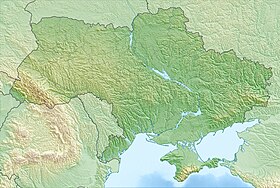
| Park named after Ivan Franko | |
|---|---|
 | |
| Location | |
| A country |
|
| Region | Lviv region |
| City | Lviv |



Franko Park is located on the slope of a hill that rises above the Lviv Basin in the central part of the city. It is limited by the streets of Krushelnitskaya (former Chernyshevsky) , Universitetskaya, Listopadova China and Yana Mateyko. In the ground part of the park is a complex of the monument to Ivan Franko, located opposite the Lviv University ; opposite the top of the park is the Dniester Hotel . The total area of Ivan Franko Park is 10.6 hectares. [2]
The first public park in Lviv, it was founded at the end of the XVI century. The park was founded on the territory of the former urban fields, which were first owned by the rich petty bourgeois family of the Scholz-Wolfovichi. In 1614, the city authorities temporarily transferred the park to the use of Jesuit monks, who began construction of their church and monastery in Lviv. The monks built a brick factory here to provide this construction with brick. A brewery was also built here, and part of the land was leased to peasants and a tavern was opened for them. This temporary use lasted almost 160 years, until the Jesuit Order was abolished with the advent of Austrian power. On the maps of Lviv and in historical documents of those times, the name "Jesuit Garden" or "Jesuit Gardens" is found.
In 1655, the artillery of Russian troops was stationed here, which, together with the troops of Bogdan Khmelnitsky, besieged Lviv.
In 1773, he became the property of the Austrian authorities. In 1835, in the middle of the park, a graceful gazebo was built - a rotunda, which has survived to this day. In the lower part of the park, where the main building of Lviv University is now located, there was a "Hechta casino". The park changed owners several times, but this did not save him from a gradual desolation, until in 1855 he became the property of the city. The park began to equip the famous urban gardener Bauer, who arranged the territory in a landscape style. Most trees were planted during the years 1885-1890 . In 1886 , a central alley was laid, continuing the street Jagiellonian (now Sichovy Sagittarius). In the interwar period it was called Kosciuszko Park in honor of the Polish national hero Tadeusz Kosciuszko . In the Soviet period, the park received the name of the writer Ivan Franko , who lived opposite him in 1878 - 1879 (on the modern street of Krushelnitskaya ).
In the years 1894-1896, the City Development and Decoration Society established busts of Jan Dobrzansky, a writer, Jan Nepomuk Kaminsky, the director of the Polish theater, Leon Sapieha, the governor of Galicia, Arthur Grotger, the Lviv painter, Bishop S., opposite the building of the Galician Seym (now the building of the Lviv University). Glowinsky - the founder of the Youth Education Fund, and in the alley - a bust of Count I. Dunin-Borkovsky - the Hellenistic poet. On the flowerbeds in front of the Seym building there was a cast-iron vase with bas-reliefs that depicted in a free interpretation B. Torvaldsen's work “The Course of Human Life”. In 1949, after the removal of the monument to the governor Agenor Golukhovsky, who stood at the entrance to the park from the current street. Sich Sagittarius, the vase was moved to the place of the monument, where it is still located. [2]
In the Soviet period, the Park Cinema was also located here. In 1964, a monument to I. Franko was erected in front of the university in the park (sculptors V. Borisenko, D. Krvavich , E. Misko , V. Odrekhovsky. Ya. Chaika, architect A. Shulyar).
Earlier in the park was the building of the Ukrainian Society for the Conservation of Nature, now it houses the Consulate of Bulgaria. In the upper part of the park is a gardener's house, below it is a playground
The main plantations are trees planted in 1855-1890: oaks , maples , linden , osokori . Later, rarer plants were also planted: a coffin , a maple leaf plane tree , a yew berry , rocky oak, and others.
 |  |  | ||
| Franco Park Central Walking Alley | The side adjacent to the Listopadovoy Chin street | Exit from the park at the intersection of Universitetskaya and Sichovy Strelets |
Notes
- ↑ Ivan Frank Park | Excursions in Lviv. What to see in Lviv? (Russian) (unopened) ? . lviv-tourist.info. Date of treatment October 3, 2018.
- ↑ 1 2 Lviv | Park named after Ivan Franko . otdyhaem.com.ua (February 3, 2010). Date of treatment October 3, 2018.
Links
- Parks of Lviv (Ukrainian)
- Photo of the park to them. Ivan Franco