Israeli-Syrian relations - diplomatic and economic relations between Israel and Syria . Since the independence of Israel in 1948, both states have been at war. Two countries fought in three major wars, namely, the War of Independence of Israel in 1948, the Six Day War in 1967 and the Doomsday War in 1973, and were also later involved in the Civil War in Lebanon and the 1982 Lebanon War . The rest of the time a truce was observed. From time to time, unsuccessful attempts were made to achieve peace between neighboring states.
| Israeli-Syrian relations | |||||
|---|---|---|---|---|---|
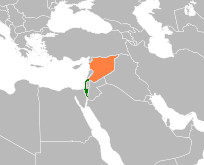 | |||||


Syria has never recognized the existence of the State of Israel, and to this day does not accept Israeli passports to enter Syria. Israel also regards Syria as an enemy state and forbids its citizens from traveling to this country. There have never been bilateral diplomatic relations between the two states since the creation of each of them in the middle of the 20th century.
There were no economic or cultural ties between the two countries, but only limited movement of certain citizens across the border. Syria continues its active participation in the Arab boycott of Israel . Both states allow limited apple trade to residents of Druze villages on the Golan Heights, which are located on either side of the ceasefire line. The state of peace on the ceasefire line was disrupted during the Syrian civil war , which began in 2011 and continues today, but Israel participated in this conflict minimally.
Both countries are the successors of the Ottoman Empire . The length of the state border between the countries is 83 km [1] .
History
1948-1975

Since the signing of the armistice agreements in 1949, relations between Israel and Syria have been characterized by periods of hostility; talk of a ceasefire, often through intermediaries; and disengagement agreements, such as the 1974 Israeli-Syrian Disengagement Agreement .
Before the Six Day War of 1967, intermittent clashes took place in the demilitarized zones over water resources, as well as shelling and infiltration from the Golan Heights. After the war, negotiations focused on “land for peace”, in particular the demand for Israel to return the Golan Heights to Syria, as well as the subsequent recognition by Israel of Syria and the establishment of peaceful relations with it, which is provided for in UN Security Council Resolution No. 242 . In the Syrian-Israeli negotiations with US mediation in the 1990s, Syria demanded that Israel move to the "borders on June 4, 1967," namely, west of the former border of the British Mandate of Palestine and Syria [2] . Syria tried to recapture the Golan Heights during the Doomsday War , but to no avail, it managed to get only a small part of them under the 1974 Disengagement Agreement, and it had to withdraw its armed forces more east compared to their position in 1967-1973.
During the Lebanon Civil War
In 1982, Israel invaded Lebanon to expel the PLO forces from there. Syria sent ground troops and the Air Force to help the Lebanese, but almost all of them were defeated by the Israelis. Syria continued to support Lebanese militants, until the withdrawal of Israeli troops from Lebanon in 2000.
Attempted Peace Settlement 1990s
The first high-level public negotiations aimed at the permanent resolution of the conflict between Israel and Syria were held at and after the 1991 multilateral Madrid Conference . During the 1990s, several Israeli governments negotiated with Syrian President Hafez al-Assad . While serious progress was made, they were unsuccessful.
During Damascus Spring: 2000-2005
High points of hostility in the 2000s included an air raid in Ain es Sahib (IDF mission against Palestinian militants in Syria) in 2003 and Operation Orchard (Israeli Air Force mission and commando against the alleged Syrian nuclear program) in 2007.
Union of Syria and Iran: 2006 - n. at.
During the Second Lebanon War, Syria threatened to enter the war on Hezbollah's side, provided her support and allowed Iran to supply her materials through its territory. Turkey later organized peace talks between the two countries, but Syria later withdrew from them in response to the 2008–2009 war in Gaza .
In September 2007, as a result of Operation Fruit Orchard, the Israeli Air Force destroyed structures that Israel considered the site of a nuclear reactor in the Dayr al-Zaur region [3] [4] [5] .
In 2010, Syrian President Bashar al-Assad accused Israel of violating peace, and Syrian Foreign Minister Walid Muallem warned that in case of war Syrian missiles would be sent to Israeli cities. Israeli Foreign Minister Avigdor Lieberman replied with a statement that the Syrian army would be defeated in the event of a war with Israel and that Assad and his family would lose power. Lieberman also advised Syria to abandon its claims to the Golan Heights [6] . For several months in 2010, Prime Minister Benjamin Netanyahu participated in secret negotiations with Syria through US mediation [7] .
Syrian Civil War: 2011 - n. at.
Several incidents took place on the ceasefire line between Israel and Syria during the Syrian civil war , experiencing a state of calm between the two countries. It is believed that these incidents are the result of intense hostilities in the Kuneitra governorate in 2012-14, as well as later incidents between the Syrian army and rebels, continuing on the Syrian-controlled side of the Golan and in the neutral zone of the Golan Heights, as well as the involvement of Hezbollah in the civil war in Syria. As a result of all the incidents that began in late 2012 and by mid-2014, one civilian Israeli was killed and at least 4 soldiers were injured; on the Syrian-controlled side, about 10 soldiers were killed, as well as two unidentified militants who attempted to break into the Israeli part of the Golan Heights [8] .
Humanitarian Aid
According to the Israel Defense Forces in July 2018, about 30 operations were carried out to transfer humanitarian aid to the Syrians from the Israelis. In total, 75,700 liters of fuel, 20 sets of medical equipment, about 77 tons of clothes, 556 tents, 30 “shadow nets”, 12.5 tons of baby food, 130 tons of food were delivered. Similar operations were carried out by the IDF unit to support good neighborly relations with Syria through the border crossing "Abashan" [9] .
Economic Relations
Since 2004, Israel has been exporting apples to Syria through the Kuneitra checkpoint. In 2010, about 10,000 tons of apples grown by Druze farmers in the Golan Heights were sent to Syria [10] . Israeli Minister Ayub Kara called for an agreement with Syria to supply water to the cities of the Golan Heights. Today, 10% of the water in the Druze city of Majdal Shams is supplied by Syria from the source of Ein al-Tufah. This agreement has been in force for 25 years [11] .
In March 2019, the IDF command blocked the supply of apples to Syria for security reasons, despite the permission issued by the Israeli Ministry of Agriculture [12] .
Tourism and cultural exchange
In 2010, the Israeli government permitted a pilgrimage to Syria to a group of 300 Druze citizens of Israel who wanted to visit religious places in Syria [13] . A group of dancers from the five Druze villages of Israel went to Aleppo to compete in a dubka competition, a traditional Arabic dance [14] . Civilians are allowed to cross the border in Cuneitra for university studies or marriage. Syrian citizens of the Golan Heights are entitled to free tuition, books and housing [15] . Since 1993, 67 Syrian brides crossed the border to the Golan Heights and 11 brides from the Golan Heights went to Syria [16] .
Notes
- ↑ The World Factbook - Central Intelligence Agency
- ↑ Frederic C. Hof, “ Mapping Peace between Syria and Israel, ” United States Institute of Peace, Washington DC 2009
- ↑ IAEA: Syria tried to build nuclear reactor Associated Press Latest Update: 04.28.11, 18:10
- ↑ Beaumont, Peter . Was Israeli raid a dry run for attack on Iran? (September 16, 2007). Archived on May 4, 2008. Date of appeal September 16, 2007.
- ↑ Stephens, Bret . Osirak II (September 18, 2007). Archived on February 7, 2014. Date of appeal September 19, 2007.
- ↑ FM: If Syria provokes Israel, Assad will be out of power . The Jerusalem Post - JPost.com . Date of treatment April 17, 2016.
- ↑ Secret Israel-Syria Peace Talks Involved Golan Heights Exit The New York Times (October 13, 2012). Date of treatment April 17, 2016.
- ↑ Israel kills two Syrian gunmen on Golan border . The Times of Israel . Date of treatment October 30, 2014.
- ↑ The IDF gave gifts to the Syrian refugees from the Israelis. VIDEO , NEWSru.co.il
- ↑ Israeli Trucks Cross Into Syria in Annual 'Apple Invasion' . Haaretz.com . Date of treatment April 17, 2016.
- ↑ Israeli Druze Minister: Syria Should Give Water to Golan Towns . Haaretz.com . Date of treatment April 17, 2016.
- ↑ IDF canceled supply of Druze apples to Syria , NEWSru.co.il
- ↑ Israeli Druze to go on historic visit to Syria . ynet . Date of treatment April 17, 2016.
- ↑ Hebrew press sees thaw in Syria-Israel relations . Maan News Agency . Date of treatment April 17, 2016.
- ↑ Susan Taylor Martin. Golan families dream of reunion . Tampa Bay Times (February 18, 2007). Date of treatment October 25, 2008.
- ↑ One way ticket for Druze Syrian Brides Archived on April 11, 2009.