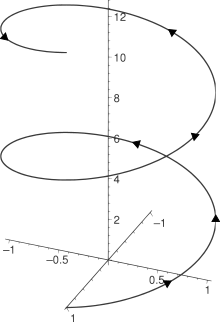


A helix is a curve in three-dimensional space located on a round cylinder or round cone , intersecting the generators at the same angle [1] .
A cylindrical helix is defined in rectangular coordinates by parametric equations of the form:
- ,

or in another entry:
-
- ,



Where Are real constants that are not equal to zero.

The projection of a cylindrical helix on a plane is a circle .

A conical helix (also a helical helix [2] ) is determined by parametric equations of the form:
- ,

or:
-
- .


Projection of a helical line onto a plane - the spiral of Archimedes .
A body shaped like a helix in colloquial speech is often called a spiral, which is not entirely correct, since in mathematics spirals are called a certain class of plane curves .
Content
- 1 Right and Left Helix Lines
- 2 Elements and properties
- 3 Examples of bodies in the form of a helix
- 4 notes
Right and Left Helix
There are mirror-symmetrical helix lines. The "right" helical lines are the lines generated by the " rule of the gimlet " or by the "rule of the right hand." This property of helix lines is called chirality - “right chirality” and “left chirality”. A pair of mirror-symmetrical helix lines are called enantiomorphs. If the coefficient in the parametric task of a cylindrical helix in the right three coordinates is positive, then such a line is called "right", if negative - then "left".
The vast majority of threads used in mechanical engineering for fastening hardware have a “right” thread or a “right” chirality, that is, screwing is done clockwise. Left-handed threads are used very rarely in special applications, for example, to prevent self-unscrewing of pulleys from mechanism shafts.
Elements and Properties
Value called the pitch of the helix , geometrically this is the distance between adjacent turns of the line, counted along the generatrix of the cylinder .
All helical lines are slope lines , that is, tangents to them form a constant angle with some constant direction. As with any slope, the curvature of a cylindrical helix and torsion constant at any point and equal to:
- ,
- .
Length element :
- .
Angle between the tangent to the cylindrical helix and the tangent to the circumference of the cylinder at the same point is called the helical angle , it is equal to:
- .
Helix examples of bodies
The following molecules , for example, have the shape of a helix or helicoid :
- DNA is a double helix (double screw),
- RNA
- actin filament - double helix,
- calmodulin
- molecules having chirality
- asparaginase .
Many parts of machines and mechanisms also have forms of helical lines - springs , part of screw drills , connecting screws , bolts , studs , screws ( screws ) of meat grinders , extruders , Archimedes screw , screws of snow blowers and others (they realize a helical surface - a helicoid ).
Notes
- ↑ Helix - an article from the Mathematical Encyclopedia . E.V. Shikin
- ↑ Helix - an article from the Great Soviet Encyclopedia . E. G. Poznyak.