The Decembrists is an opera by the Soviet composer Yuri Shaporin based on the play by Alexei Tolstoy “Polina Göbl” on the libretto by Vsevolod Rozhdestvensky . The most large-scale musical work on the events of December 1825 [1] .
| Opera | |
| Decembrists | |
|---|---|
| Composer | |
| Librettist | |
| Libretto language | |
| Plot source | based on the play by A. Tolstoy "Polina Gebl" |
| Action | |
| Pictures | |
| First production | |
| Place the first production | The Bolshoi Theatre |
| Scene | |
| Time of action | 1825–1826 |
The opera was created for almost three decades and during that time has undergone significant changes. Conceived as an intimate love-lyrical drama, in the process of work, it was transformed into a monumental heroic and patriotic work, one of the most significant in the musical theater of the Soviet period [2] . First performed at the Bolshoi Theater on June 23, 1953, was in the repertoire of Soviet theaters for more than two decades. For the creation of the opera "Decembrists" Yu. A. Shaporin was awarded the State Prize of the RSFSR named after M. I. Glinka (1966).
Creation History
Lyric drama: Annenkov and Polina

I.A. Annenkov
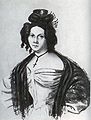
Polina Göbl

In 1925, Soviet Russia prepared for the celebration of the 100th anniversary of the Decembrist uprising. In 1922—1926, many literary, theatrical and film productions, created especially for the memorable date, saw the light of day. Thus, the design of the opera, whose heroes were participants in historical events, emerged from Yu. Shaporin against the background of the increased popularity of the theme [2] .
The composer began work on opera in 1925 together with A. N. Tolstoy . The first version of the libretto was based on Tolstoy’s play “Polina Göbl”, which the writer created with the significant participation of the historian P. E. Shchyogolev . Working in the archives recently opened for scientific work, Shchyogolev discovered the diary of the Moscow modist Frenchwoman Polina Göbl, who became the wife of the Decembrist Annenkov and known as Praskovia Annenkova [3] [4] . Inspired by this romantic story, A. Tolstoy sketched several scenes of the play, and Shaporin quickly wrote the music of two paintings [5] , and at an evening dedicated to the anniversary of the uprising, they were presented at the State Academic Opera and Ballet Theater (former Mariinsky) in Leningrad [6] . The first name of the opera, like the play, coincided with the name of the main character [3] ; central to the plot was a love drama that took place against the backdrop of the Decembrist movement [2] [7] . Subsequently, both the text and the music were radically revised, and the scenes presented in Leningrad were not included in the final version of the opera [5] .
Further work on the opera dragged on. Probably, the play of Tolstoy, published only once in 1926 (in the magazine “ New Russia ”, No. 1) with the subtitle “dramatic poem” and written in prose with verse fragments, was originally created as a libretto, even in a footnote to the publication it was stated that “ music for the text of the poem is written by Y. Shaporin " [8] [9] . But Tolstoy had no experience with opera material and didn’t take into account the particularities of the genre when creating the libretto: the text did not have a division into arias , ensembles and choruses [5] , the text was written in prose, and for the opera, as Tolstoy believed, poems were needed. In addition, after sketching a few scenes, Tolstoy was distracted by another work [4] . Shaporin had to wait a long time for literary developments from Tolstoy. In addition, they claim that already at the beginning of work on the opera, the librettist and the composer lacked agreement in the design [1] : Shaporin’s creative preference for the cantata and oratorio genre tended to become more monumental in the work [8] . Noting the dramatic harmony and brilliance of the libretto language, the composer and musicologist Bogdanov-Berezovsky wrote in 1932 that the advantages of music are superior to him, the images and associations she creates are clearer and more specific [1] .
Over the years, the material has undergone a change in the official interpretation of the history of the December uprising, and the authors had to revise the plot and plan of the work. The play "Polina Göbl" consisted of nine paintings, seven of them contained the development of the love drama of Annenkov and Polina. Annenkov was represented in it by one of the main leaders of the conspiracy, and the mission of the wife of the Decembrist , the embodiment of the idea of patriotic duty, went to the Frenchwoman , who, according to the composer, sang Karmagnola in the initial version of the opera. This state of affairs went against the official ideology . In the mid-1930s, the poet Vsevolod Rozhdestvensky , who already had experience with operatic librettos, was brought to work on the text on the advice of A. Tolstoy [4] . Rozhdestvensky was faced with the task of developing a historical-revolutionary plot and presenting the main, and not the sideline, insurrection leaders, according to the official historical science of those years [8] .
Work on the opera was carried out under the constant supervision of the leading cultural institutions. At numerous meetings with historians, they demanded to accurately reproduce the events of the uprising. The influence of cultural and political leadership most of all affected the sixth film of the opera, directly devoted to the events on Senatskaya Square [10] . The plot is now based on carefully selected real historical facts relating to the last period of activity of the Northern society [2] . The love story moved from Paris to the Russian estate [9] , the original characters — Polina and Annenkov — disappeared from the opera: instead of the non-patriotic image of the French dressmaker, a type of Russian noblewoman, sung by Nekrasov, was introduced [10] . From the intimate lyrical drama, the opera was transformed into a monumental historical revolutionary tragedy [7] .
Second Edition: Decembrists
The second edition of the opera, containing seven paintings, was completed in 1941. In it, the images of Annenkov and Göbl were shifted into the background by the images of the Decembrist heroes [1] . The first (“In Paris”), the seventh (“Nicholas I's Cabinet”) and the ninth (“Vyazma”) pictures were removed from the original plan, the picture “Ball” was added, where the authors transferred the episode of the meeting of Pauline with the tsar, the rest of the pictures were significantly revised . It was supposed to abolish the second picture “At the old woman Annenkova”, but director L. V. Baratov advised to save it in order to show the contrast of high revolutionary ideas with the reality of the Russian serf. The second edition included episodes related to the reflection of the people's life — the laudatory song of serf girls performed on orders, the satirical song Prov Provaro beer and other fragments. We also saved the scene of Annenkov's conversation with his mother, where the viewer gets acquainted with the political views of the hero. The meeting of the Decembrists in the third film “Fair” ended with the song of the driver . The main numbers of the fourth picture “At Ryleev” are formed - the song by Kakhovsky , the choir “Fatherland” in the words of Katenin , the anthem in the words of A. S. Pushkin . At a meeting at the S. Kirov Theater [11] in December 1939, a symphonic picture was included in the plan of the opera before the culmination of the action - an uprising on Senatskaya Square , but this idea was not implemented in the final version. The scene of the opera finale in the seventh film was the Peter and Paul Fortress , the main numbers of this painting were written: the soldier’s song, Annenkov’s conversation with Kuchelbecker (final edition - Bestuzhev and Shchepin-Rostovsky’s talk), the story of the execution of the Decembrists, the meeting of Annenkov and Polina. The opera ended with a Decembrist chorus to Pushkin’s poems “ To Siberia ” [8] :
| Deep in Siberian ores Keep proud patience Your sorrowful labor will not be lost. And think high aspiration. |
A. Tolstoy, despite serious changes in the dramatic and musical structure of the opera, continued to defend the lyrical interpretation of the plot. Even the name of the opera in the second edition has remained the same as the writer intended - “Polina Göbl” [8] .
In the course of work on the second edition, fragments of the opera were again presented to the public: in the season of 1937/1938, a montage was broadcast on radio that included 17 numbers that reflected the plot picture of the work as a whole. Many episodes, mainly related to the lyric line, were subsequently excluded. Others formed the basis for the subsequent development of the musical image of the people [8] .
The premiere of the opera at the Bolshoi Theater was scheduled for the 1940/1941 season, directed by conductor A. M. Pazovsky , director L. V. Baratov, artist E. E. Lanceray . But Shaporin did not have time to complete the work on the score by the deadline. The work of the group of authors in collaboration with theatrical figures was interrupted by the Great Patriotic War [8] .
The third and fourth editions: the ideological and patriotic hymn
Shaporin returned to work on the opera after the end of the war. As work progressed, the ideological and patriotic sound of the history of the Decembrists grew stronger. A lot of music was written anew, including the new painting “On the Post Road”, which tells about the secret conspiracy of the Decembrists, and Kakhovsky's song to Pushkin’s poem “To Chaadaev”. In the third picture (“Fair”) new episodes appeared. By 1950, after writing the paintings "In the Winter Palace", "Senatskaya Square", "Ball", "Peter and Paul Fortress", Shaporin was engaged in a thorough revision of the episodes. Shaporin presented the third edition of the opera at the Bolshoi Theater in 1950, and in 1951 there was an audition for it in concert and an extended discussion with the participation of historians, composers and members of the theater's creative team [8] . The piece was harshly criticized by both historians and musicians [1] . According to the memoirs of the singer I. Petrov , the opera was too long, so much music could not be performed in one evening, and the musicians persuaded it to be cut [12] . In general, while appreciating the music, the participants in the discussion expressed sharp objections to the libretto. The flaws in the dramatic composition, the insufficiently broad demonstration of the revolutionary movement and the interconnection of the Northern and Southern societies, the lack of substantiation of the socio-historical causes of the Decembrist movement, the unconvincing relationship of the Decembrists with the people were noted [8] .
Following the discussion, an urgent processing of the libretto began. The main characters, Annenkov and Polina, were replaced by the little-known Shchepin-Rostovsky and the daughter of a ruined landowner; the love line was supplemented with episodes from the lives of other road users and became abstractly collective [8] . A key place in the plot was taken by the collective image of the Decembrists, the dramatic basis of the action was their relationship with the people [10] . Vsevolod Ivanov created the new version of the libretto of the first film (“In the Estate”), Shaporin wrote for it an arioso of the old soldier, which was not included in the final version. Gypsy scenes in the third film, which were awarded separate criticism by academician E. V. Tarle for inappropriate modernization, were significantly reduced, and the final of the “Fair” scene was changed. On the advice of the director E. N. Sokovnin , who worked on the opera in Leningrad, the painting “Casemate” was introduced. Fragments that caused a feeling of fatal doom and a premonition of a catastrophe were excluded from the opera, but elements of musical stylistics appeared that created sublime emotions and a “sense of historical optimism”. The tragic finale "In the depths of Siberian ores" changed the scene of unity of the Decembrists with the people and the symbolically sounding "looking to the future" finale with the words of A. Odoyevsky [8] :
| Our sorrowful labor will not disappear, From the spark ignite the flame And enlightened our people Crowded under the holy banner. |
Creative teams from the Bolshoi Theater and the S. Kirov Theater in Leningrad [7] [8] , which formed a kind of “creative laboratory” [12], took part in the revision of the opera. After the first run-through rehearsals in 1952, Shaporin again made adjustments to the work [8] . At the very last stage in February 1953, at the ultimatum of the leadership, Pestel appeared among the characters, who had nothing to do with the plot line of the opera, but necessary to display the entire cohort of leading Decembrists [3] [10] . The image of Pestelya personified the Southern Society, without which the officially approved historical picture of the uprising would have looked unfinished [2] .
After all the revisions to the libretto, there was almost no text written by Tolstoy, since his wife, N. V. Krandievskaya [4] [9], wrote poems to the libretto. But since the well-known writer stood at the origins of the opera and was the co-author of the original idea, when preparing for the premiere, the authors found it necessary to indicate in the poster that the opera was written "based on A. Tolstoy" [4] .
Premiere and Stage Story
The premiere of the opera "The Decembrists" was held in Moscow on June 23, 1953, staged by N. P. Okhlopkov [13] and in Leningrad on July 4 of the same year [7] , staged by E. Sokovnin, conducted by B. Khaykin [14] . The performance at the Bolshoi Theater corresponded to the canons of the monumental-epic performance. The decoration reproduced the scene with scrupulous precision, be it a square in St. Petersburg, an office in the Winter Palace, a casemate of the Peter and Paul Fortress, or a Siberian road [10] . Ballroom choreographer Leonid Lavrovsky put [13] . In the Bolshoi and Kirovsky Theaters, the opera was in various stage editions: the Bolshoi Theater represented the opera in four acts, the action of the final film took place in Siberia at the stage. In Leningrad, the last picture was included in the third act, and the place of its operation was transferred to the courtyard of the Peter and Paul Fortress [8] .
In 1957, the opera was staged in Prague and in Ostrava [13] [15] . The Decembrists were part of the Bolshoi touring program in the cities of the USSR [16] . On the main stage of the theater, the performance was shown 69 times, he was in the repertoire until May 1969. In the Kirov Theater, opera was again included in the repertoire in the mid-1970s to celebrate the 150th anniversary of the Decembrist uprising [4] . Y. Shaporin was present at all performances of his only opera at the Bolshoi and at almost every performance at the Kirov Theater until his death in 1966 [17] [18] .
Characters
| Role | Singing voice | Performer at the premiere of [13] [19] [20] [21] June 23, 1953 (Conductor: A. Melik-Pashayev ) |
|---|---|---|
| Ryleev, Decembrist | baritone | A. Ivanov |
| Pestel, Decembrist | bass | A. Pirogov |
| Bestuzhev (Marlinsky [7] ), Decembrist | bass | I. Petrov |
| Kahovsky, Decembrist | tenor | G. Nelepp |
| Trubetskoy , Decembrist | baritone | P. Selivanov |
| Yakubovich , Decembrist | baritone | P. Volovov |
| Shchepin-Rostovsky, Decembrist | tenor | G. Bolshakov |
| Olga Mironovna, mother of Shchepin-Rostovsky | mezzo-soprano | E. Verbitskaya |
| Orlova, the impoverished landowner | mezzo-soprano | |
| Elena, her daughter | soprano | N. Pokrovskaya |
| Marya Timofeevna, housekeeper Shchepina-Rostovskaya | soprano | N. Kositsyna |
| Landowner | tenor | |
| Stesha, Gypsy | mezzo-soprano | V. Davydova |
| Rostovtsev | tenor | P. Chekin |
| Nikolay I | bass | A. Ognivtsev |
| Count benkendorf | bass | |
| Governor-General | bass | |
| Metropolitan | tenor | |
| Old soldier | bass | N. Shchegolkov |
| Hourly | bass | |
| Night watchman | bass | I. Mikhailov |
| men, parsters at the fair, policemen, butler, Nastya (daughter of Ryleev, without singing) | ||
Story
The plot of the opera is based on historical facts related to the activities of the Southern and Northern secret societies. The news of the disclosure of secret societies by the government and the situation of the interregnum, which arose after the sudden death of Emperor Alexander I in 1825, forced the Decembrists to proceed to open actions, which ended with the defeat of the uprising on 14 December. The leaders of the uprising were executed, other participants were exiled to Siberia. The action covers all these stages of the uprising [1] .
First action
1. On the estate. The son of a despotic landowner Shchepina-Rostovsky is a young officer, Dmitry Shchepin, in love with Elena Orlova, a girl from a homeless and poor family, but his mother will never agree to this marriage. From bitter thoughts, the young man is distracted by the assignment of Pestel, the head of the Southern Society, who suggested that Shchepin go to St. Petersburg and hand over a letter to the head of the Northern Society, Ryleev. The time of the uprising against the autocracy and the proclamation of the republic is approaching.
2. On the mail path. Members of the secret society Kakhovsky, Trubetskoy, Shchepin, Yakubovich and Rostovtsev hold a meeting in a tavern on the post road between St. Petersburg and Moscow. Suddenly comes the news of the death of Alexander I. Bestuzhev calls upon the conspirators to immediately revolt.
3. Fair. At the fairground bustle and fun. On the occasion of the death of the emperor, the police force the people to stop the fairground festivities. On the empty square Shchepina finds Helen, who went after her lover in the hope of never parting with him.
Second Step
4. In Ryleev. On the night of December 14, participants in the uprising gathered in the house of Ryleev. Trubetskoy brings alarming news about the renunciation of Constantine and the impending oath to Nicholas. Ryleev sweeps aside fluctuations and suggests immediately leading the troops to the storming of the royal palace. Rostovtsev is trying to stop the conspirators, but to no avail.
5. In the Winter Palace. Emperor Nicholas I, watching from the office window collecting the rebels in Senatskaya Square, orders an order to persuade the troops to take an oath or sink the rebels in blood.
6. Senate Square. The Moscow Life Guards regiment, led by Bestuzhev and Schepin, and the naval guards, comes to the square. The people welcomed the rebels. Trubetskoy, who should command the troops, was frightened by mass unrest and fled. Under the pressure of an artillery battery, the uprising was crushed.
Step
7. Ball in the palace. In the St. Petersburg mansion of one of the wealthy dignitaries, a masquerade ball thunders on the occasion of the suppression of the insurgency. Elena penetrated here in the hope of begging the tsar for permission to escort the convict to Shchepin’s exile to Siberia. She manages to conceive, but she can never return from Siberia.
8. In the casemate. Sentenced to execution Ryleev languishes in a dungeon of the Peter and Paul Fortress. The last time on the road to the scaffold, he was seen with his associates Muravyov-Apostol , Bestuzhev-Ryumin , Kakhovsky and Pestel.
Step Four
9. To Siberia. On the Siberian road, the column of Decembrists going to penal servitude is catching up with Elena in the crew. She will spend the rest of her days in exile with her beloved. People from the surrounding villages sympathetically escort convicts. Bestuzhev appeals to the people: “Our sorrowful work will not disappear! A spark will burn from the flame. ”
Artistic features
The Decembrists was called one of the best Soviet operas dedicated to the Russian revolutionary movement [1] . Modern critics have noted the great artistic force with which the images of the Decembrists were recreated [7] , an organic fusion of the general theme of the struggle of the Russian people against the autocracy and the classical historical and everyday tradition [22] . The artistic merit of the opera is recognized in the post-Soviet era [10] .
Dramatic composition
In all scenes of the opera, the historical sequence of events is observed, increasing to the climax - the confrontation on Senate Square. The first picture — the meeting of Shchepin-Rostovsky with Pestel — is a prologue. The second picture represents the plot of the action and the exposure of the images of the Decembrists. In the last pictures, the main lines of action associated with the Decembrists, the people and the love drama are completed. The author of the libretto applies contrast (Shchepina-Rostovskaya - Pestel in the first film; Senatskaya Ploshchad and Bal), successfully uses turning points in history (the news of the death of the king, of the accession of Nicholas I to the throne). Critics noted the high culture, imagery and sublimely romantic style of the poetic text, successfully found symbolism [2] .
The dramatic images of the Decembrists and the people were generally approved. Decembrists in the libretto are represented in opposition to hostile forces. An important shortcoming was the lack of direct confrontation between the Decembrists and the king, although in the process of working on an opera, such a scene was planned and could show the images of the opposing characters more clearly [2] .
At the same time, the fundamental difference between the final libretto and the original idea led to the duality of the dramatic composition of the completed work. The revolutionary pathos of the Decembrists and the lyrical history of Shchepin-Rostovsky and Helena develop in different plot-dramatic plans, separate from each other. Some actions Shchepin-Rostovsky unconvincing. In the “somewhat sluggish” drama, there is no conflict beginning, the characters are represented not so much in actions, as in reflections [2] [3] .
Music
In the opera Shaporin embodied all the best that has been accumulated by the composer for many years of creativity. It combines mastery of broad generalizations, persuasive musical dramaturgy, vivid melodic characteristics [23] , “delicate taste, skill and a sense of proportion” [3] . Opera is an example of following the canons of the genre both in form and in musical language [24] . The musical material of the work is inextricably linked with the traditions of classical Russian opera. It develops the heritage of the Russian folk song, military and student songs from the time of the Decembrists, everyday music [23] . The ideas of freedom, asceticism, valor are expressed by the poetic, sublime system of music [7] .
For various dramatic circumstances, Shaporin uses various expressive means and forms [2] . Leitmotifs , or leit-temes, sound in music - clear musical constructions expressing the harmonic and intonational grain of the image. In Shaporin's interpretation, the leitmotifs do not remain unchanged, but are transformed in parallel with the changes in the plot. Ensemble and choral scenes are melodicly clear. Шапорин отказался от законченности музыкальных номеров оперы в пользу сквозного развития драматургической линии: ансамбли часто появляются непосредственно в конце сольных номеров, становясь их развитием и логическим завершением [1] . Так, трёхчастная с элементами сонатной формы ария Рылеева «О, Русь моя» переходит в построенную на её основе хоровую сцену [2] . Велика роль оркестра , в частности, в сцене восстания его средствами передаются все смысловые акценты. В трёхчастной оркестровой увертюре , начинающейся с фанфар , олицетворяющих восстание, звучат лейтмотивы: маршевая тема восставших войск, тема самодержавия, гимн декабристов [1] . В объёмной фресковой композиции «Ярмарка» оркестр в полной мере участвует вступлением , экспозицией , разработкой , репризой и кодой [2] .
В музыкальной композиции контрастно чередуются и противопоставляются друг другу музыкальные образы основных действующих сил — декабристов, самодержавия и народа. По логике развития сюжета в шестой картине, где все силы сходятся на Сенатской площади, основные музыкальные линии должны были вступить во взаимодействие и даже в противоборство, но музыка этой картины носит излишне иллюстративный характер, общая линия развития не сформирована, кульминация не состоялась. Как отмечает музыковед С. В. Катонова, конфликт между Еленой и Николаем в седьмой картине также не поддержан достаточными выразительными музыкальными средствами. В отличие от драматической кульминации, музыкальной кульминацией оперы стала четвёртая картина, оставляющая последующему действию завершающую роль [2] .
Коллективный портрет декабристов — музыкальный приём, отмеченный критиками как новаторский и не встречавшийся в оперной музыке [3] [8] , — создаётся героическими мужскими хорами и ансамблями [7] . Роль основного лейтмотива оперы отведена патриотическому гимну на стихотворение А. С. Пушкина «К Чаадаеву». Музыкальная тема, уходящая корнями к песням французской революции, полностью представлена в квинтете в конце второй картины [2] [3] :
В начале четвёртой картины производная мелодия звучит в песне Каховского с хором, а в конце картины — в припеве ансамбля. Отдельные обороты многократно появляются в вокальных партиях декабристов и оркестре. Гимн создает основу группового музыкального портрета декабристов. Родственна гимну и другая тема коллективного образа декабристов, появляющаяся в третьей части увертюры, затем в арии Рылеева в четвёртой картине. Эта песня на стихи А. Одоевского формирует мощный финал оперы [3] . Музыкальному образу декабристов свойственны эпическая широта, распевность и романтическая полётность, восходящая к традициям Глинки и Бородина [10] .
Индивидуальные музыкальные характеристики декабристов основаны на русской гражданской песенной лирике и революционных гимнах, что должно воспроизводить исторический дух эпохи и революционный пафос восстания. Эти образы не детализованы и лишь дополняют коллективный портрет, индивидуальность обозначена каким-то одним характерным для персонажа акцентом [3] . Композитор отказался от развёрнутых мелодекламаций и нарисовал индивидуальные портреты героев через жанровую характеристику. Так, Каховский обычно выступает запевалой в ансамблевых и хоровых номерах. Через дифирамбы Пестеля создаётся облик одухотворённого и приподнятого героя, куплеты Бестужева рисуют образ удалого весельчака. Склонный к раздумьям Рылеев является выразителем смысла происходящих событий [10] . Его характеристика, по мнению искусствоведов, могла быть полнее, если бы в оперу вошла сцена допроса у Николая I, оставшаяся лишь в планах. Образ Щепина-Ростовского решён в ином плане, его преобладающее лирическое начало ярко изображено уже в ариозо первой картины [3] . Недостаточно рельефным, риторичным получился музыкальный образ Пестеля, во многом из-за сухого литературного текста его партии [6] .
П. И. Пестель
К. Ф. Рылеев
П. Г. Каховский
А. А. Бестужев
С. П. Трубецкой
А. И. Якубович
Д. А. Щепин-Ростовский
Музыкальная характеристика персонажей-антагонистов стала предметом особой дискуссии критиков [3] . Уже в увертюре противопоставлены фанфарная тема восстания и мрачная, оформленная барабанной дробью, тема Николая I [25] . Отзвуки темы самодержавия звучат во второй и третьей картинах. В четвёртой картине представители враждебных сил уже вовлечены в действие и оттеняют положительные образы декабристов [2] . Лейттему монолога, впервые звучащую в начале второй картины в момент сообщения о смерти императора Александра и олицетворяющую самодержавие, сравнивали с «роковы́ми» темами в классической музыке [3] :
Музыкальная характеристика Николая I полностью представлена в пятой картине, в монологе «В недобрый час вступаю я на трон». Критики отмечали, что композитору не удалось музыкальными средствами в достаточной мере изобразить «жестокую, бесчеловечную сущность» Николая I [3] , главный персонаж контрдействия оказался карикатурной обобщённой маской [10] . Партии персонажей, олицетворяющих крепостническое государство, в противовес напевности и лиризму музыкальных образов декабристов, выражены декламационно-речитативными формами [26] . Лишена напевности и партия Трубецкого, спасовавшего перед народным движением [19] , его музыкальная характеристика, построенная на сухом речитативном рисунке [6] , невыразительна [10] .
Народные сцены в опере играют роль социально-исторического фона, в произведении подчёркнута отстранённость декабристов от народа [19] . Его музыкальная характеристика представлена в первой картине: лейтмотив страдающего под крепостническим гнётом населения звучит в жалобной песне «Ах, талан ли, мой талан» [19] . В сцене «Ярмарка» яркие музыкальные номера отражают пробуждающуюся силу масс. В этой сцене использован необычный приём, когда звучат одновременно три песни разных жанров. Солдатская песня «За Дунаем» из шестой картины очень удачна [3] , исполняется как отдельный концертный номер. Яркое музыкальное дарование композитора проявилось и в песнях ночного сторожа в третьей картине и умирающего солдата в шестой картине [10] . Однако образы простых людей разрозненны и не связаны в цельную развивающуюся линию. Народный хор в сцене восстания на Сенатской площади не поддерживает драматургию кульминации. Отдельной критике был подвергнут портрет цыганки Стеши, чья музыкальная характеристика ограничилась подобием расхожей «цыганщины» [3] [10] .
Лирическая линия , представленная в опере образами Щепина-Ростовского и Елены в близком Шапорину духе русского классического романса, не связана с ведущей темой [2] [3] . М. Е. Тараканов отмечает благородную сдержанность и безупречный вкус лирических номеров третьей и девятой картин, в них кантилена сочетается с широтой распева. Критики отмечают эмоциональную открытость, свойственную лирике Чайковского и Рахманинова, и чистые интонации в духе Глазунова и Бородина [3] [10] . К сожалению, среди сохранившихся музыкальных фрагментов, не вошедших в оперу, не обнаружены музыкальные отрывки, связанные с первой героиней оперы — Полиной Гёбль. Известно, что они существенно отличались от образа Елены Орловой [8] .
Основные музыкальные номера
| Picture | room | Автор текста [7] [27] , примечание |
|---|---|---|
| Introduction | ||
| 1 действие | ||
| Картина 1: «В имении» | Хор девушек «Ах, талан» | Слова народные |
| Ариозо Щепина «Её душа мне с давних пор родная» | ||
| Ария Пестеля «О, родина мать» | ||
| Картина 2: «На почтовом тракте» | Гимн декабристов «Товарищ, верь!» | На стихи А. С. Пушкина «К Чаадаеву» |
| Песня Бестужева «Ой вы, вёрсты» | Слова Н. В. Крандиевской-Толстой [4] . В первой редакции оперы — песня ямщика [3] . | |
| Картина 3: «Ярмарка» | Песня мужиков «Эх, в Таганроге» | |
| Вальс девушек «Ходи, ходи быстрее по кругу» | ||
| Цыганская песня «Пров пива наварил» | Слова Н. В. Крандиевской-Толстой [4] | |
| Песня сторожа «Колотушка моя» | ||
| Дуэт Щепина и Елены | ||
| 2 действие | ||
| Картина 4: «У Рылеева» | Хор «Друзья! Уже пришел черёд» | |
| Песня Каховского «Когда поток с высоких гор» | ||
| Ария Рылеева «О, Русь моя» | ||
| Песня Рылеева «Отечество наше страдает» | На слова декабриста П. Катенина | |
| Картина 5: «В Зимнем дворце» | Монолог Николая «В недобрый час» | |
| Картина 6: «Сенатская площадь» | Песня-марш «За Дунаем» | Слова А. Н. Толстого |
| Ариозо старого солдата «Ох, братцы» | ||
| 3 действие | ||
| Картина 7: «Бал-маскарад» | Mazurka Polonaise Waltz | |
| Картина 8: «Каземат» | Ария Пестеля «Высокой правды речь» | |
| 4 действие | ||
| Картина 9: «На сибирской дороге» | Песня Сергеича «Ой, погодушка» | |
| Баллада Сергеича «Однажды я ночью» | ||
| Песня Бестужева «Наш скорбный труд не пропадёт» | На слова А. Одоевского | |
Record
Опера записана в Большом театре 1954 году. Издана на грампластинках фирмой « Мелодия » в 1956 [28] , 1961 [29] и 1966 [30] годах, британским лейблом « Parlophone Odeon » в 1958 году [31] .
Notes
- ↑ 1 2 3 4 5 6 7 8 9 Хотунцов Н. Декабристы и музыка: популярный очерк. — М. : Музыка, 1975. — С. 75—87. — 88 с.
- ↑ 1 2 3 4 5 6 7 8 9 10 11 12 13 14 15 Катонова С. В. Опера «Декабристы» Ю. А. Шапорина : Автореферат диссертации на соискание учёной степени кандидата искусствоведения. — Ленинград, 1955. — 20 с.
- ↑ 1 2 3 4 5 6 7 8 9 10 11 12 13 14 15 16 17 18 История музыки народов СССР. Том 4. / Под ред. Келдыша Ю. В.. — М. : Советский композитор, 1973. — С. 129—136.
- ↑ 1 2 3 4 5 6 7 8 Рождественский В. И. Опера «Декабристы» Ю. А. Шапорина // « Звезда » : журнал. — 1976. — № 1. — С. 195—198.
- ↑ 1 2 3 Михеева (Соллертинская) Л. В. Юрий Шапорин 1887-1966 // 111 ораторий, кантат и вокальных циклов. Справочник-путеводитель. — СПб: Культ-информ-пресс, 2007. — С. 465—467. — 624 с. — ISBN 5-8392-0272-Х.
- ↑ 1 2 3 "Декабристы" Ю. Шапорина . bolshoi-theatre.su .
- ↑ 1 2 3 4 5 6 7 8 9 10 11 Декабристы // 50 опер / редактор-составитель М. С. Друскин . — Ленинград: Советский композитор, 1962. — С. 287—292. — 328 с. — 25 000 экз.
- ↑ 1 2 3 4 5 6 7 8 9 10 11 12 13 14 15 16 Катонова С. В. История создания оперы "Декабристы" Ю. А Шапорина // Учёные записки Научно-исследовательского института театра, музыки и кинематографии. — Л. , 1958. — Т. 2. — С. 129—150.
- ↑ 1 2 3 Толстая Е. «Полина Гебль» и «Декабристы» (в гл. 7: Царскосельские пенаты) // Ключи счастья. Алексей Толстой и литературный Петербург. — Новое литературное обозрение, 2013. — 544 с. — ISBN 978-5-4448-0007-2 .
- ↑ 1 2 3 4 5 6 7 8 9 10 11 12 13 Опера 40-х и 50-х годов // История современной отечественной музыки: Учебник. Выпуск 2 (1941—1958) / Ред. Тараканов М. Е. — Московская консерватория,. — М. : Музыка, 1999. — С. 344—350. — 487 с. — ISBN 5-7140-0419-1 .
- ↑ Государственный академический театр оперы и балета (ГАТОБ) получил имя С. М. Кирова в 1935 году.
- ↑ 1 2 Петров И. И. Четверть века в Большом. — "Алгоритм", 2003. — ISBN 5-9265-0085-0 .
- ↑ 1 2 3 4 Декабристы . Театральная энциклопедия. Дата обращения 3 мая 2017. Архивировано 1 апреля 2015 года.
- ↑ А. К. Кенигсберг. Оперные спектакли Мариинского театра 1917-1967 . Gergiev.ru .
- ↑ Опера «Декабристы» в Чехословакии // Музыкальная жизнь. — 1957. — № 1. — С. 17.
- ↑ Шумов В. В столице Украины // Огонёк : журнал. — 1954. — № 20 (1405) (16 мая). — С. 7.
- ↑ Сульдин А. В. История СССР. Хроника великой страны. 1917–1991. — М. : АСТ, 2016. — С. 407. — ISBN 978-5-17-083622-2 .
- ↑ Хайкин Б. Э. Беседы о дирижёрском ремесле. — Советский Композитор, 1984. — С. 88. — 238 с.
- ↑ 1 2 3 4 Спектакли прошлых лет: "Декабристы" (1958 г.), часть 2 . bolshoi-theatre.su. Дата обращения 3 мая 2017.
- ↑ Спектакли прошлых лет: "Декабристы" (1958 г.), часть 3 . bolshoi-theatre.su. Дата обращения 3 мая 2017.
- ↑ Спектакли прошлых лет: "Декабристы" (1958 г.), часть 5 . bolshoi-theatre.su. Дата обращения 3 мая 2017.
- ↑ Чёрная Е. Беседы об опере, глава 5. — Знание, 1981. — 160 с. — (Народный университет. Факультет литературы и искусства). - 40 000 copies
- ↑ 1 2 Юрий Александрович Шапорин // Оперные либретто / редакторы-составители: Панкратова В. А., Полякова Л. В.. — 3-е. — М: Музыка , 1971. — Т. 1. — С. 308—315. — 591 с.
- ↑ Арановский М. Г. Симфонические искания. Проблемы жанра симфонии в советской музыке 1960-1975 годов. — Ленинград: Советский композитор, 1979. — 287 с.
- ↑ Спектакли прошлых лет: "Декабристы" (1958 г.), часть 4 . bolshoi-theatre.su. Дата обращения 31 мая 2017.
- ↑ Спектакли прошлых лет: "Декабристы" (1958 г.), часть 1 . bolshoi-theatre.su. Дата обращения 31 мая 2017.
- ↑ Панкратова В., Полякова Л. Опера Шапорина «Декабристы» . Belcanto.ru (1 мая 2011).
- ↑ Ю. Шапорин (р. 1887). «Декабристы», опера в 4 действиях . Каталог советских пластинок .
- ↑ Ю. Шапорин – Опера Декабристы . Discogs .
- ↑ Ю. Шапорин (1887—1966) «Декабристы»: опера в 3 д. (ГАБТ, А. Мелик-Пашаев) . Каталог советских пластинок (5 октября 2013).
- ↑ Shaporin, Chorus Of The Bolshoi Theatre, Bolshoi Theatre Orchestra – The Decembrists . Discogs .