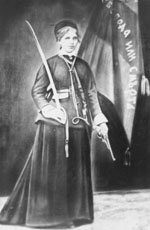
Raina Georgieva (full name Raina Popgeorgieva-Futekova ), also known as "Raina Princess" - a Bulgarian teacher from Panagyurishte , a participant in the April Uprising of 1876 [1] .
| Raina Georgieva | |
|---|---|
 | |
| Date of Birth | |
| Place of Birth | |
| Date of death | |
| Occupation | |
Content
Biography
She was born on January 6, 1856 [ January 18, 1856 ] in the family of priest George Tasov Futekov (an active participant in the development of public education and enlightenment in Bulgaria) and Nona Nalbantova [1] .
At the age of seven, she began studying at the Panagyurishte school (which at that time was led by Elizaveta Ivanova Kostova), after which she was sent to continue her studies at the five-year female gymnasium in Stara Zagora . She studied at the gymnasium at the expense of family and community funds (the community provided funds for training on the condition that after graduating from the gymnasium she will become a teacher in her hometown), in 1874 she graduated with honors from the gymnasium and returned to Panagyurishte and began teaching at the city school However, the community was forced to reduce teacher salaries to all teachers after the Turkish authorities (seeking to prevent the development of Bulgarian schools) increased taxes on citizens [1] .
At that time, Panagyurishte was one of the centers for preparing the all-Bulgarian uprising against the Ottoman Empire (a city with an eight-thousandth population was the organizational center of the 4th district of rebels, an underground revolutionary committee was operating here) [1] .
In 1875, Raina organized a charity women's society at a Panagyurian women's school, during which she met with the organizers and participants of the upcoming uprising [1] .
In the spring of 1876, on behalf of the head of the underground committee, Georgy Benkovsky, she sewed the banner of the rebels [1] .
On April 14, 1876, in Oborisht, at the spurs of Sredna Gora, at a meeting of leaders of the uprising in the Plovdiv district, a decision was approved to start the uprising on May 1, 1876 [2] , the later start of the uprising was postponed to May 11, 1876 , but as a result of the betrayal of the preparation of the speech, Turkish authorities are aware that the arrests began and on April 19, 1876, the uprising began ahead of time.
On April 20, 1876, the leaders of the uprising in Panagyurisht struck the alarm in the main square, the rebels successfully took power in the city, after which the formation of armed detachments began, it was decided to hold a military parade to inspire the townspeople. Initially, it was planned that the insurgent Kraicho Samohodov would become the standard bearer, but by coincidence, the rebel column with the banner was headed by Raina Georgieva [1] .
Who was the first to call the teacher "Raina Princess" (in honor of Princess Raina, daughter of Bulgarian Tsar Peter) is not reliably established, various versions are given in the testimonies of contemporaries and studies, but information that one of the leaders of the uprising is the Bulgarian Princess Raina quickly spread among population, became known to the Turkish authorities and beyond the borders of Bulgaria [1] .
After the uprising was suppressed, Raina's father was killed by the Turks, she herself was extradited to Hafuzu Pasha, arrested and subjected to interrogations and torture [1] .
From Plovdiv prison, Raina was taken to Pazardzhik , where she was interrogated by Hamid Pasha, a special commission was set up by the Turkish authorities to determine whether the person under investigation was a princess or an impostor, and also to receive information from her about the participants in the uprising and their supporters [1 ] .
The consuls of the European powers and foreign journalists in Filippopol met with the arrested woman, after which the Turks did not dare to execute the captive. The Russian consul actively acted in defense of the arrested, Raina was pardoned and sent to Panagyurishte, but due to the danger that threatened her here she was soon transferred to the Russian Empire [1] .
In October 1876, the Ladies' Department of the Moscow Slavic Committee addressed the Russian consul in Philippopol N. Gerov with a letter stating that he was ready to accept and raise 15 Bulgarian orphans. Later, at the expense of society, 27 orphans and one participant in the uprising, teacher Raina Georgieva from Panagyurishte, were placed and taken into custody in Moscow monasteries, institutes, boarding houses and private families [3] .
In Russia, Raina lived in the Passion Monastery in Moscow, here she graduated from obstetrics courses, participated in the arrangement of Bulgarian orphans who arrived with her, and participated in public life. Rayna came to Russia together with her brother Vasil, who graduated from a military school and became a Russian citizen (during the First World War in 1915, Colonel of the Russian Army Vasil Futekov died in the battle with the German troops in the Masurian Lakes region) [1] .
In 1877, her autobiography was published in Russia [1] .
After the end of the Russian-Turkish war of 1877-1878. and the liberation of Bulgaria - returned to Bulgaria, first taught at a three-year school for girls in the city of Tarnovo, in the summer of 1882 she moved to Panagyurishte, where she married Vasil Dipchev. The mother of five sons (Ivan, George, Vladimir, Peter and Asen), one of whom died in childhood, the rest became soldiers of the Bulgarian army [1] .
After the death of her husband in 1898, she worked as a midwife, and died on July 29, 1917 in Sofia [1] .
Memory, Reflection in Culture and Art
- house-museum "Raina Princess" in Panagyurishte
- Monument "Raina Princess" in Panagyurishte
- Bulgarian folk song "Raina Princess" [4]
Notes
- ↑ 1 2 3 4 5 6 7 8 9 10 11 12 13 14 15 Rosalia Ermolyeva. Legendary Raina // The Border Guard magazine, No. 3 (935), March 1981. p. 45-54
- ↑ April Uprising 1876 // Great Russian Encyclopedia / redkoll., Pred. Yu.S. Osipov. volume 2. M., Scientific publishing house "Big Russian Encyclopedia", 2005. p.129
- ↑ I. Kozmenko. Russian society and the April Bulgarian uprising of 1876 // “Questions of history”, No. 5, May 1947. pp. 95-108
- ↑ In Panagyurishte, 3000 souls flutter in one voice of “Raina Princess”
Literature
- Magda Petkanova. Raina Princess. Biographical sketch. Sofia, 1962. (bulg.)