“Arms and the Man” ( born Arms and the Man ) - a comedy by Bernard Shaw in three acts. Often put under the name " Chocolate Soldier " ( English Chocolate Cream Soldier ).
| Weapons and man | |
|---|---|
| Arms and the man | |
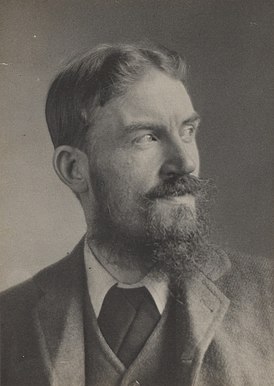 George Bernard Shaw in 1894 | |
| Genre | comedy |
| Author | Bernard Show |
| Original language | English |
| Date of writing | 1894 |
| Date of first publication | 1898 |
| Previous | " Mrs. Warren 's Profession " |
| Following | Candida |
“Arms and Man” opens a cycle of 4 plays (1894-1896), which the author ironically called “Pleasant Pieces” upon publication; the cycle includes, in addition to this, the play "Candida", "Chosen One of Fate", "Wait and See." The ideological basis of this play was Shaw's desire to expose a reality-distorting romantic attitude to life (and in particular the hypocritical romanticization of war). The show calls for opposing this worldview with rational realism, the “philosophy of reality”, only they are able to pose and solve real problems [1] [2] .
Bright, funny and witty comedy turned out to be the first play of the Show to win commercial success, and not only in the UK. With her begins the international reputation of the Show as a first-class comedian. Over the years, such outstanding actors as Laurence Olivier , Ralph Richardson , Marlon Brando , John Gilgood played in this play.
The play was twice filmed, there are also two operettas based on its motives. "Weapons and man" continues to be put in different countries and today. The Russian translation for the six-volume full collection of plays by the Show was performed by Polina Melkova .
Content
- 1 History of writing and staging
- 2 Textology
- 2.1 Actors
- 2.2 The plot
- 2.3 Ideological and artistic motives
- 2.4 Criticism
- 3 Films and adaptations
- 4 Performances in Russian and Soviet theaters
- 5 notes
- 6 Literature
- 7 References
History of writing and staging

In 1893, the famous actress temporarily led the London Avenue Theater and faced a shortage of repertoire. As a result, she commissioned several “new playwrights,” including her friend, 37-year-old Show, a popular comedy. By this time, Shaw had already gained (somewhat scandalous) fame for his series of "Bad Tricks" in the spirit of " Christian socialism ." In 1894, the Show presented to the theater the play “Weapons and Man” - an anti-war and anti-romantic comedy [3] .
The title of the play “Arms and Man” is taken from the beginning of Virgil ’s Aeneid : “ I Will Sing Arms and Husband ” ( lat. Arma virumque cano ); the classic quote, as Shaw often does, sounds like a mockery, since one of the goals of the play is to dispel romantic heroism [4] . The show was originally intended to portray a military conflict in a conditional country, but ultimately indicated the exact place and time of action: November 1885, the Serbo-Bulgarian War [5] . The show was very conscientious about details of a military nature, he studied eyewitness accounts, newspaper reports [6] . Many of the ethnographic details mentioned in the play are also authentic, including Bulgarian names and surnames; however, for the name Raina, Shaw indicated an inaccurate transcription of Rah-eena , that is, Raina (P. Melkova translated the correct spelling of the name), and the name Luka ( Louka ) Shaw took for the female [7] . The prototype of Raina, according to the show, was activist Annie Besant [8] .
In the performance of 1894, Florence Farr played the role of Luke's maid. The success of the audience was, according to Shaw, “promising,” at the premiere, the audience gave a standing ovation and called the author to the stage. There is a story that one of the viewers was dissatisfied and booed the appearance of the Show on stage, to which the latter calmly replied: “Dear friend, I completely agree with you, but what can we do - we are in the minority” [9] [3] .
The play was from April 21 to July 7, 1894, then repeatedly resumed, staged in many other theaters in the UK and beyond, including Russia. In New York, the lead role was played by [4]
Textology
Actors
The transcription of names is given by the translation of Polina Melkova .
- Captain Bluntshli is a Swiss mercenary. Calm, businesslike, alien to any romance, he believes that the main task of a soldier is not to accomplish a feat, but to survive himself [10] .
- Raina Petkoff is a romantically inclined 23-year-old Bulgarian girl.
- Sergey Saranov ( Sergius Saranoff ) - a young Bulgarian officer, fiance Raina.
- Major Pavel Petkoff ( Major Pavel Petkoff ) - Rayna's father, 50 years old.
- Katerina Petkova ( Catherine ) - mother Raina.
- Luka ( Louka ) - a young maid in the house Petkov, attractive, proud and ambitious.
- Nicola ( Nicola ) - an elderly servant in the house of Petkov.
- Russian officer ( the Russian officer ) - head of the Bulgarian patrol.
Story
The first act. A small Bulgarian town near the Bulgarian-Serbian border, there is a rich Petkov house in it, night, end of November 1885. Beauty Raina is worried about the fate of her fiancé Sergei, who is fighting nearby. Mother informs her that the Bulgarian army had just won the battle of Slivnitsa , and Sergey was the first to launch an attack without an order and boldly break through enemy batteries. The Serbs are scattered and hiding anywhere. Enthusiastic Raina remains alone. Suddenly a man in Serbian uniform bursts into the room through the balcony; at the same time, a patrol knocks on the door of the house, catching enemy soldiers. Raina is touched by the miserable look of the fugitive, hides him and escorts the patrolmen. The man introduces himself - he is an experienced soldier-mercenary, his revolver is not loaded, instead of cartridges he carries chocolate with him, because in battle they are more useful. The captain explains to Raina that Sergey’s cavalry dashing attack on the Serbs was suicidal madness, and it was successful only because the ammunition for the Serbian machine guns, as it turned out, was put in the wrong caliber. Raina is discouraged - what she considered heroism turned into stupidity and incompetence, the real war turned out to be completely different from her representation. The exhausted captain falls asleep. In the morning, Raina gives him his father’s frock coat, in his pocket he puts his photo with the inscription “To my chocolate soldier” and lets go.
The second act. March 1886 The war is over, peace is signed, the army is demobilized. The head of the family returns to the Petkov’s house, and Sergey comes. Raina and Sergei behave according to all the rules of romance, although Raina cannot forget the fugitive she saved, while Sergei likes not Raina, but the servant Luke. A captain, a former fugitive, appears, his name is Bluchly, he appeared on the pretext of Raina's return of a frock coat. Petkov recognizes Blyunchli - together they just engaged in an exchange of prisoners and became friends. Bluchly accepted as a guest.
The third act. The library in the house of Petkov. Blyunchli and Sergey work on documents, drawing up the details of the peace treaty. Then Sergey speaks with Luke, who incidentally reports that Bluntchly is not indifferent to Raina. Sergey challenges Bluntchley to a duel, when Raina finds out about this, accuses Sergey of courting Luka. The duel is canceled, romantic poses are discarded. Raina, unexpectedly for herself, after a conversation with Bluchly discovers that to be herself, without portraying the book heroine, is much easier. Sergey comes to the same conclusion and bitterly says: “Oh war, war! The dream of patriots and heroes! She is a hoax, Bluchly, as empty pretense as love. ” Having freed himself from romantic conventions, Sergey announces his engagement to Luke, and Blyunchli, after discovering a compromising photograph in his frock coat, confesses that he came to see Raina again and asks for her hand. Raina's parents hesitate, then Bluchly informs them that he inherited a large fortune in Switzerland; then all issues are resolved to the common pleasure.
Ideological and artistic motives
In the preface to The Pleasant Pieces, Bernard Shaw stated that he regarded romance as a “great heresy,” which should be treated with good-natured mockery or contempt, and which should be expelled from life and literature. In his opinion, radical romanticism inevitably leads to pessimism and despair. The protagonist of the play “Arms and Man” is practical and devoid of any idealism; he takes into battle not only cartridges, but also chocolates to reinforce forces [1] . Shaw maintained this position until the end of his life; for example, in the play St. John , he led Jeanne d'Arc to a smart sober girl, devoid of any raid of mysticism or romance.
Shaw understood the struggle of realism with romanticism as a struggle for the abolition of ingrained social prejudices, against the liberal idealization of the existing system and its policies. In the foreword above, he protested against the “fictitious morals and fictional decency” that the newspapers deceitfully paint as robberies, crimes, wars, cruelty, greed and other charms of civilization for progress, morality, religion, patriotism, the power of an empire and the greatness of a nation. The show stated [11] :
I see a lot of good in the world, and it is developing rapidly if idealists do not interfere ... From my point of view, the tragedy and comedy of life are caused by the terrible and sometimes ridiculous consequences of our persistent attempts to build all the principles on ideals prompted by our unfulfilled passions. and not on genuine scientific natural history.
English literary critic A. Ward ( AC Ward ) stated that both the serious and humorous components of this early comedy show are still as relevant as if they were written today. Ward identified two main themes of the play: war and marriage. These two topics are related by the fact that the presence of romantic illusions, the inability to see things realistically in both cases can lead to disastrous consequences - which is convincingly shown by Shaw [12] .
Criticism
Unlike the previous series (“Unpleasant plays”), this comedy does not affect acute social problems, and British critics reacted to it more peacefully. Some critics accused Shaw of ridiculing heroism and patriotism. The Prince of Wales, the future king Edward VII , called the show a slander against the military. The show immediately made an article entitled “A realist dramatist to his critics,” emphasizing that one should not confuse genuine reality with theatrically idealized reality, and genuine humanism is inseparable from realism: “War, as we know, entails romantic fantasy especially strongly.” The show cited Cervantes ’s novel Don Quixote as an example of a disappointing clash of romance with reality [4] [13] [14] ..
Another piece of critics regarded comedy as a bizarre farce. The show accused critics of the fact that for them, war is nothing more than a sport or a spectacle; He emphasized that he relied on the testimonies of regular military personnel and described military everyday life strictly realistically [15] .
Shaw himself evaluated this play in different ways, either claiming that his later plays are much better, sometimes calling it classical. In particular, in 1927 he said that only after the First World War did the British, “smelling gunpowder”, make sure that “Weapon and Man” is a classic and relevant play [3] .
Some Bulgarian critics expressed dissatisfaction with the fact that the play contains ironic remarks about the Bulgarian way of life (for example, Petkov’s phrase “permanent washing is harmful to health” from the second act or the statement that there is only one library in all of Bulgaria). The show explained that he did not want to insult the Bulgarians, this "nation of brave newcomers" had only just begun joining European civilization, so their attempts are at times clumsy and funny [16] .
George Orwell believed that “Arms and Man” is Shaw’s most witty, instructive and perfect { flawless } play, and its morality (the inadmissibility of wars) is still relevant today [17] .
Soviet critic Anna Romm called Shaw's comedy an intellectual drama and noted: “Blunchley’s flat and wingless rationalism is backed by the magnificent Voltaire rationalism of Bernard Shaw, a sage and philosopher who fought to preserve the natural, healthy principles of human nature. The comedy “Arms and Man” with its complex and original structure concealed the possibility of the emergence of art forms still unknown to the European theater ” [14] . Another critic, Pyotr Balashov, called “Weapons and Man” a comedy of the loss of romantic illusions [6] .
Films and adaptations
In 1930, Sergei Eisenstein received an offer from Paramount Pictures to co-shoot the film. Eisenstein suggested, as one of the options, the film adaptation of the play "Man and Weapon", but the studio rejected this offer [18] .
Subsequently, the play was repeatedly filmed.
- 1932 (Cecil Lewis, UK). The show itself wrote the script and added a number of new scenes [19] .
- 1958 (Germany, with Liselotta Pulver ).
- 1983 ( Film production , London, with Richard Bryers and Alice Krieg ).
- 1989 ( BBC Television , with Pip Torrens).
In 1909, at the request of Viennese librettists, the show allowed the creation of an operetta based on the play by setting the conditions: the original dialogs and character names will not be used in the operetta, and the libretto should be declared a comedy as a parody of the show in commercials. At the same time, Shaw refused the fee due to him as an author. Much to Shaw's indignation, these conditions were not met (there was only a replacement for the names of the characters), and in 1908 Oscar Strauss 's operetta Chocolate Soldier appeared, copying the play in many respects. The show never again allowed the adaptation of its comedies into musical performances; in particular, he did not allow Franz Legard to write an operetta based on the play Pygmalion [20] . In 1973, another musical based on the play was staged by Udo Jurgens in Vienna.
Performances in Russian and Soviet theaters
Source: [4] .
- 1905-1906: Petersburg Maly Theater .
- 1920: People’s House, Petrograd.
- 1923: Theater of the proletarian actor, led by N. Orbelov and M.V. Kastalskaya.
- 1936: Theater of Miniatures.
- 1966: Moscow Drama Theater named after A.S. Pushkin .
- 2014: Moscow Art Theater named after Gorky [21] .
- 2015: Maly Drama Theater (St. Petersburg) [22] .
Notes
- ↑ 1 2 Preface of the Show, 1978 , p. 320-323.
- ↑ Comments on the play, 1978 , p. 636-637.
- ↑ 1 2 3 Hesket Pearson, 1997 , Chapter “Art for the Artist”.
- ↑ 1 2 3 4 Comments on the play, 1978 , p. 638.
- ↑ Comments on the play, 1978 , p. 638-639.
- ↑ 1 2 Balashov P., 1982 , p. 119-120.
- ↑ Arms and the Man, 1976 , p. 16.
- ↑ Balashov P., 1982 , p. 122.
- ↑ Frezza, Daniel . About the Playwright: George Bernard Shaw
- ↑ Balashov P., 1982 , p. 121.
- ↑ Shaw Foreword, 1978 , p. 323.
- ↑ Introduction by AC Ward, 1976 , p. 95-96.
- ↑ On drama and theater, 1963 , p. 98-99.
- ↑ 1 2 Romm A.S., 1965 , p. 81.
- ↑ On drama and theater, 1963 , p. 108-109.
- ↑ On drama and theater, 1963 , p. 98.
- ↑ George Orwell . George Bernard Shaw, Chapter 8 // George Orwell . The Lost Writings, Edited by WJ West, Arbor House, New York, 1985. This also appears as Chapter 8 in Orwell, The War Broadcasts , Edited by W. J. West, The British Broadcasting Corporation, and The Old Piano Factory, London , 1985.
- ↑ Montagu, Ivor. With Eisenstein in Hollywood. - Berlin: Seven Seas Books, 1968 .-- P. 151.
- ↑ Balashov P., 1982 , p. 279.
- ↑ Ellwood Annaheim. Shaw's Folly - Straus' Fortune (English) (2002). Date of treatment July 15, 2016. Archived June 20, 2005.
- ↑ Valeria Babushkina. The Gorky Moscow Art Theater will show "The Chocolate Soldier" by Bernard Shaw . Date of treatment February 24, 2017.
- ↑ The Small Drama Theater presented the premiere of the performance “Chocolate Soldier” . Date of treatment February 24, 2017.
Literature
- Anikst A. A. , Nikolyukin A. N. Comments on the play “Arms and Man” // Bernard Shaw . A complete collection of plays in six volumes. - M .: Art, 1978. - T. 1. - 648 p.
- Balashov P. The art world of Bernard Shaw. - M .: Fiction, 1982. - 326 p.
- Denninghouse F. Theatrical vocation of Bernard Shaw. - M .: Progress, 1978.- 328 s.
- Pearson, Hesket. Bernard Show. - Rostov-on-Don: Phoenix, 1997 .-- 544 p. - (Mark on history). - ISBN 5-222-00176-8 .
- Romm A.S. George Bernard Shaw: 1856-1950. - M. — L .: Art, 1965. - 249 p. - (Classics of foreign drama).
- Hughes, Emrys. Bernard Show. - M .: Young Guard, 1968 .-- 288 p. - (The life of wonderful people).
- The show, Bernard. About drama and theater. - M .: Art, 1963.
- The show, Bernard. Preface to Pleasant Plays // Complete collection of plays in six volumes. - M .: Art, 1978. - T. 1. - S. 313—324.
- Shaw, Bernard. Arms and the Man. - Moscow: Progress Publishers, 1976. - 118 p.
- Ward AC Introduction to Arms and the Man // Shaw, Bernard . Arms and the Man. - Moscow: Progress Publishers, 1976. - P. 95-100.
Links
- Lowers James K., Marilynn O. Harper. "Arms and the Man" by George Bernard Shaw . Date of treatment February 28, 2017.
- McNabb, Jim. Arms and the Man by George Bernard Shaw: Study Guide . Ottawa: National Arts Center. Date of treatment February 28, 2017.
- Smith, Nicole. Arms and the Man by George Bernard Shaw: Class and Social Critique in the Play . Date of treatment February 28, 2017.