Myoko ( 妙 高 , named after a mountain in Niigata Prefecture ) is a Japanese cruiser [approx. 1] , the first mortgaged and third commissioned representative of the Myoko type .
| Myoko | |
|---|---|
| 妙 高 | |
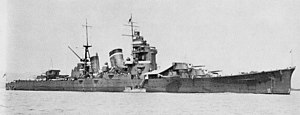 Heavy cruiser Meko in 1931 | |
| Service | |
 Japan Japan | |
| Named after | |
| Class and type of vessel | Myoko heavy cruiser |
| Organization | Imperial Navy of Japan |
| Manufacturer | Arsenal of the fleet, Yokosuka |
| Ordered to build | 1923 year |
| Construction started | October 25, 1924 |
| Launched | April 16, 1927 |
| Commissioned | July 31, 1929 |
| Status | Flooded June 8, 1946 |
| Main characteristics | |
| Displacement | standard / full Initially: 11 156/14 194 t [1] After the upgrade: 12 342/15 933 t [2] |
| Length | 201.74 m (waterline); 203.76 m (the largest, after modernization) |
| Width | 19.0 m (largest initially); 20.73 m (after modernization) |
| Draft | 6.23 m (original); 6.35 m (after modernization) |
| Reservation | Armor belt - 102 mm; deck - 32-35 mm; PTP - 58 mm; towers - 25 mm; |
| Engines | 4 ТЗА "Kampon", 12 Kampon Ro Go Boilers |
| Power | 130,000 liters with. (95.6 Mw ) |
| Mover | 4 propellers |
| Speed | 35.5 knots initially 33.3 after modernization |
| Sailing range | 7,000 nautical miles at 14 knots (effective, original) |
| Crew | 764 people initially; 970 after the second upgrade |
| Armament (Original) | |
| Artillery | 5 × 2 - 200 mm / 50 type 3 No. 1 |
| Flak | 6 × 1 120 mm / 45 type 10, 2 × 7.7 mm Lewis machine gun ; |
| Mine torpedo armament | 12 (4 × 3) - 610 mm TA type 12 (24 torpedoes type 8); |
| Aviation group | 1 catapult, up to 2 seaplanes |
| Armament (After modernization) | |
| Artillery | 5 × 2 - 203 mm / 50 type 3 No. 2 |
| Flak | 4 × 2 127 mm / 40 type 89 , 4 × 2 - 25 mm / 60 type 96 (up to 48 by the end of the war), 2 × 2 13.2 mm machine gun type 93 |
| Mine torpedo armament | 16 (4 × 4) - 610 mm TA type 92 (24 torpedoes type 93 ) |
| Aviation group | 2 catapults, up to 4 seaplanes |
Ordered among four cruisers of this type under the Taisho 12th Fleet Replenishment Program in 1923. Its construction in 1924-1928 was carried out by the Navy Arsenal in Yokosuka. For a number of reasons, the cruiser laid down by the head cruiser entered the penultimate system..
In the pre-war period, the cruiser, among other ships, passed through the center of the typhoon in September 1935, participated in the transfer of troops at the beginning of the Second Sino-Japanese War, and patrolled the coast of China. He successively underwent two major modernizations in 1931-1932 and 1940-1941. .
As part of the 5th cruiser division, Meko took an active part in the hostilities at the Pacific Theater of World War II , including the capture of the Philippines (it was damaged by a bomb on January 4, 1942), the Netherlands East Indies, and the battles in Coral sea , off the islands of Santa Cruz , in the bay of Empress Augusta and in the Philippine Sea . From the summer of 1943 to the summer of 1944, the cruiser successively passed three military modifications . During the battle in Leyte Gulf on October 24, 1944, the Myoko Sea was damaged by airborne torpedoes in the Sibuyan Sea, remained with two out of four efficient turbines, but eventually returned to Singapore. When moving to repair in Japan on December 13 of the same year, the cruiser was torpedoed by an American submarine Bergall, losing control and then losing a damaged aft end in a stormy sea. The seriously damaged ship was nevertheless towed to Singapore on December 25. The cruiser was no longer being restored and was used as a non-self-propelled anti-aircraft floating battery, after the end of the war in September 1945, it went to the British and was flooded by them on June 8, 1946 in the Strait of Mallaki .
Construction
An order to build the first pair of 10,000-ton cruisers worth 21.9 million yen under the Taisho 12 year replenishment program was issued in the spring of 1923 [3] . On December 10, 1923, cruiser No. 5 (the first in a pair) was given the name “Meko”, in honor of the mountain in the southeast of Niigata Prefecture . This name was used for the first time at the Nuclear Physics Institute , although earlier it was among the 8,000-ton ships of the 8-8 program reserved for naming [4] .
On October 25, 1924, the hull of the new cruiser was laid on the slipway No. 2 of the Navy Arsenal in Yokosuka , the first in the series [5] . The shipyard was previously severely damaged by the earthquake in 1923 , and the one-type “ Nati ” was built faster a month later at the shipyard in Kure . However, this lag was offset by the collapse on December 24, 1925 of two gantry cranes that delayed the Nati from the slipway for eight months [6] .
The Meko was launched on April 16, 1927 in the presence of Emperor Hirohito and 150,000 spectators. “Nati” was launched two months later, but its completion was afloat faster, since for Arsenal Yokosuki the most priority tasks were to rebuild the battleship “ Kaga ” into an aircraft carrier and modernize the battle cruiser “ Haruna ” [7] . On sea trials on April 15, 1929, at Tateyama with a displacement of 11,923 tons and a vehicle capacity of 131,763 liters. with. Myoko developed 35.225 nodes, which was slightly less than the project 35.5 [8] . On July 31 of the same year, the cruiser was adopted by the fleet third in the series, after Nati and Haguro . Nevertheless, the type was continued to be officially named after him [9] .
The visual difference between the type representatives was the number and location of the steam pipes on the first chimney. Myoko carried four of them: two in pairs on each side of the pipe [10] .
Service History
Prewar
After entering into operation on July 31, 1929, Meko was assigned to the Kure naval base. In November, all four ships of the Myoko type were credited to the 4th division of the Second Fleet cruisers (the flagship is Asigara , the Myoko was the third ship in the division with three marks on the front pipe) [11] .
From May 17 to June 19, 1930, Meko, along with the rest of the units included in the compound, sailed to the southern seas to test the operation of the systems in a tropical climate. In August, the numbering of ships inside the 4th Division was changed, now Meko became the second in it (two marks on pipes). On November 26, the division participated in a naval review in Yokosuka . At the end of the year, on Myoko, the first chimney was lengthened by 2 m to reduce the smoke of the bridge, and rain hoods were installed on both pipes. In December, the order of the ships in the formation was again changed - “Myoko” became the flagship of the formation (one mark on pipes) [11] .
From March 29 to the end of April 1931, the 4th Division, together with Furutaka and Aoba , operated in the Qingdao area, and participated in exercises in August and September. In November, the Myoko began work on replacing main-caliber guns with new type 3 No. 2, remodeling cellars and lifts for heavier ammunition, and improving ventilation. On August 4, 1932, during the annual naval maneuvers of the Myoko fleet, along with Nati, he participated in firing new type 91 armor-piercing shells at the Haikan No. 4 target ship (former Aso mine-layer, until 1905 - the Russian armored cruiser " Bayan "), then sunk by torpedoes of submarines [12] . In August, the order of the ships in the formation was changed again - Asigara became the flagship, Myoko got the fourth number (one large and one small mark on pipes) [13] .
On December 1, 1932, all 4 Myoko-class cruisers were put into reserve, their place in the 4th division was taken by the recently commissioned 4 Takao-class cruisers . On May 20, 1933, representatives of the Myoko type were transferred to the 5th Division (the cruisers of the Furutaka and Aoba types that were part of it were transferred to the 6th Division). For the period of the Special large maneuvers, they were withdrawn from the reserve (no marks were applied on the pipes), to participate in the maneuvers they went to sea on August 16, made a trip to the area of the southern seas, returned to Tokyo Bay on August 21 and participated in a sea parade four days later in yokohama . On December 11, in anticipation of the first major modernization, Meko, along with Nati, was given to the naval region of Kure, and from February 1, 1934 - to the naval region of Sasebo . Since November 15 of the same year, the cruiser was assigned to Sasebo’s naval base (instead of the Kure’s naval base); moreover, until its removal from the list, the home naval base did not change [11] .
The first stage of work on the Meko was carried out in the Sasebo Arsenal from November 20, 1934 to March 31, 1935 (this upgrade was the first of four ships of its type). In the course of work, old anti-aircraft guns, fixed torpedo tubes and a catapult with aircraft hangar were dismantled (new ones were installed instead: 4 × 2 127 mm / 40 type 89, 2 × 4 TA type 92 model 1, 2 × type No. 2 model 3 ), the first tier of the superstructure was extended to the 4th tower of the Civil Code (forming a new anti-aircraft deck), the old anti-torpedo boules were replaced by larger ones, instead of unreliable cruising electric motors, induction turbines were installed, additional rooms for the increased crew were placed on the middle deck [14] . After leaving the repair, the cruiser returned to the squad of ships of the naval area of Sasebo. Then, from mid-July to October 2, he participated in annual maneuvers (for their period, "Myoko", "Nati" and "Haguro" were reduced to the 3rd division), passing on September 26 along with other units of the Fourth Fleet through the center typhoon . At the same time, Myoko suffered damage to the superstructure, but the signs of insufficient longitudinal strength were the loss of rivets in several places and the flooding of some compartments. In October, Myoko, along with other representatives of the type, went through the second stage of modernization work at the Sasebo Arsenal, receiving new searchlights and two quadruple 13.2-mm machine guns, while the type 91 SUAZO and Lewis machine guns were also moving [15] . The third stage was carried out there in January-March 1936 as a result of investigations into incidents with the Fourth Fleet and an explosion in the Asigar cruiser’s tower: weaknesses in the hull were reinforced with 25-mm plates, and the system for purging the gun barrel of the main guns after the shot was fired [16] .
On April 1, Myoko returned to the 5th Division along with Nati and Haguro (flagship, one mark on the front pipe). Since April 4, the 5th division conducted exercises in the Terasima Strait, on April 13th went to the Yellow Sea, where in the Qingdao region fired jointly in the 7th division, and returned to Sasebo on April 22nd [17] . Finally, from May 25 to June 29, Myoko, along with Nati and Haguro, passed the fourth stage of work in Sasebo, during which they installed a more powerful drive of the cargo boom on the main mast, and its supports were strengthened. In August-September, a cruiser in the 5th division participated in the annual maneuvers of the fleet, making a trip to the Taiwan area [18] .
From March 27 to April 6, 1937, Myoko, along with Nati and Haguro, made a short trip to Qingdao and back. After the outbreak of the Second Sino-Japanese War, all four cruisers of the Myoko, May type, and the 2nd destroyer squadron participated in the transfer to Shanghai of the 3rd Infantry Division of the NIA on August 20-23 [19] . On July 28, Myoko was transferred to the 9th division of the Third (Chinese) fleet and became its flagship. Based in the ports of Taiwan, from September 1, 1937 to October 15, 1939, he made a total of 23 trips to the coast of South China, including five in 1937, twelve in 1938 and six in 1939. The subordination of the 9th division changed: from October 20 to December 1, 1937, it was part of the Fourth Fleet, then returned to the Third Fleet and, finally, from February 1, 1938 it became part of the Fifth Fleet. On November 25, 1939, Myoko was withdrawn to the reserve of the third category and from November 28 stood up in joke in Sasebo in anticipation of modernization [20] .
The second major modernization of the cruiser took place at the Kure Navy Arsenal from March 19, 1940 to April 18, 1941 - the last among representatives of its type, since the shipyard was loaded with the replacement of gun turrets on the Mogami and Kumano cruisers [21] . The modernization consisted in the installation of a second pair of torpedo tubes, four twin Type 96 anti-aircraft guns and two twin Type 93 machine guns (the four were removed), the catapults were replaced with the new Type 2 Model 5, the bullets were replaced with improved ones, the fire control devices were installed the same as earlier on Asigaru. Also equipped with a torpedo fire control post on the foremast, a central communication post, an encryption room and a centralized post for controlling the flooding and drainage of the compartments. Since the modernization was completed already in the pre-war environment, in its process a demagnetizing winding of the case was also installed and hermetic steel tubes were loaded into the protruding parts of the boules [22] .
April 10, 1941 "Myoko" returned to the 5th division, becoming its flagship (one white mark on the rear pipe). He spent the summer doing combat training off his shores; in early September he was docked in Sasebo [20] . From November 17 to 23, ships of the 5th division took stockpiles of ammunition, fuel and supplies in Kure. “Myoko” together with “Haguro” went to sea on November 26 and arrived on the Palau Islands on December 1 [23] .
World War II
After the outbreak of war, the 5th division consisting of Meko (Rear Admiral Takagi's flag), Nati and Haguro ensured Operation M — the capture of the southern Philippines . On December 11, cruisers covered the landing at Legazpi , 19-20 - at Davao , 24 - on the island of Holo . On January 4, 1942, the 5th division, along with the cruisers Nagara, Naka, Dzintsu, and the Mizuho hydro-carrier, was anchored in Maladag Bay in the western part of Davao Bay when it was attacked by eight B- bombers at 11:55 17D from the 19th US Army Air Force Bomber Group. Each of the aircraft carried four 600-pound ( 272 kg ) bombs, several of which fell near the sides, and one at 12:01 hit the Meko in the bow, on the left side of the GK-2 tower. The bomb broke through the upper deck and exploded in the gap between it and the middle deck, where the officer’s cabins were located, causing great damage there. The explosion tore the heat shields from the tower of the GK No. 2, light rangefinders on it and the nose superstructure also received minor damage from the fragments. A total of 35 people died and 29 were injured, including 10 - seriously. Admiral Takagi with headquarters switched to Nati, and Myoko, after an emergency repair of the damage, went to Sasebo, where he arrived on January 9. After repairs and docking, he went to sea on February 20, accompanied by the destroyer Inazuma , and on February 26 arrived in Makassar [24] [25] .
Second Battle of the Java Sea
On the same day, February 26, Meko, along with Asigara and the destroyers Inazuma, Ikazuti and Akebono left Makassar and headed for Java. On March 1, at 11:03, while patrolling in the area 90 miles west of Bavean from the cruisers Nati and Haguro, the remnants of the ABDA fleet from the heavy cruiser Exeter and two (originally seen one) destroyers were discovered. Since they shot most of the ammunition on February 27-28, the suitable Meko and Asigara should play a decisive role in the new battle. Between 11:17 and 11:28 two seaplanes were lifted for additional reconnaissance purposes. The enemy by this time changed course to the north, and then east, exposing smokescreens. Both groups of Japanese cruisers chased him, converging ticks from the north and south [26] .
At 11:50, with the removal of 23,500 meters, Meko and Asigara opened fire on the ABDA fleet, starting the second battle in the Java Sea . At 12:45 they were joined by the other two cruisers of the 5th division. At 12:50 a 203-mm shell exploded in the Exeter boiler room, disabling 4 of 5 serviceable boilers and interrupting the main steam line. The ship de-energized and left by the crew at 13:30 was finished off by two torpedoes from the Inazuma. After the Exeter, the 5th Division concentrated fire on destroyers. At 13:05, a direct hit from the Myoko or Asigara disrupted the Incanter destroyer’s power plant and was flooded by the team at 13:35 due to the threat of capture. The damaged Pope was able to get out of the battle, but in the afternoon it was sunk by aircraft from the Ryujo aircraft carrier [27] [28] . "Myoko" and "Asigara" in total for the battle fired 1171 203-mm projectile and 8 oxygen torpedoes type 93, the latter - all by. On March 5, both cruisers returned to Makassar [29] .
On the same day, Myoko again became the flagship of the 5th Division, which now consisted only of him and the Haguro. On March 13, both cruisers left Makassar and a week later arrived in Sasebo, where they got up for repairs. During the repair, the shot barrels of the GK guns were replaced, type 95 spotters were replaced with type 0, and ventilation was also improved. At the stern there were placed two gutters for dropping depth charges, the ammunition load of the latter was up to 12 pieces [30] .
On April 8, Myoko left Sasebo with Haguro and arrived in Hashirajima the next day. On April 18, both cruisers intercepted an American aircraft carrier connection in connection with the Doolittle raid , did not succeed, and returned to Yokosuka on April 22. After refueling, from April 23 to 27, the cruisers switched to Truk . On May 1, the 5th division went to sea as part of the Mobile Corps to participate in Operation MO, and on May 6–7 participated in the battle in the Coral Sea , entering the Air Defense Order of the 5th division of aircraft carriers . On May 13, Myoko, Haguro, and the destroyers Ariake, Shiratsuy, and Sigure acted as cover during the operation to seize the islands of Nauru and Ocean (canceled due to the threat of American carrier-based air raids); Truk, where the destroyer Yugure joined, and on May 22 arrived in Kure [31] [25] .
As part of Operation MI , the 5th Division, along with the 1st Division of the 4th Division (Atago and Chokai), left Hashirajima on May 29, heading for Midway, the landing of which was scheduled for June 7. On June 5–7, all four cruisers marched toward the American compound in the hope of a successful night battle. After the cancellation of Operation MI, the 5th Division was assigned to the Northern Union. 23 июня «Мёко» зашёл в Сэндай , после пополнения припасов и дозаправки он вышел в море 28 июня и вместе с «Хагуро» поддерживал высадку на Атту и Кыске (операция « АЛ »). В районе Алеутских островов 5-я дивизия находилась до 7 июля и 12-го вернулась в Хасирадзиму [32] .
В связи с высадкой американцев на Гуадалканале 11 августа «Мёко» вместе с «Хагуро» и 4-й дивизией («Атаго», «Такао», «Мая») покинул Хасирадзиму и 17 августа прибыл на Трук. 20 августа в составе соединения вице-адмирала Кондо он вышел в море для проведения операции «КА». Корабли должны были провести ночной бой с американским авианосным соединением в ночь с 24 на 25 августа сразу после сражения у Восточных Соломоновых островов , но не смогли найти противника и 5 сентября вернулись на Трук. 9 сентября соединение Кондо вновь вышло в море, патрулируя район северных Соломоновых островов. 14 сентября корабли были атакованы десятью бомбардировщиками B-17E из 11-й бомбардировочной группы, на «Мёко» при этом от близкого разрыва бомбы была легко повреждена одна 25-мм установка в центральной части корпуса. С 15 по 17 сентября корабли дозаправились в море, 20 сентября легли на обратный курс и 23-го вернулись на Трук [33] .
11 октября «Мёко» в составе соединения Кондо покинул Трук с целью обстрела аэродрома Хендерсон-филд на Гуадалканале. В первую ночь по нему отстрелялись «Конго» и «Харуна», во вторую «Тёкай» и « Кинугаса », в третью, с 15 на 16 октября — «Мая» и «Мёко». «Мёко» выпустил по цели всего 462 203-мм снарядов тип 3 и тип 91. 17 и 18 октября соединение Кондо дозаправилось в море и 26 октября в сражении у у Санта-Крус играло роль прикрытия сил Нагумо в ожидании ночного боя, который не состоялся. 27 октября соединения встретились и три дня спустя прибыли на Трук. С 4 по 10 ноября «Мёко» вместе с авианосцем « Дзуйкаку » и эсминцем «Токицукадзэ» перешёл в Сасэбо и встал там на ремонт [34] [25] . С 11 по 24 ноября он прошёл докование в Арсенале Сасэбо. Параллельно с этим сменился командующий дивизией — с 10 ноября ей командовал контр-адмирал Сэнтаро Омори [35] .
27 ноября 5-я дивизия в составе «Мёко» и «Хагуро» покинули Сасэбо и 29-го прибыли в Йокосуку, где крейсера приняли на борт солдат 6-го батальона морской пехоты ВМБ Курэ. С 30 ноября по 8 декабря они перевезли солдат в Рабаул и 10 декабря бросили якорь на Труке. С 31 января по 9 февраля 1943 года 5-я и 4-я дивизии обеспечивали прикрытие эвакуации японских войск с Гуадалканала (операция « КЭ »), патрулируя северную часть Соломонова архипелага . Следующие три месяца до мая они провели на Труке в состоянии готовности [36] .
8 мая 1943 года 5-я дивизия вместе с линкором « Ямато » покинула Трук и 13 мая прибыла в Йокосуку. Через два дня, 15 мая, оба крейсера в связи с высадкой американцев на Атту были приданы Северному соединению и отправились на Парамусиро , где провели с 19 мая по 12 июня. 16 июня корабли прибыли в Сасэбо, встав на ремонт в его арсенале. На «Мёко» работы продлились до 18 июля, докование он прошёл с 1 по 13 июля. В ходе ремонта крейсер прошёл первую военную модернизацию: добавили ещё четыре спаренных 25-мм автомата (по бокам грот-мачты и на мостик, пулемёты тип 93 при этом сняли), доведя число стволов до 16, на площадку фок-мачты вместо гониометра установили радиолокатор обнаружения воздушных целей № 21 второй модификации, способный засечь одиночный самолёт с дальности в 70 км , а их группу — со 100 км . 18 июля 5-я дивизия покинула Сасэбо и на следующий день прибыла в Хасирадзиму. С 30 по 31 июля она перешла в Нагахаму, где корабли взяли на борт солдат Японской императорской армии и грузы, и отправилась в Рабаул, куда прибыла 9 августа, с промежуточным заходом на Трук 5—6 августа. Разгрузившись, оба крейсера в тот же день отправились на Трук, достигнув его 10 августа. 18 сентября «Мёко» и «Хагуро» выходили в море на перехват рейда американского авианосного соединения, с промежуточной стоянкой 20—23 сентября на атолл Эниветок , но снова не достигли успеха и 25 сентября вернулись на Трук [37]
9 октября 5-я дивизия была придана Флоту юго-западного района и через два дня в сопровождении эсминцев «Наганами» и «Судзукадзэ» покинула Трук, сопровождая конвой. 13 октября крейсера прибыли в Рабаул и до конца месяца находились там в готовности. В связи с высадкой американцев на Бугенвиле 5-я дивизия 1 ноября в 15:20 вышла в море в составе соединения контр-адмирала Омори, включавшего также крейсера « Сэндай », « Агано » и 6 эсминцев (на 4 из которых находилось 1100 солдат). В ходе ночного боя в заливе Императрицы Августы 2 ноября «Мёко» был повреждён при столкновении с эсминцем «Хацукадзэ» (помят форштевень и левый борт на уровне средней палубы, снесено два торпедных аппарата), непосредственно боевых повреждений при этом не получив. Утром того же дня «Мёко» и «Хагуро» вернулись в Рабаул и попали под налёт B-25 ВВС армии США , но не пострадали. С 4 по 7 ноября они перешли на Трук, избежав последующих налётов, а с 12 по 17 ноября совершили переход с сопровождении эсминцев «Сигурэ» и «Сирацую» в Сасэбо, где встали на ремонт. Почти весь период ремонта, с 18 ноября по 13 декабря, «Мёко» провёл в сухом доке Арсенала Сасэбо, пройдя вторую военную модернизацию: установлены 8 одиночных 25-мм автоматов (число стволов достигло 24), радиолокатор обнаружения надводных целей № 22 4-й модификации (дальность обнаружения эсминца — 17 км , крейсера — 20, линкора — 35), для улучшения герметичности корпуса все иллюминаторы на нижней палубе и часть на средней заделывались путём приваривания на их место круглых стальных заглушек. В период ремонта 25 ноября контр-адмирала Омори на должности командующего 5-й дивизией сменил контр-адмирал Сэнтаро Хасимото [38] [25] .
16 декабря «Мёко» и «Хагуро» покинули Сасэбо и на следующий день прибыли в Курэ. С 23 по 29 декабря они вместе с крейсером «Тонэ» перешли на Трук. С 2 по 5 января все три крейсера в сопровождении эсминцев «Фудзинами» и «Сирацую» совершили поход с грузом до Кавиенга и обратно, затем до начала февраля находились в готовности на Труке [39] [25] .
10 февраля 1944 года, непосредственно перед рейдом американского авианосного соединения, 5-я дивизия вместе с 4-й дивизией («Атаго» и «Тёкай») и 17-м дивизионом эсминцев покинула Трук. В 21:00 соединение атаковала американская подводная лодка «Пермит», выпустившая по крейсерам 4 торпеды, но все мимо. 13 февраля корабли прибыли на Палау, где находились в готовности до конца первой декады марта. 1 марта шесть крейсеров 5-й и 4-й дивизий были приданы Первому мобильному флоту. С 9 по 22 марта «Мёко» и «Хагуро» сопровождали танкеры «Осэ» и «Иро» с стоянкой в Баликпапане 12 и 13 марта и Таракане 14—20 марта. С 29 марта по 1 апреля 5-я и 4-я дивизии, крейсер « Носиро » и эсминец «Харусамэ» перешли из Палау в Давао . По прибытию «Мёко» пополнил запасы провизии с транспорта «Китаками-мару». С 4 по 9 апреля соединение совершило переход из Давао в Лингу, по пути 6 апреля его атаковала американская подводная лодка «Дэйс», выпустившая шесть торпед (все мимо), другая подлодка, « Дартер », обнаружила японские корабли, но не смогла выйти на позицию для торпедной стрельбы. 12 мая 5-я дивизия покинула Лингу и 15-го прибыла в Тави-Тави, затем отправилась в Таракан для дозаправки и 18 мая вернулась назад в Тави-Тави [40] [25] .
30 мая, в связи с высадкой американцев на остров Биак , 5-я дивизия вместе с линкором « Фусо » и шесть эсминцами покинула базу, имея целью прикрытие конвоя до места высадки (операция «КОН»). 31 мая соединение прибыло в Давао и 2 июня направилось с конвоем в Биак. Однако в связи с обнаружением конвоя подлодками и воздушной разведкой операция «КОН» 3 июня была отменена, и 5 июня корабли вернулись в Давао. 7 июня 5-я дивизия вместе с эсминцами «Асагумо» и «Кадзагумо» покинула Давао для прикрытия нового конвоя до Биака (операция «КОН» № 3) и 11-го прибыла на остров Бачан ; на переходе «Мёко» 8 июня дозаправился с танкера «Нитиэй-мару». Выход конвоя был намечен на 15 июня, однако более приоритетным оказалось осуществление операции «А-Го» в связи с началом американской операции по захвату Марианских островов . 13 июня 5-я дивизия покинула Бачан и вместе с 1-й дивизией («Ямато» и «Мусаси») присоединилась к Первому мобильному соединению; 16 и 17 июня корабли дозаправились в море. В ходе сражения в Филиппинском море 19—20 июня 5-я дивизия была частью тактической группы «А» вице-адмирала Одзава вместе с 1-й дивизией авианосцев (« Тайхо », «Дзуйкаку», « Сёкаку ») и 10-й эскадры эсминцев, входя в ордер ПВО авианосцев. После сражения не получившие повреждений крейсера 22 июня прибыли на Окинаву, а 23—24 июня перешли в Курэ для ремонта. В ходе ремонта, продолжавшегося до 29 июня, «Мёко» прошёл третью военную модернизацию: установлены ещё 16 одиночных и 4 строенных 25-мм автомата (общее число стволов — 52), увеличен боекомплект 25-мм снарядов до 2200 на ствол, на фок-мачте размещён дополнительная РЛС обнаружения воздушных целей № 13, в верхней части носовой надстройки — РЛС обнаружения надводных целей № 22 модель 4 [41] [25] .
30 июня 5-я дивизия покинула Курэ, 1 июля зашла в Хасирадзиму, где взяла на борт солдат ЯИА и грузы, 4 июля выгрузила их в Маниле, 8-го зашла в Замбоангу и 12-го прибыла в Сингапур. 13 июля «Мёко» в одиночку перешёл в Лингу, 31 июля к нему присоединился «Хагуро». На этой базе крейсера простояли в общей сложности три месяца, до второй декады октября, занимаясь боевой подготовкой. В этот период установленная в июне РЛС № 22 4-й модификации модернизировалась с установкой супергетеродинного приёмника и позволяла после этого управлять артиллерийским огнём, ставшие ненужными визиры слежения за целью тип 92 сняли, была демонтирована и задняя пара торпедных аппаратов, не имевшая системы быстрой перезарядки [42] .
Сражение в заливе Лейте и последующие действия
On October 18, 1944, at 01:00, the 5th Division (Myoko and Haguro), as part of the First Raid Combat of Vice Admiral Kurita, left Lingu to carry out Operation Sho-Go . On October 20, the ships arrived in Brunei and two days later again went to sea, heading for the Strait of San Bernandino [43] . On October 24, during a battle in the Sibuyan Sea , east of the island of Maestre de Campo, at 10:29 a cruiser was hit on the starboard side of a 569-mm Mk 13 aircraft torpedo with 262 kg of explosives dropped by a torpedo bomber TBM-1C Avenger from the 18 1st torpedo-squadron from the aircraft carrier " Intrepid " [approx. 2] . The torpedo hit between 248 and 250 frames, and as a result of its explosion, engine room No. 4 and the aft compartment of the generators were flooded. Both starboard valleines were also damaged and the maximum speed dropped to 15 knots. Vice Admiral Hashimoto moved his flag to Haguro, and Myoko was sent back to Brunei, accompanied by the destroyer Kisinami, where he arrived safely on October 29, with an intermediate stop on October 27 at Koron Bay. From October 30 to November 3, "Myoko" together with "Haguro", "Kisinami" and minesweeper No. 34 moved from Brunei to Singapore [44] [25] .
The cruiser underwent emergency repairs at the ship repair plant at the Seletar naval base in Singapore, but it was not possible to completely repair the damage with its forces - repairs were needed in Japan. The transition was planned to begin on December 9, but it was postponed for three days. At 07:00 on December 12, the Myoko, accompanied by the destroyer Usio, left Singapore, heading for the Inland Sea, with an intermediate call to Kamran . The cruiser at the transition could issue 16 knots, the destroyer damaged on November 13 in Manila on the service port of the left side - 18. On the 12th and the day of December 13, the transition went along the intended route, but the radio was filled with alarming messages about the American landing fleet discovered in the Sulu Sea, which the Japanese mistakenly thought were heading for Luzon (in fact, he was going to Mindoro ). In connection with this, Vice Admiral Sim left Lingoux and headed to Cap Saint-Jacques , from where he was supposed to oppose the enemy. No new orders were received by Meko and Usio, but they were considered to be possible that the cruiser, which had retained limited combat effectiveness, would be involved in the operation after arriving in Kamran [45] .
At the same time, at 4:30 p.m. on December 5, an American submarine "Ballall" type " Balao " (commander - captain 2nd rank John Milton Hyde) left the base in Exmouth Bay in Western Australia. Together with the Day, she was supposed to put up a minefield on the Royalist bank off the east coast of Indochina. The route to the banks ran through the Lombok Strait , the Flores Sea , the Java Sea and the Karimat Strait, skirting Java from the east. On December 11, during a planned inspection of torpedoes, a leak of compressed air was found in the torpedoes charged in TAs No. 5 and 6 - in the first case, the torpedo was left in the vehicle, in the second it was removed. Bergall and Japanese compound courses converged at Royalist Bank [45] .
On the evening of December 13, a strong radio signal was heard on the Bergall, drowning out the submarine's radio station. Then, at 5:55 p.m. through a survey through periscope No. 2, its source was also discovered - going to the northeast by a 14-junction passage 32 km to the east a warship. Hyde and First-Time Jervis decided to catch up. The Bergall began to approach her at full speed, but due to strong vibration at 18:45 the speed was reduced to 18 knots. At 19:20, the distance to the target decreased to 24 km , by 20:30 it was already clearly visible in the periscope and was identified as a heavy cruiser of the Atago or Tone types with light accompanying it on the starboard side (on the opposite side of the submarine) cruiser. “Bergall” could attack only in the surface position due to shallow depths and only with bow devices - the fodder was occupied by mines. However, Hyde, seeing the value of the target, decided to take a chance and go to the torpedo shooting position, using the darkening western sky as a cover and hoping that the cruiser’s locator, which is switched on at large intervals, will not detect the boat. At 21:35, the heavy cruiser blocked the ship accompanying him for the submarine with his hull, which meant an ideal moment for an attack. Two minutes later, at 21:37, from a range of 3 km , the Bergall launched six Mk 14 torpedoes (including the one in which there was a leak) from a nasal vehicle along the cruiser, mounted to a depth of 1.8 m [45] .
At 9:40 p.m., one (possibly two) of the torpedoes fired hit the Meko at the rear end with 325 frames on the port side. This caused an explosion of fuel vapor in the feed tanks, severely damaging the feed and causing a strong subsequent fire. In addition, the steering wheel and three of the four propellers were demolished - although the cruiser could give a move on the remaining outboard propeller of the port side, but it was no longer controlled. In general, the damage was heavier than October 24, although starting from the area of the fifth tower of the Civil Code and further to the nose, the hull remained completely intact. At the Bergall, however, two consecutive explosions with an eight-second interval were interpreted as practically guaranteed the sinking of the heavy cruiser (“seeing” a torn stern visually and on the radar - perhaps it had a piece of skin along with the steering wheel — and greatly exaggerating the extent of the fire at the stern) and damage to the ship accompanying him, especially since he also stopped. However, the latter was a ruse - the commander of "Usio" (who was the "light cruiser"), captain of the 2nd rank Araki decided to bring the submarine closer in order to shoot for sure. At 22:00, when the distance was reduced to 2.7 km , the destroyer opened fire on the “Bergall” from the bow of the 127-mm installation, making three volleys in total, then the target was lost by a searchlight. The shell from the first salvo hit the submarine and pierced its solid hull, without exploding, but forcing its commander to leave the battle under cover of night. "Usio" did not pursue the "Bergall", because he could not leave the cruiser damaged and deprived of the ability to be controlled. In the end, after 12 days in a surface position, avoiding all patrol aircraft and submarine hunters, the submarine arrived at Fremantle base at noon on December 25 [46] [45] .
After examining the scale of the damage, the commander of the Meko 1st-rank captain Ishiwara asked Araki if the Usoo could tow his ship. The answer was unambiguously negative due to the insufficient capacity of a healthy TZA on the port side of the destroyer. However, Ishiwara did not agree with this, since with the help of the remaining outboard propeller of the port side “Myoko” in theory it could give out 6 knots, “Usio” needed only to correct its course, and therefore the situation was not hopeless and did not require urgent abandonment of the ship team. Araki agreed with his arguments, and the next two days, December 14 and 15, the destroyer pulled the cruiser through the stormy sea to Cap Saint-Jacques. By December 15, the fires at the Myoko stern were finally extinguished and the requested assistance arrived - two minesweepers and two auxiliary hunters for the Kayko-maru and Tatebe-maru submarines. The latter began towing the Myoko on the tow rope at a speed of 5 knots, replacing the destroyer. At 08:15 on December 16, Japanese ships were located south of Cap Saint-Jacques, and Usio was released to join the XI-82 convoy in Saigon, whose exit to the metropolis was scheduled for the next day. The weather was getting worse, the forecast did not promise its improvement, and by noon an order was received to tow the Meko back to Singapore and expect reinforcements to arrive soon. At 11:00, the 2nd destroyer squadron received an order from the Fleet headquarters in the southwestern region to prepare the Oedo cruiser and the Kasumi and Hatsushimo destroyers for help. In Singapore, the commander of the 5th Division, Vice Admiral Hashimoto, at 14:30 ordered his flagship Haguro to leave the dock, load all supplies and go to sea on December 18, where he was to be accompanied by the Tiburi kaibokan . At Myoko, however, the situation became desperate due to weather - at 05:10 on December 17, under the impact of the waves, 325 frames completely separated and the damaged aft end sank. Towing speed had to be reduced to 2.5 knots. In connection with this and Hashimoto’s request, the destroyers “Kasumi” and “Hatsushimo” at 23:00 left the tanker “Nitiey-maru” going to Cap Saint-Jacques and went with the help of “Myoko” [45] .
At the same time, the Fleet headquarters in the southwestern region was planning a raid operation against the American bridgehead in the San Jose area on Mindoro. Initially, it was planned to single out only the 43rd destroyer division, which was supposed to approach the landing area on the night of the 15th, however, the condition of materiel and fuel supplies did not allow this task to be completed. The main hopes then began to be assigned to the Fifth Fleet of Vice Admiral Sima, however, it was not immediately possible to assemble it for the campaign, as a number of ships were allocated to help Meko. On the morning of December 17, in connection with the flight of the American reconnaissance aircraft, Sima's second raiding force left Kamran and arrived at Cap-Saint-Jacques at 3:00 p.m. the next day, where he was joined by the Nityey-maru tanker. Due to the announced threat of a raid at 15:30, the ships of Sima went to sea again and headed to Saigon [45] .
Almost simultaneously, Kasumi and Hatsushimo met with Myoko, but because of the same threat of a raid, they were around him in an air defense warrant for two hours. Then, “Kasumi” took up a position from the shore and at 17:33 began towing the cruiser on a cable connected to the anchor chains of the latter, “Hatsushimo” was more steep. The storm continued at sea, and at 02:38 on December 18 the cable burst. With Kasumi, they tried again to tow the Myoko, while the Hatsushimo was searching for enemy submarines. At 10:50 on December 19, Haguro and Tiburi arrived from Singapore, but even because of the storm they could not take the cruiser in tow. At noon on December 20, Kasumi departed for Cap-Saint-Jacques to head the 2nd EEM in a raid on Mindoro. The rush was due to the fact that the aircraft carrier “ Unryu ” allocated for the operation was torpedoed and died the day before, and it became clear that there was no sense in postponing it anymore, as well as the fact that there would be no air cover anymore [ 45] .
On December 21, the destroyer Tidori arrived to replace the Kasumi. At 9:00 on December 23, the weather improved so much that the Haguro was able to take the Meko in tow, and finally, at 02:38 on December 25 the ships arrived in Singapore - the seven-day trip of the damaged cruiser in tow was over. With the help of the shipyard in Singapore, the remains of the destroyed stern were removed to the fifth tower of the GK, and the transverse bulkhead in front of it was strengthened, playing the role of aft inspection, but there was nothing more complicated. The raid on Mindoro by the forces of the Shima ships (Operation Ray) took place only on December 26-27, when the American bridgehead was already strengthened there, nominally becoming the last successful operation of the Japanese fleet in World War II [45] .
| "Myoko" at the joke in the naval base Seletar after surrender | |||||||||
| |||||||||
Due to the impossibility of moving to the Myoko metropolis, like the damaged Takao, in January it began to be used as a non-self-propelled floating anti-aircraft battery to protect the Naval Aviation Base Seletar from raids. On January 20, 1945, both cruisers were withdrawn from the 5th division and reassigned directly to the First Southern Expeditionary Fleet (the latter was in turn part of the Fleet of the southwestern region, and from February 5, it was part of the Fleet of the 10th region). On February 1, 113 B-29 bombers from Tinian hit Seletar, and there were close bomb explosions in the area of the Myoko stern. In early February, the cruiser was docked in the dry dock of King George VI [47] [25] .
On July 31, 1945, as part of Operation Straggle, the British ultra-small submarines XE-1 and XE-3 were to destroy the Myoko and Takao, placing subversive charges at their bottom. However, XE-1 (commander-captain-lieutenant Jack Smart) was discovered by a Japanese patrol ship and could not complete its task, while XE-3 partially completed it, resulting in additional damage to Takao. After the surrender of Japan on September 21, both cruisers were surrendered by the British military who arrived in Singapore and were used by them as non-self-propelled floating barracks / floating bases until the spring of 1946. Then the British leadership decided to flood the former Japanese ships in the Strait of Malacca near Port Sweittenham at a depth of at least 150 meters. On July 2, the Myoko left Seletar in tow of the Naval Forces and at 03:10 on July 8 it was flooded at a point with coordinates On August 10, he was removed from the lists of the Japanese fleet. On October 29, Takao was flooded almost in the same place. Ironically, the two cruisers, built one after the other on the slipway No. 2 of the Yokosuki Arsenal, many years later also sequentially ended up next to each other on the seabed [48] .
Commanders
- 12/10/1928 - 11/11/1929 Captain 1st rank (taisa) Takuo Fujisawa ( Japanese я 沢 宅 雄 ) [25] ;
- 11.11.1929 - 11.10.1929 captain of the 1st rank (taisa) Yoshiyuki Niiyama ( Japanese 新 山 良 幸 ) [25] ;
- 11/10/1929 - 12/01/1929 Captain 1st rank (taisa) Tom Uematsu ( Japanese 植 松 練 磨 ) [25] ;
- 12/01/1929 - 12/01/1931 captain of the 1st rank (taisa) Tyonan Yamaguchi ( Japanese 山口 長 南 ) [25] ;
- 12/01/1931 - 12/01/1932 Captain 1st rank (taysa) Haruma Izawa ( Japanese 井 沢 春 馬 ) [25] ;
- 12/01/1932 - 11/15/1934 captain of the 1st rank (taisa) Hideo Takahashi ( Japanese 高橋 頴 雄 ) [25] ;
- 11/15/1934 - 11/15/1935 captain 1st rank (taisa) Hidehiko Ukita ( Japanese 浮 田秀彦 ) [25] ;
- 11/15/1935 - 12/01/1936 captain of the 1st rank (taisa) Keijiro Goga ( Japanese 伍賀啓 次郎 ) [25] ;
- 12/01/1936 - 04.25.1938 captain of the 1st rank (taisa) Ruytaro Fujita ( Japanese я 類 太郎 ) [25] ;
- 04/25/1938 - 11/15/1938 captain of the 1st rank (taisa) Zenciro Hoshina ( Japanese я 科 善 四郎 ) [25] ;
- 11/15/1938 - 07/20/1939 captain of the 1st rank (taisa) Kenzo Ito ( Japanese 伊藤 賢 三 ) [25] ;
- 07.20.1939 - 11.15.1939 captain 1st rank (taisa) Koso Abe ( Japanese 阿 部 孝 壮 ) [25] ;
- 11/15/1939 - 11/15/1940 captain of the 1st rank (taisa) Sakan Itagaki ( Japanese 板垣 成 紀 ) [25] ;
- 11/15/1940 - 11/08/1941 captain of the 1st rank (taisa) Hideo Yano ( Japanese 矢野 英雄 ) [25] ;
- 11/8/1941 - 03/23/1942 captain of the 1st rank (taisa) Teijiro Yamazumi ( Japanese 山 澄 貞 次郎 ) [25] ;
- 03/23/1942 - 2.3.1943 captain of the 1st rank (taisa) Teruhiko Miyoshi ( Japanese 三好 輝 彦 ) [25] ;
- 2.3.1943 - 12/05/1943 captain of the 1st rank (taisa) Katsuhei Nakamura ( Japanese 中 村 勝平 ) [25] ;
- 12/05/1943 - 01/15/1945 captain of the 1st rank (taisa) Itsu Ishiwara ( Japanese 石 原 繁 ) [25] ;
- 01/15/1945 - 03/22/1945 captain of the 1st rank (taisa) Sutejiro Onoda ( Jap . 小野 田捨 次郎 ) [25] ;
- 03/22/1945 - 02/09/1945 captain of the 1st rank (taisa) Hakao Kagayama ( Japanese 加 賀 山 外 雄 ) [25] .
Notes
- Comments
- ↑ Officially classified as a class 1 cruiser (itto junkyokan, displacement), since 1931 it is similar, but in caliber (203 mm). In the then accepted international terminology, the term "heavy cruiser" corresponds to it.
- ↑ Other sources rank this torpedo bomber to the 29th torpedo bomber squadron from the light aircraft carrier Cabot . See the book of Lacroix and Wells, p.347.
- Sources
- ↑ Lacroix, Wells, 1997 , p. 809
- ↑ Lacroix, Wells, 1997 , p. 812.
- ↑ Lacroix, Wells, 1997 , p. 84.
- ↑ Lacroix, Wells, 1997 , p. 87.
- ↑ Lacroix, Wells, 1997 , p. 808.
- ↑ Lacroix, Wells, 1997 , p. 85.
- ↑ Lacroix, Wells, 1997 , p. 85-86.
- ↑ Lacroix, Wells, 1997 , p. 107.
- ↑ Lacroix, Wells, 1997 , p. 86.
- ↑ Lacroix, Wells, 1997 , p. 82.
- ↑ 1 2 3 Lacroix, Wells, 1997 , p. 109, 113.
- ↑ Lacroix, Wells, 1997 , p. 109.
- ↑ Lacroix, Wells, 1997 , p. 113.
- ↑ Lacroix, Wells, 1997 , p. 220-224.
- ↑ Lacroix, Wells, 1997 , p. 224-225.
- ↑ Lacroix, Wells, 1997 , p. 225.
- ↑ Lacroix, Wells, 1997 , p. 226.
- ↑ Lacroix, Wells, 1997 , p. 227.
- ↑ Lacroix, Wells, 1997 , p. 274.
- ↑ 1 2 Lacroix, Wells, 1997 , p. 275.
- ↑ Lacroix, Wells, 1997 , p. 263, 275.
- ↑ Lacroix, Wells, 1997 , p. 266-269, 275.
- ↑ Lacroix, Wells, 1997 , p. 276.
- ↑ Lacroix, Wells, 1997 , p. 296-297.
- ↑ 1 2 3 4 5 6 7 8 9 10 11 12 13 14 15 16 17 18 19 20 21 22 23 24 25 26 27 28 29 Hackett, Kingsepp .
- ↑ SS26, 2018 , p. 443–444.
- ↑ SS26, 2018 , p. 445.
- ↑ Cox, 2014 , p. 362-364.
- ↑ Lacroix, Wells, 1997 , p. 298.
- ↑ Lacroix, Wells, 1997 , p. 298-299.
- ↑ Lacroix, Wells, 1997 , p. 301.
- ↑ Lacroix, Wells, 1997 , p. 302.
- ↑ Lacroix, Wells, 1997 , p. 307-308.
- ↑ Lacroix, Wells, 1997 , p. 310-311.
- ↑ Lacroix, Wells, 1997 , p. 312, 314.
- ↑ Lacroix, Wells, 1997 , p. 312-313, 317.
- ↑ Lacroix, Wells, 1997 , p. 317, 319.
- ↑ Lacroix, Wells, 1997 , p. 319-320, 327.
- ↑ Lacroix, Wells, 1997 , p. 321.
- ↑ Lacroix, Wells, 1997 , p. 336.
- ↑ Lacroix, Wells, 1997 , p. 336-339, 342-344.
- ↑ Lacroix, Wells, 1997 , p. 339, 342-344.
- ↑ Lacroix, Wells, 1997 , p. 348.
- ↑ Lacroix, Wells, 1997 , p. 347—348.
- ↑ 1 2 3 4 5 6 7 8 Tully .
- ↑ Lacroix, Wells, 1997 , p. 351-354.
- ↑ Lacroix, Wells, 1997 , p. 355.
- ↑ Lacroix, Wells, 1997 , p. 361–62.
Literature
- Willem Remmelink (translation). Senshi Sosho volume 26: The Operations of the Navy in the Dutch East Indies and the Bay of Bengal Tokyo, 1969) . - Leiden University Press, 2018 .-- 750 p. - ISBN 978-90-8728-280-6 .
- Eric Lacroix, Linton Wells II. Japanese cruisers of the Pacific war. - Annapolis, MD: Naval Institute Press, 1997 .-- 882 p. - ISBN 1-86176-058-2 .
- Jeffrey Cox. Rising Sun, Falling Skies: The Disastrous Java Sea Campaign of World War II. - Oxford: Osprey Publishing, 2014 .-- 480 p. - ISBN 978-1-78096-726-4 .
Links
- Jon Parshall, Bob Hackett, Sander Kingsepp, Allyn Nevitt. Imperial Japanese Navy Page . Date of treatment June 14, 2006.
- Tully, Anthony P. CombinedFleet.com A Tale of Two Cripples: USS BERGALL vs MYOKO Neopr . Combinedfleet.com (2000).
- Bob Hackett; Sander Kingsepp. CombinedFleet.com IJNMS MYOKO : Tabular Record of Movement . JUNYOKAN! . Combinedfleet.com (1997).