Peruvian hairless dog ( Spanish: perro sin pelo del Perú ), or Inca Peruvian orchid , or Inca hairless dog , or viringo , or calato - an ancient primitive [K 1] breed of dog native to Peru . It existed long before the Inca civilization; it appeared between the 3rd century BC and the 14th century AD. There are two varieties - almost hairless and completely covered with wool [1] [2] , as well as three sizes - small, medium and large [3] . Used as a companion [3] , was originally bred as a greyhound [4] .
| Peruvian hairless dog | |
|---|---|
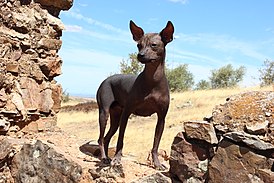 | |
| Other name | Inca Peruvian Orchid, Inca's naked dog, virigo, calato |
| Origin | |
| A place |  Peru Peru |
| Time | 300 BC e. - 1460 g. e. |
| Characteristics | |
| Height | small: 25-40 cm medium: 41-50 cm large: 51-65 cm |
| The weight | small: 4-8 kg average: 8-12 kg large: 12-30 kg |
| Wool | for a variety in wool - short, smooth and snug |
| Color | any, in any combination |
| Litter | 4-8 puppies |
| Life span | 12-15 years old |
| Other | |
| Using | companion dog |
| IF classification | |
| Group | 5. Spitz and primitive breed |
| Section | 6. Primitive breeds |
| room | 234 |
| Year | 1981 |
| Other Classifications | |
| AKC Group | Miscellaneous |
| Year of the AKC | 1996 |
Content
- 1 Breed History
- 2 Genetic studies
- 3 Appearance
- 4 Temperament
- 5 Breeding
- 6 Health
- 7 Maintenance and care
- 8 See also
- 9 Comments
- 10 notes
Breed History

Among the exhibits of the Lima Archaeological Museum there are objects of pottery of pre-Pink civilizations Vikus , Mochika , Chankai , Chankai with the influence of Tiwanaku , Chimu and others with the image of a Peruvian naked dog [1] [5] . According to the assurances of Spanish archaeologists, they belong to various peoples of Latin America and date from the period starting from 300 BC [1] and ending with 1460 AD [5] .
In 1987, a skeleton of a dog similar to this was discovered in an ancient burial place of a noble representative of the Chimu culture tribe. Further numerous excavations of the beginning of the XXI century on the territory of Peru revealed graves with 170 mummified animals [1] . As early as 1621, Pablo Jose de Arriaga wrote about black hairless dogs, which were raised specifically for future burials [6] .
At first glance, their skin, very reminiscent of human skin, is disgusting, but soon you discover that this is a very good friend, an ideal companion on cold nights, because this dog has a hot body; she is a vegetarian because she lacks teeth.
- Bernabe Cobo , “History of the New World”, XVII century [6]
In the days of the Incas, around the 11th century, the Peruvian dog, or as it was called then - the Peruvian moon dog, was among the six sacred dogs of this civilization, which absorbed the touches of the culture of enslaved peoples, and in the conquered territories the earlier usual practice was banned eating dogs [1] .
The unusual appearance and high body temperature of the Peruvian dog was associated with its mystical power and a large supply of positive energy, which is why it was attributed healing properties and the ability to treat many diseases. During the holidays, dogs were dressed in ceremonial clothes, and also used in various rituals [1] [2] .
In remote parts of the west of Latin America, the names of this dog in the languages of the Incas and Native American tribes - aiku and kakya [1] are preserved .
After the conquest of the Inca empire by the Spanish conquistadors at the beginning of the 16th century, the hairless dog practically disappeared, partially preserved only in the countryside, where it was crossed with woolly brothers until the 19th century, after which the dog was on the verge of extinction [1] . In this regard, the Peruvian authorities declared it a national treasure, and its breeding and export outside the country were taken under control [2] .
For decades, the efforts of enthusiasts breed was bred almost anew [1] . In the 1960s, it appeared in the United States, where in 1996 it was recognized by the American Club of Dog Breeding as a rare breed, and in the 1980s in Europe [6] . In June 1981, recognized by the International Cynological Federation and assigned to the group of Spitz and primitive breeds, to a subgroup of primitive breeds [7] . In 2001, a Peruvian hairless dog was officially recognized as a national treasure [6] .
Genetic research
The hairlessness of the Peruvian dog is due to the dominant FOXI3 gene ( English Forkhead Homebox Domain 13 ), which causes ectoderm dysplasia syndrome and is present in other mammals , including humans . The action of the gene is characterized by the presence of rare residual hair on the legs, tail, head and ears, as well as an abnormality of the dental system , up to the complete absence of teeth. Breeding studies have shown that the general genetic basis of hairlessness is inherent in three breeds: the Peruvian and Mexican hairless dogs, as well as the Chinese crested dog . In the American Hairless Terrier breed, the absence of hair is due to a different, recessive gene, not associated with changes in the dental system; puppies are born entirely dressed in soft hair and lose it completely after the first molt [8] .
This discovery was a surprise, since it testifies to the common origin of these breeds, while it was believed that American and Asian dogs have different roots. Archaeological finds confirm that naked dogs, akin to the Chinese, lived on the American continent before America became known to travelers from Europe. The genetic similarity of dogs indicates the presence of trade relations between Asia and America long before the discovery of the New World [8] .
The dominant hairless gene, referred to in the literature as in a homozygous state leads to the death of the embryo . Therefore, all hairless individuals of the Peruvian hairless dog have a genotype [8] .
Appearance
An elegant slender dog whose appearance expresses speed, strength and harmony without any hint of rudeness. It has two varieties: naked, with a bristly tuft on the head, hair on the ears and tip of the tail; and completely covered with sparse hair. Has an equal ratio between the height at the withers and the oblique length of the trunk, the body of the bitches can be more stretched. Another feature is the incomplete dental formula associated with the congenital absence of hair [2] [5] [8] .
The head of the wolf structure, the skull is mesocephalic, when viewed from above - wide; the lines of the forehead and muzzle are parallel. The superciliary arches are moderately developed, the occipital protuberance is poorly marked. The transition from the forehead to the muzzle forms an angle of approximately equal to 140 °. The nose is well pigmented, the back of the nose is straight, the color of the lobe should be in harmony with the various skin colors of the naked representatives of the breed and with the color of the hair of “dressed” individuals. Incisors in scissor bite. Cheekbones are normally developed [5] .
Dogs with a woolly variety have a complete tooth formula, naked dogs have an incomplete toothbrush, and the conditions for increasing the number of teeth have not been identified, almost toothless puppies can be born to parents with an almost complete tooth formula and vice versa. Small Peruvian dogs almost always have less teeth than medium and large; in those and in others they often have a noticeable lean forward. According to the new standard, the “naked” representative of the breed may lack even all teeth and this will not be a disadvantage [4] .
The eyes are medium sized, slightly almond-shaped, with an attentive and intelligent expression, normally and correctly positioned. Color - from black to yellow, in harmony with either the color of the coat or the skin color of naked individuals [5] .
Ears of medium length, broad at the base and gradually tapering to almost pointed tips; at rest, they are laid back; in a guarded dog, standing, forming an angle of 50–90 ° [5] .
The neck is close in shape to a truncated cone, flexible, with good muscles, no suspension, about the length of the head. The back line is straight, sometimes with a dorso-lumbar bulge, disappearing to the croup. The withers are weakly expressed, the back with well-developed muscles, the lower back is strong and muscular, approximately 1/5 of the height at the withers. The top line is straight, some individuals are distinguished by a dorso-lumbar bulge that disappears to the croup, which, however, is the preferred sign for Peruvian breeders [4] . The upper contour of the croup is slightly rounded, with an inclination to the horizontal of about 40 °, its structure provides a good push. The chest when viewed from the front is not wide, reaches almost to the elbows, the ribs are slightly curved, but not flat. The chest circumference behind the elbows should exceed the height at the withers by about 18%. The lower contour of the body stretches a clear elegant line, the abdomen is good, but moderately matched [5] .
The tail is low set, tapers from the base to the end, almost reaches the hocks along the length. In an excited state, it can be kept raised in a rounded bend above the back, but should not be bent by a ring. At rest, lowered with a slightly raised end, sometimes drawn to the stomach [5] .
The forelimbs when viewed from the front are completely vertical, the elbows are not twisted. The angle of the shoulder-blade joint is 100-120 °. When looking in profile, the angle formed by the metacarpus and the vertical is 15–20 °. The hind limbs when viewed from behind should be vertical, the muscles are round and elastic, the bend of the sciatic tubercles is well marked. The angle of the hip joint is 120-130 °, the knee angle is 140 °. Front and hind legs of medium length, “hare” type [K 2] , with strong heat-resistant pads and well-developed interdigital membranes. Claws are longer than in dogs of other breeds [4] , for black dogs black claws are preferable, for lighter dogs - light ones [5] .
The skin is smooth and supple throughout the body [9] . In the naked species, the formation of several rounded, almost concentric lines on the head, around the eyes and cheekbones is possible. Skin color can vary from black, slate-black, gray-black, blue-black, the entire range of gray, all shades of genetically blue color and dark brown to white. Preferred monotonous skin colors are possible, as well as having pinkish marks on all parts of the body, while white or pink spots should not cover more than 1/3 of the body [K 3] .
In the hairless variety, according to Peruvian breeders, the complete absence of wool is considered ideal, but its residues on the head, limbs and tail, as well as several rare bristles on the back are allowed. In this case, the remnants of the wool should not be thick and hard, as they should not cover the cheekbones and muzzle. The “dressed” coat should be short, smooth and snug, like a short-haired dog, but in no case curly, most representatives have no undercoat . The color of any color and in any combination [4] [5] .
The height at the withers of males and bitches depends on their size: for small - 25-40 cm, for medium - 41-50 cm, for large - 51-65 cm. The weight of small - 4-8 kg, medium - 8-12 kg, large - 12-30 kg [3] .
Temperament
Calm, balanced, quick-witted, active and alert dog. Good watchman. Gently attached to his home and master, from whom he prefers not to go far. She is very distrustful of strangers and does not like to be touched, showing with her whole appearance how unpleasant she is, which is a pedigree trait [2] [4] [10] .
Breeding
Earlier dogs of a woolly variety with a genotype were excluded from breeding, but recent studies of the genome proved that their use in breeding will enhance the genetic value of the breed and will contribute to its development, increase genetic diversity and conservation, which will make it possible to attract new breeders. In addition, the use of such dogs in breeding does not affect hair growth in hairless dogs, but it helps to improve their dental formula [4] [5] .
| External video files | |
|---|---|
| Animal Planet - DOGS 101 - Rare breeds - Peruvian Inca Orchid | |
Only woolly individuals whose parents are hairless dogs with pedigrees or duly registered in the stud book are registered. In the future, dogs in wool can only be knitted with hairless representatives, while breeding between two “dressed” dogs is prohibited, as registration of such dogs in the stud books is prohibited if their parents are not properly registered [4] [5] .
In the litter of two heterozygous hairless dogs, puppies covered with wool are born, the so-called "puffs". Their number is unpredictable, but according to the laws of Mendel statistically their number should be about 1/3. When breeding hairless and dressed dogs, it is equally probable to obtain hairless and hairy descendants. The Peruvian hairless dog is a very rare breed, and of the three varieties, the miniature one is considered the smallest, which is why its export from Peru is prohibited at the legislative level [1] [4] .
Health
Peruvian orchids are distinguished by excellent health, despite the constant inbreeding associated with the smallest number of these dogs in the world [4] . Both hairless and hairy dogs, unlike dogs of other breeds that protrude their tongues to lower the temperature, are cooled by the entire surface of the skin, which makes it difficult to tolerate too hot or cold climates [1] .
The weak point of the Peruvians is teeth, prone to disease and loss, which begins at the age of two, which, by the way, is not a defect [4] . There are skin problems, including cancer , the appearance of scratches and scars, and epilepsy and inflammation of the pancreas are also possible [4] [11] [12] .
The average life expectancy is from 12 to 15 years [10] . In the litter of small Peruvian dogs from 4 to 5 puppies, larger ones have 6-8 puppies, sometimes 12 [6] .
Maintenance and care
Perfectly suited for maintenance in a city apartment, as they do not leave wool [2] . The skin of Peruvian hairless dogs is extremely sensitive to damage and exposure to the sun, so it is very important to keep it in good condition, regularly moisturizing [2] . Particular attention should be paid to the ears, where it is very thin and can crack [1] . To maintain good shape, the dog must move a lot [6] .
See also
- American hairless terrier
- Chinese Crested Dog
- Xoloitzcuintle
Comments
- ↑ Primitive dogs are those that are formed as a result of natural selection in a free life and are very different from dogs bred by humans.
- ↑ A “hare” paw, unlike a “feline”, is more elongated, with two elongated central fingers. Allows the dog to quickly gain and maintain running speed. Breeds with a cleft paw include, for example, Whippet and Greyhound .
- ↑ In the new standard, solid color is called preferred. However, the Peruvian hairless dog is also called the Inca Peruvian hairless Orchid for its spotted color, which in many countries is called the “Orchid”, and it was always the spotted representatives who were the elite in the Inca tribes and lived with shamans [4] .
Notes
- ↑ 1 2 3 4 5 6 7 8 9 10 11 12 Sorokina J. Peruvian Inca Orchid // Friend: Journal. - 2016. - No. 11. - ISSN 1609-0527 .
- ↑ 1 2 3 4 5 6 7 Krukov V.I. Dogs. The most complete encyclopedia. - M .: Eksmo, 2013 .-- S. 223. - 464 p. - ISBN 978-5-699-59539-6 .
- ↑ 1 2 3 PERUVIAN HAIRLESS DOG. FCI-Standard No. 310 Federation Cynologique Internationale. Date of treatment February 17, 2017.
- ↑ 1 2 3 4 5 6 7 8 9 10 11 12 13 Comments on standard No. 310 dated 08.13.2013 (doc). Russian Cynological Federation. Date of treatment February 18, 2017.
- ↑ 1 2 3 4 5 6 7 8 9 10 11 12 Peruvian hairless dog. FCI Standard No. 310 dated 08/13/2013 (Doc). Russian Cynological Federation. Date of treatment February 16, 2017.
- ↑ 1 2 3 4 5 6 Mishikha O. Peruvian Hairless Dog (Inca Orchid) // Friend: magazine. - 2007. - No. 3. - S. 34-35. - ISSN 1609-0527 .
- ↑ FCI breeds nomenclature. PERRO SIN PELO DEL PERÚ (310 ) . Federation Cynologique Internationale. Date of treatment February 18, 2017.
- ↑ 1 2 3 4 Kaelin C., Barsh G. Molecular Genetics of Coat Color, Texture and Length in the Dog // Ostrander E., Ruvinsky A. The Genetics of the Dog, 2nd Edition. - CABI, 2012 .-- P. 73. - ISBN 978-1-84593-940-3 .
- ↑ Pocket Genius: Dogs. Facts at your fingertips / N. Gupta, C. Stamps. - New York: DK Publishing, 2016 .-- P. 128. - 160 p. - ISBN 978-1-4654-4585-8 . (eng.)
- ↑ 1 2 Dogs. All breeds / Ed. I. Rezko. - M .: AST, 2013 .-- S. 91. - 192 p. - ISBN 978-5-17-080827-4 .
- ↑ Pagett J. Control of hereditary diseases in dogs / Ed. M.R. Pogosbekova. - M .: Sofia, 2006 .-- S. 213. - 280 p. - 3000 copies. - ISBN 5-9668-0013-8 .
- ↑ Animal Planet — DOGS 101 — Rare breeds — Peruvian Inca Orchid (начиная с 3 мин 37 с) (англ.)