Volkovsky reservoir - a reservoir in the Sverdlovsk region on the Iset River (a Tobol tributary) within the city of Kamensk-Uralsky .
| Volkovsky reservoir | |
|---|---|
 | |
| Morphometry | |
| Volume | up to 21 km³ |
| Deepest | 23 m |
| Specifications | |
| Year of filling | 1938 |
| Pool | |
| Flowing stream | To go |
| Flowing stream | To go |
| Location | |
| A country |
|
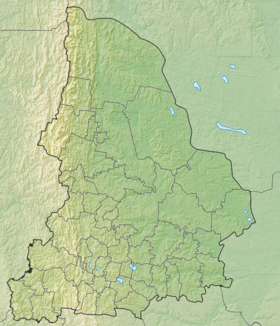
| The subject of the Russian Federation | Sverdlovsk region |


Content
Description
The reservoir is formed by a dam. The name received from the nearest village - Volkovsky (in 1936 it became part of the city). The construction of the dam began on May 13, 1935. The designing organization was the Leningrad Branch of Hydroelectroproject, now Hydroproject. The concrete structure of the dam is supported by porphyrite rock, the height difference is 17 m. The dam is equipped with eight adjustable spillways, along which a highway bridge and a pedestrian sidewalk are laid. The buildings in the upper part of the dam are decorated with flat pilasters and profiled eaves. In 1939, the Volkov dam was commissioned and became the first concrete dam in the Urals. With its space-planning solution, the Volkovskaya dam resembles a dam on the Istra River (project by architect M. G. Kupovsky).
The length of the resulting reservoir is 20 km, width is up to 2.5 km, the volume of water is 21 million cubic meters. m. mirror area 3.6 km² [1] The height of the dam from the sole to the top reaches 25 m, the length of the dam on the top of the concrete part is 160 m. The reservoir serves the Ural Aluminum Plant , Krasnogorsk TPP and the industrial needs of the city’s enterprises. [1] A two-lane road and a pedestrian pavement pass through the dam. Water pressure is felt 9 km upstream of the river [2] [3] .
V. P. Shevalev gives the following description: “The dam built near the village of Volkovo, built for the needs of the Ural Aluminum Plant in the thirties, formed a large reservoir. Backwater is felt 9 kilometers up the river. The height of the edge of the water of the Krasnogorsk pond is 119 meters. The water level behind the dam lies at a height of 106 meters above the level of the Baltic Sea. Below with. Volkovo, where the river erodes loose, younger deposits, its valley expands to 1-2 kilometers, the slopes become more gentle. The channel part of the Iset valley is small, the floodplain is often absent and forms only where loose rocks come out on the banks. Below the Krasnogorsk pond, where the rocks go deep, floodplain and other terraces are already well visible. ” [3]
Current State
- 2013
In October 2013, Viktor Yakimov, together with the Chairman of the regional government, Denis Pasler , during a working visit to Kamensk-Uralsky, examined the Iset River in the area of the Volkov Dam. The purpose of the visit was the need to solve the problems of hot water supply in the city, since about 90 thousand of Kamenets get hot water prepared from the source water taken from this particular reservoir. Initially, the Volkov Reservoir, commissioned in 1939, was intended for industrial water supply to the Krasnogorsk TPP, the Ural Aluminum Plant and several other enterprises. However, in subsequent years, the same water was used as the source for the implementation of a hot water supply for residential consumers [4] .
According to estimates made by experts in 1986, silt sediments accounted for 5 million cubic meters out of 14.1 million cubic meters of the standard volume of the reservoir [4] . In 2000, the volume of deposits increased to 7 million cubic meters. A diving survey of the bottom of the water area adjacent to the dam, made in 2006, confirmed the presence of sand and silt sediments up to seven meters thick, which is almost half the design depth. The situation in the water intake area, which is 1.5 km away from the dam site, is even worse. Negative data on the quality of the source water of the Volkovsky reservoir is confirmed by the results of monitoring. This problem has two solutions: the first is to clear the bottom of silt sediments, the second is to build a second string of water intake from Sysert [4] .
Sludge deposits today also prevent water intake for Krasnogorsk CHP. According to the technical director - Chief Engineer of the TPP Sergey Pankratov, the lower windows of the system are silted up. And this process continues. The degree of siltation of the bottom is also indicated by such phenomena as an increase in the number of islands in the river basin, the corresponding smell and turbidity. According to eyewitnesses, during and after the war, everything was dumped here, including industrial enterprises [4] .
- 2015
In June 2015, the prosecutor's office checked a number of hydraulic structures in the Sverdlovsk region and revealed a lot of violations. In particular, during the inspection of the Volkovskaya dam, it was established that the latter has design flaws and damage: the condition of the segment gates is unsatisfactory, major repairs are required. The audit showed that the hydraulic structure is not properly guarded, their pre-declaratory examination is absent, and the organization that operates the hydraulic structure does not have insurance contracts for compulsory civil liability of the owner of the hazardous facility. The requirements of Art. 9, 19 of the Federal Law “On the Safety of Hydraulic Structures” regarding the need to develop and approve plans for the localization and elimination of accidents at hydraulic structures. [five]
Volkov's exposure to ball lavas
80 meters from the Volkov dam on the left bank of Iset there is a natural monument “Volkov outcrop of ball lavas ”.
The geological and botanical nature monument of regional importance “Volkovskoe outcrop of ball lavas”, with a total area of half a hectare, was formed in order to ensure proper protection of exits of ball and pillow lavas up to seven meters high, sprouted with moss and lichen. According to the results of research by volcanologists, underwater eruptions occurred at a depth of more than 3000 meters. The natural territory consists of one site and occupies the 123rd quarter of the City forestry of the Kamensk-Uralsky forestry. “Volkov’s exposure of ball lavas” of the region refers to the rope and ball lavas of the underwater outpourings of the Devonian period, their age is more than 360 million years, they are witnesses of underwater volcanism and the real natural heritage of the amazing Ural region [6] .
Notes
- ↑ 1 2 Volkovsky reservoir, dam, Kamensk-Uralsky (Inaccessible link) . The appeal date is February 13, 2017. Archived on February 13, 2017.
- ↑ Volkovskaya dam (inaccessible link) . The date of circulation is October 6, 2016. Archived October 6, 2016.
- ↑ 1 2 V. Shevalev Open-air museum. - Sea otter. - Kamensk-Uralsky, 1997. - 224 p.
- ↑ 1 2 3 4 Viktor Yakimov examined the water area of the Iset River near the Volkov Dam .
- ↑ Dam in Kamensk-Uralsky on the verge of a breakthrough? (inaccessible link) . The appeal date is February 13, 2017. Archived on February 13, 2017.
- ↑ Monument of nature Volkovskoe outcrop of ball lavas
Literature
- Smirnov L.N. Constructivism in Architectural Monuments of the Sverdlovsk Region / L.N. Smirnov. - Yekaterinburg: NIIMK, 2008. - 160 pp., Ill.
- The arch of monuments of architecture and culture of the Sverdlovsk region. Volume 2. Sverdlovsk region / hole. ed. V.E. Zvagelskaya. - Yekaterinburg: SOCRATES, 2008 .-- 648 p., Ill.
- Museum of UAZ-SUAL. An album with photographs of the Ural Aluminum Plant. - L .: Montazhprojectaluminium, 1934.