“History and Monuments of Byzantine Enamel: From the Collection of A. V. Zvenigorodsky” (1892) is an art history monograph and scientific commentary on the collection of Byzantine enamels of a St. Petersburg patron and collector Alexander Zvenigorodsky , written by the Byzantine and art historian Nikodim Pavlovich Kondakov .
| History and monuments of Byzantine enamel: From the collection of A. V. Zvenigorodsky | |
|---|---|
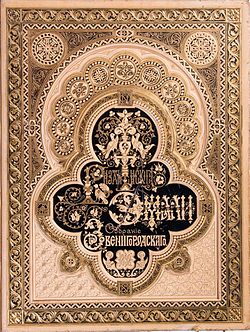 binding of the publication in Russian | |
| Author | N.P. Kondakov |
| Genre | science fiction |
| Original language | Russian , French , German |
| Original published | 1892 |
| Registration | Ropet I.P. , Mate V.V. |
| Publisher | St. Petersburg , printing house of M. M. Stasyulevich ; Frankfurt am Main , printing house of August Osterrit |
It is one of the most expensive books in the history of Russian printing [1] and is the "crown" of the Russian style in book publishing [2] . In the history of European printing "Byzantine enamels" entered as a "Russian miracle" and "a book in princely dress" [1] . As a scientific work, this work of N. P. Kondakov in terms of information and presentation retains its value and relevance [3] [4] .
Book History


(cover and flyleaf)
The publication was conceived by Alexander Zvenigorodsky as a luxurious gift to the crowned persons and famous book depositories. The book L'Imitation de Jésus-Christ ( On the Imitation of Christ ), published in 1855 in Paris at the direction of Emperor Napoleon III for the World Exhibition for the Glorification of France [1], served as a model. This luxurious publication was sent to all countries of the world and aroused interest in the scientific and artistic world. Zvenigorodsky wanted his book to be overshadowed by French art and print [1] . The book had two previous editions issued in German.
A collection of enamels Zvenigorod formed in the mid 1880s. In 1884, while undergoing long-term treatment in Aachen , he exhibited it in the city museum, and the exposition “gave rise to several solid and highly attractive assessments ...” [5] . After that, the collector made the first attempt to publish its description, which was, according to his plan, both scientific and accessible to any reader [4] . In 1884, with a circulation of 100 copies in German, the book “Byzantine enamels from the collection of A. Zvenigorodsky exhibited in the city museum of Aachen” was published in the printing house of Rudolf Barth, the text for which was written by the chaplain of the church of St. Adalbert in Aachen, Johann Schulz. The book was published with 14 black-and-white photolithographs , in graften binding, bookends of the “peacock feather” type and silk bookmark - lass [4] .
Pastor Schulz, after a positive review by the scientific community, continued to work on a description of the Zvenigorodsky collection. At his expense, he traveled to Germany, Belgium, Italy and France to familiarize himself with European collections, and all significant Russian works on enamels, as directed by Zvenigorodsky, were specially translated into German for working with them Schulz [6] . However, due to the fact that Schulz was a specialist in Rhine and Limoges chiseled enamels , and not Byzantine cloisonne, Zvenigorodsky was not satisfied with his work [7] . Despite this, after Schultz died, his unfinished work, out of respect for the author, was published by Zvenigorodsky in 1890. The book "Byzantine cloisonne enamel of Pater Johann Schulz" was printed with a circulation of 300 numbered copies in the printing house of August Osterrit in Frankfurt am Main . The publication was framed in brown knee-bar binding with gold stamping, ornamented bookends and a sawn-off edge painted under the “peacock feather” [8] .
After two German publications, Zvenigorodsky began work on a new Russian edition of a description of his collection. Its curator was Vladimir Stasov , who drew for the design of the architect Ivan Ropet , who, during his work, “gave free rein to his unbridled love for everything patterned” [9] . To describe his collection, Zvenigorodsky, on the advice of Stasov, invited the already well-known Russian Byzantinist and chief curator of the Hermitage Nikodim Kondakov . After reflection, Kondakov agreed, provided that the work he wrote would not only be devoted to the Zvenigorodsky collection, but would also describe the history and technology of Byzantine enamel as a whole, and the material from the Zvenigorodsky collection would be used as an addition [3] . In a letter from Austria on November 20, 1886, Zvenigorodsky wrote to Kondakov:
| You ... guessed my idea that the book on enamels would not be an interpretation of only my enamels, but the whole question of Byzantine enamels - their origin, history, significance in the history of art, etc. Once again, bringing you my heartfelt gratitude for agreeing to decorate my publication with your opinion, I humbly ask you to accept the assurance of my deepest respect and sincere gratitude to you [10] . |
Accepting the offer of Zvenigorodsky, Kondakov, at his request, working on the book, made two trips - one in Europe, the second in the Caucasus [6] .
In 1892, the book was published in Russian, French and German, 200 numbered copies each [11] . The translation of Kondakov’s work into German was performed in St. Petersburg by von Kretschmann, and into French in Paris by F. Travinsky [12] . Books in Russian were printed by the printing house of Mikhail Stasyulevich in St. Petersburg , and publications in French and German were printed in Frankfurt am Main in the printing house of August Osterrit [13] . Zvenigorodsky devoted the publication to Emperor Alexander III and placed in his book an adventure title, designed by Ropet in the style of a festive address to the autocrat.
The foreword to the book was written by Zvenigorodsky himself. In it, he talked about his collection, described the acquisition for her of samples of Byzantine and Georgian enamel with purchase dates and names of sellers [4] .
Four years after the publication of the book, the historian of church art from Aachen, canon Franz Bock, published 300 numbered copies, composed in the style of “Byzantine enamels” the composition “Byzantine cloisonne enamel from the collection of Dr. Alex Zvenigorodsky and a magnificent publication published about it. Archaeological-Historical-Artistic Study of Dr. Franz Bocca " [14] . Zvenigorodsky regarded this publication as an important addition to his book, but Kondakov had a different opinion [15] .
Book Design
The book was framed, made at the Huebel and Denk factory in Leipzig , made of white shagreen and embossed with pure gold on a black background (several copies were bound in compound bindings with a leather spine and lids in the knee [1] ) [16] . On the front cover, a quadricole is crowded out, against the background of which is placed the name of the book made in ligature, surrounded by a decorative ornament. On the back cover, on the ornamental background, the coat of arms of the princes of Zvenigorod was supplanted with gold [1] . The thickness of the book cover is about a centimeter; an embossed floral ornament is placed on its end [2] . Bookends are decorated using a multi-color Byzantine ornament with gold-embossed borders. The book edge on three sides is gilded and manually ornamented with a geometric Byzantine pattern of green and red colors [16] , and the edge of the edge adjacent to the binding covers is coated with aluminum paint [17] .
The book has a dust cover made of silk brocade with gold. The fabric for it was made by the Moscow factory of the brothers Alexander and Vladimir Sapozhnikov , and it cost Zvenigorodsky 10,000 rubles [13] .
The book was accompanied by a bookmark in the form of a wide ribbon of multi-colored silk , silver and gold threads. On it is embroidered a Greek text from the tragedy “Erechteus” of Euripides : “Unwrap these speaking sheets glorifying the wise” [18] .
The book is printed on beige paper imitating parchment . For its printing, the printing house of Mikhail Stasyulevich produced a font imitating the charter by which the oldest of the well-known Russian books was written - the Ostromir Gospel [1] . This font was used for the title page, titles, captions, illustrations, stamping on binding. The main text of the book is in Elizabethan type .
Chromolithographic illustrations are made from objects from the collection of Zvenigorodsky and other collections “from nature in paints, with all possible care” [19] . Twenty-eight tables with the image of enamels were executed according to engravings by Vasily Mate , Ivan Tvorozhnikov and other graphic artists [20] . They were printed at the printing house of Augustus Osterrit in Frankfurt. The rest of the artistic elements ( shmuttitla , endings, black-and-white illustrations) were performed at the Expedition for the procurement of government securities in St. Petersburg [18] . Regarding chromolithographs, Stasov noted: “... in this edition it is printed in gold, printed not in fake gold (bronze powder), as is now usually done, but in real pure gold on sheets” [20] . After the publication of the book, all the cliches of her drawings were destroyed [16] [4] [21] .
German title page
Chromolithography “Earrings and Necklaces”
Preface Screensaver
After the publication of the book, the Russian Byzantine academician Vasily Vasilievsky described the publication as “a luxury combined with grace that reveals the sophisticated taste of a connoisseur and passionate lover, which is a collector of Byzantine enamels” [22] . According to art historian Yegor Redin , “Byzantine enamels” are “a work of art in which both the content and the form are beautiful and one goes in harmony with the other” [6] . The art critic Yuri Gerchuk, regarding the design of the book, notes that the ornaments in it seem extremely oppressed and “the beauty of each of them is almost extinguished by the originality and brilliance of the neighboring ones” [2] , and the patterned inscriptions are fantastic and hardly readable [9] .
Composition by N.P. Kondakov
In his work, N. P. Kondakov, as agreed with A. V. Zvenigorodsky, paid attention not only to the Byzantine enamel from his collection, but also to the whole history of its production and the most important monuments [23] . The work consists of four chapters, two of which are an introduction to the study of the collection of enamels Zvenigorodsky [6] . The first chapter is a technical introduction to the history of cloisonne enamel and is devoted to the enamel technique in ancient Egypt , Assyria and Phenicia , Greek, Roman enamels, Caucasian enamels, the origin of enamel production in medieval Europe , the technique of Byzantine enamel. In the second chapter, Kondakov gives an overview of the monuments of Byzantine cloisonne enamel, which he studied " in such fullness as in no European book, and were nowhere in such an amazing mass " [6] . Among other things, he established new dating of a number of monuments and their origin.
In the third chapter, a study of Byzantine enamels from the Zvenigorod collection is given, and in the fourth - the Russians from his collection. According to the art historian E. K. Redin , the results of the study of Russian enamels " are highly instructive for Russian archeology " [6] . The main result of this study, according to Kondakov, is the conclusion that “ before the Tatar invasion, ancient Russia knew Byzantine and Oriental art productions closely, could appreciate their merits, and once owned many of the most diverse works of this kind ” [24] .
Domestic and foreign science recognized this work by Kondakov as one of a kind [23] . V. V. Stasov noted that Russian academic institutions have “ not only a right, but even an obligation to be proud of ” this work as “ one of the most comforting and joyful phenomena of our country in recent times ” [25] . Kondakov for his research on enamels was awarded the gold medal of the Russian Archaeological Society [1] .
Circulation Distribution
The publication, which spent 120 thousand rubles in silver, was not intended for sale [13] . Each numbered copy was personally signed by A. V. Zvenigorodsky indicating to whom it is intended [26] . All circulation books, according to V.V. Stasov, were donated to " the publishers, libraries, museums and other scientific institutions throughout Europe, and only very few individuals " [27] . In those copies that were intended according to Zvenigorodsky “ for my friends and friends, and especially people I respect ” [28] , a portrait of Zvenigorod's work by the French portrait painter and engraver Claude-Ferdinand Gaillard was enclosed [29] .
The book was sent to 18 countries, its recipients, among others, were the Paris Academy of Sciences , the National Libraries in Paris and Madrid, the Royal Library in Stockholm , Emperor Alexander III , Grand Dukes Sergey Alexandrovich , Konstantin Konstantinovich and George Mikhailovich , King of Romania Carol I , King of Italy Umberto I , King of Belgium Leopold II , King of Sweden Oscar II , Turkish Sultan Abdul-Hamid II , Emir of Bukhara Seid-Abdul-Ahad Khan [18] . Separate copies of the book were presented to people from the inner circle of Zvenigorod. Those copies that were still able to get on the market were sold at 1000 rubles in gold [30] .
For the presentation of the book, a stylized showcase and a bronze figurine of Zvenigorodsky cast in Paris were installed in the Imperial Public Library . Newspapers of various countries widely covered the publication of "Byzantine enamels", listing the August last names that received it as a gift [26] . The most enthusiastic reviews were received from foreign museums. So, for example, the Salzburg Museum wrote: “ Our museum was amazed to receive a publication as a gift, which, both externally and in content, surpasses everything that has still appeared in the world like that ” [31] .
The book "History and Monuments of Byzantine Enamel: From the Collection of A. V. Zvenigorodsky" is a bibliographic rarity and is rarely found on the antique market, especially in its original form - in a case, dust jacket and with a silk bookmark [18] . In Russia, copies of Zvenigorodsky's book in Russian are especially appreciated [18] . So, in 2005, a copy in Russian was sold at the Gelos auction for 4.6 million rubles, which was the best result of the second-hand auction of the year [21] [15] , and in 2012 at the auction “The House of Antique Books in Nikitsky” the Russian edition was put up for sale with an estimate of 5-6 million rubles [32] , but was not sold. A copy in French was sold in 2008 at the Sotheby 's auction for 47 thousand US dollars, and a copy in German at the Christie's auction in 2009 - for 45 thousand US dollars [33] .
Book of V.V. Stasov
The curator of the publication of “Byzantine enamels” V.V. Stasov, after the publication of the book, wrote the monograph “The History of the Book“ Byzantine Enamels “by A. V. Zvenigorodsky.” In it, he talks about the intention of the publication, the author, artists, printing houses and bookbinding workshops that created the book, etc. Moreover, most of the essay is occupied with reviews of those who received a copy of the publication, including letters and rescripts of royal persons, as well as articles from newspapers and magazines dedicated to "Byzantine enamels" [34] . Stasov's work was published in 1898 in the St. Petersburg "Cartographic Institution" of the publisher A. A. Ilyin . The circulation of the publication was 350 numbered copies (150 in Russian and 100 in German and French).
The book was decorated in the style of “Byzantine enamels” - a large format, the font of the Ostromirova Gospel , white all-calico binding with gold embossing, bookends from blue embossed paper with gold floral ornaments, a case covered with burgundy paper embossed under the skin [35] . The title page of the publication is designed in pseudo-Russian style using the technique of chromolithography . At the end of the publication, 7 illustrations are placed on separate sheets: depicting a display case for a book exhibition in the Imperial Public Library, the appearance of the publication, as well as copies of letters and reviews about the publication [36] .
Stasov's monograph is a rarity in the antique book market [36] . So, at the Christie's auction in 2007, a copy of the book was sold at a price of about 20 thousand US dollars [33]
Notes
- ↑ 1 2 3 4 5 6 7 8 Seslavinsky, 2010 , p. 238.
- ↑ 1 2 3 Gerchuk, 2014 , p. 225.
- ↑ 1 2 Beruchashvili, 2015 , p. five.
- ↑ 1 2 3 4 5 Byzantine enamels. Detective story (inaccessible link) . Date of treatment February 10, 2017. Archived February 11, 2017.
- ↑ History and monuments of Byzantine enamel: From the collection of A. V. Zvenigorodsky. - SPb. , 1892. - S. III.
- ↑ 1 2 3 4 5 6 Redin E.K. Review of: Byzantine enamels. Collection of A.V. Zvenigorodsky // Byzantine time-book . - 1895. - T. II , no. 1 . - S. 222-233 . Archived February 19, 2017.
- ↑ Beruchashvili, 2015 , p. 3.
- ↑ Beruchashvili, 2015 , p. four.
- ↑ 1 2 Gerchuk, 2014 , p. 226.
- ↑ Archive of the Russian Academy of Sciences of the St. Petersburg branch, fund. 115, op. 2, unit 132 "Alexander Viktorovich Zvenigorodsky." Cit. by: Beruchashvili N. History of monographs on the collection of cloisonne enamels by A. V. Zvenigorodsky . - Tbilisi, 2015.
- ↑ Seslavinsky, 2010 , p. 237.
- ↑ Beruchashvili, 2015 , p. 6.
- ↑ 1 2 3 Beruchashvili, 2015 , p. 9.
- ↑ Beruchashvili, 2015 , p. 10-11.
- ↑ 1 2 Beruchashvili, 2015 , p. eleven.
- ↑ 1 2 3 Beruchashvili, 2015 , p. eight.
- ↑ Seslavinsky, 2010 , p. 238-240.
- ↑ 1 2 3 4 5 Seslavinsky, 2010 , p. 240.
- ↑ Beruchashvili, 2015 , p. 7.
- ↑ 1 2 Stasov V.V. History of the book of A.V. Zvenigorodsky. - SPb. , 1898. - S. 15.
- ↑ 1 2 Prosina T. L. History of the book “Byzantine Enamels” by A. V. Zvenigorodsky . GBUK LO "GIAPMZ" Park Monrepos ". Date of treatment February 10, 2017.
- ↑ Zhukova I. A. A. V. Zvenigorodsky - donor of the Radishchev Museum // Materials of the III Bogolyubov readings. Results of scientific. work of the Saratov state. thin Museum them. A.N. Radishchev in 1990-1995. Saratov, March 28-29, 1996
- ↑ 1 2 Lopukhin A.P. Kondakov . Theological Encyclopedic Dictionary. Volume XII. Date of treatment February 18, 2017.
- ↑ History and monuments of Byzantine enamel: From the collection of A. V. Zvenigorodsky. - SPb. , 1892. - S. 307.
- ↑ Stasov V.V. Review of the publication of A.V. Zvenigorodsky. History and monuments of Byzantine enamel // Notes of the Imperial Russian Archaeological Society. - 1897. - T. IX , no. 1-2 .
- ↑ 1 2 Beruchashvili, 2015 , p. ten.
- ↑ Stasov V.V. History of the book of A.V. Zvenigorodsky. - SPb. , 1898.- S. 4.
- ↑ History and monuments of Byzantine enamel: From the collection of A. V. Zvenigorodsky. - SPb. , 1892. - S. VII.
- ↑ Beruchashvili, 2015 , p. 5-6.
- ↑ Martynov N.P. Half a Century in the World of Books. - M .: Book, 1990 .-- S. 94.
- ↑ Book Museum (catalog of the exhibition of the State Hermitage's Scientific Library). - SPb. , 2002 .-- S. 112.
- ↑ Unique and rarities from a private family meeting. - M. , 2012. - T. 1. - S. 55-56.
- ↑ 1 2 Seslavinsky, 2010 , p. 291.
- ↑ Seslavinsky, 2010 , p. 245.
- ↑ Seslavinsky, 2010 , p. 245-246.
- ↑ 1 2 Seslavinsky, 2010 , p. 246.
Literature
- Beruchashvili N. History of monographs on the collection of cloisonne enamels by A. V. Zvenigorodsky . - Tbilisi, 2015.
- Gerchuk Yu. Ya. Art of a printed book in Russia of the 16th — 21st centuries. - SPb. : Kolo , 2014.
- Illarionova L. I. The book of A. V. Zvenigorodsky “Byzantine enamels” - an example of service to science and charity // Rumyantsev Readings - 2012: Materials of the All-Russian Scientific Conference (April 17-18, 2012). - M .: Pashkov House, 2012 .-- S. 253—259 .
- Seslavinsky M. , Tarakanova O. Gourmet books: bibliophile publications of the late XIX - early XX centuries. - M .: White City, 2010.
- Stasov V.V. History of the book of A.V. Zvenigorodsky. - SPb. , 1898.