Domestic servants ( servants , housekeepers, housekeepers, minions, ministers, ministers, servants, servants) - those who perform various housework, and usually live in the employer's house.
| Maid | |
| Field of activity | |
|---|---|
| Patron saint | |
| ISCO Employment Code | and |
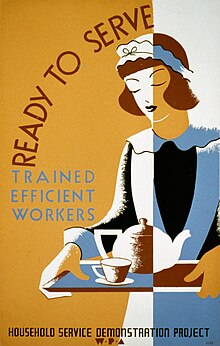
In large houses, there may be a large number of servants who perform various tasks, often forming an internal hierarchy.
History
Under the slave system and feudalism , slaves and serfs, as a rule, were used as domestic servants, respectively. “Servants, with all fear obey the masters, not only good and meek, but also severe” ( 1 Peter 2:18 ). Then the servant became hired, that is, she receives a certain fee for her work and has the right, if she wishes, to leave her job and change her place of residence. Nevertheless, in the legislation of many countries there remained for a long time survivals of serfdom in relation to servants.
Germany
Until the beginning of the 20th century, in German particular laws and Ostseen law , the rules of the so-called family law were applied to the servants. This “family-legal character” was expressed in the requirement of special respect for the servant to the owners and the absence of a right of claim on her part for rude expressions on the part of the owners: “The servant owes Mr. respect, loyalty, modesty and obedience and must devote all his time and all activities to its benefit and good; obliged to obediently obey the home order established by the master and cannot, without his permission, leave the house; if he turns out to be disobedient and unaware of his work, he must patiently endure the verbal reprimands made to him and has no right to seek resentment if even the lord used these harsh expressions ”(articles 4200-4203 of Ostseen civil law, similar to Prussian and other German law Gesindeordnungen "orders for the servant"). But the owners were entrusted with the care of the maintenance and treatment of servants.
In old Prussian law, coercive measures existed for the servant to fulfill his duties, for failure to meet the deadline, etc. Then they were replaced with monetary fines in the amount of the monthly maintenance (4225 ostseisk; the owner’s right was also preserved to force him to survive the term, but without sanction) .
UK
In England, in the Middle Ages , men usually worked in the household. The female servant was represented by the nannies, laundresses and wives of the men who served in the house, who served the wives and daughters of the castle owners.
By the 17th century, wealthy merchants, officials and artisans had the opportunity to keep servants. Women began to be hired more often, in particular due to lower wages. This trend was reinforced by taxes on male servants, introduced in 1777 due to the war for independence in the American colonies .
In the 19th century, the number of people employed in the household sector increased significantly. The industrial revolution led to even greater growth of the middle class in the 19th century, and consequently to an increase in the number of employers. Plus, the development of industry led to the fact that women who earned a living by working at home were forced to look for other ways to earn money, one of which was work in the field of home services. By the beginning of the 20th century, in Great Britain more than a third of all women worked in households, exceeding the number of men working in this field by 32 times.
The number of domestic workers has declined significantly since the First World War . Among the reasons: raising the legislative minimum wage for domestic staff and improving the quality of social protection for workers. After the Second World War, English large households with a staff of 40-50 people almost disappeared. This happened for a number of reasons: the decline in the level of well-being of employers; raising the level of education; war - few workers returned to the service of their employers [1] .
Russia
In Russia, serfs acting as domestic servants were called yard people .
In the first years after the revolution, servants remained in many old houses.
During the NEP, it became possible to officially hire domestic workers, who had by then formed trade unions and had work books. The notion of a “servant” has almost gone out of use, being replaced by a “housekeeper”.
By the 1930s, in Moscow, Leningrad and other large cities, domestic workers who acted as maids and cooks had the opportunity to keep professors, senior officials and a large category of intelligentsia living in separate apartments. Relations with the owner of the house were built according to labor law.
Often, domestic workers were "coming", that is, they did not live in the employer's house or apartment, but came here each or on agreed days. Despite this, many projects of houses built in the pre-war and early post-war years had a small nook adjacent to the kitchen, often with an additional window, where it was possible to comfortably accommodate and live for one person.
The concept of “servant” became again relevant in the 90s of the XX century in the countries of the former USSR.
Types of servants
( Abraham Boss , 17th century )
- maid
- nanny
- cook
- doorman
- waiter
- personal driver (driver)
- governess (bonn)
- housekeeper
- the Butler
- a servant is a servant at a temple, in a monastery, or with clergy of high degrees of consecration (bishops, etc.). [2] Synagogue service - chames
- Deprecated Terms
- farm laborer
- janitor
- batman
- Cossack
- valet (from German Kammerdiener ) - a room servant under the master in a rich noble house
- maid
- waiter
- groom ( groom )
- housekeeper
- coachman
- footman
- nurse
- majordom
- sexual
- gatekeeper
- servants
- housekeeper
See also
- Livery
- Footman
- Home black
Notes
- ↑ Stephen Ferry, 2009 .
- ↑ Great Dictionary of Russian Nouns. AST-Press Book. Babenko. 2009.
Literature
- Stephen Ferry Butlers, majordoms and household managers. 21st Century Professionals = Butlers and Household Managers: 21st Century Professionals. - M .: Alpina Publisher, 2009 .-- 360 p. - ISBN 978-5-9614-1083-9 .
Links
- Servants // Encyclopedic Dictionary of Brockhaus and Efron : in 86 volumes (82 volumes and 4 additional). - SPb. , 1890-1907.
- A servant in the 19th century in the UK. Part 1
- A servant in the 19th century in the UK. Part 2
- Pure Russian servility