Hikimaya ( Jap. 引 眉 , hickey - “pull” + May - “eyebrows”) - the tradition to remove eyebrows and draw dark spots on their forehead, common in Japan from the Nara period to the XIX century. Japanese aristocrats plucked or shaved their eyebrows and painted new kaizumi powder inks, which were made from soot made from sesame or rapeseed oil [1] .
Content
History
The hikimaya tradition appeared in the eighth century, when the Japanese court adopted Chinese customs and fashion [2] . Japanese aristocrats began to paint their faces with white powder. Probably, hikimayu began to do because without eyebrows it was easier to put on the face of an ax. At that time, eyebrows were drawn in the form of arcs, as well as in China [2] . Women also began to blacken their teeth , this tradition is known as ohaghuro .
Japanese culture began to flourish independently in the Heian period , from 794 years. The arts at the have reached the pinnacle of refinement. Women began to wear extremely elaborate costumes, paint their faces more thickly and paint eyebrows in the form of ovals or spots on the forehead. One explanation for this is that when the Japanese women were able to wear their hair freely falling down on both sides, the forehead became too noticeable, painting eyebrows in the form of ovals on the upper part sought to correct the balance of the face.
At the end of the Heian period, which ended in 1185, even men whitened their faces, blackened their teeth and did hikimayu [2] . Hikimaya has been in fashion for women for centuries. In the drama theater but appeared in the XIV century, masks for the roles of girls, as a rule, have eyebrows in this style.
In the Edo period , from the 17th century, only married women did hikimaya and ohaghuro [3] . In the second half of the XIX century, the Japanese government completed a policy of self-isolation and began to adopt the Western culture. Eyebrows and black teeth painted on the forehead turned out to be unacceptable for modern society, and in 1870 the hikimaya and ohahuro were banned [3] . Currently, they can be found only in historical dramas, such as but, and sometimes at local festivals.
In literature
Hikimayu is mentioned in both of the great works of the literary classics of the Heian period, The Tale of Genji and The Notes at the Head of the Bed .
An excerpt from The Tale of Genji, an episode at the end of the sixth chapter about a girl about ten years old who lives in the palace of Emperor Go-Nijou . Translated by Tatyana Sokolova-Delusina [4] :
Because of the old nun's commitment to the customs of the past, the girl still hadn't blackened her teeth, but today Genji ordered her face to be given the look and feel of the present requirements, and she was especially good with blackened teeth and well-defined brows.
Translation of "Notes at the Head" by Faith Markova [5] :
85. What is sad to see
How, blowing her nose continuously, speak through tears.
Like a woman in a hair pulling out her eyebrows.
In the cinema
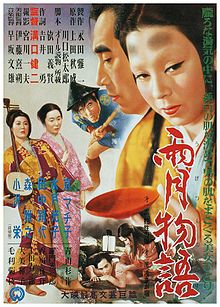
Hikimaya can be seen in many Japanese historical films, for example, such as “ Rashomon ”, “ Tales of the Foggy Moon After the Rain ”, “ Ran ”. In the first two films played by actress Matiko Kyo . In Rasemon, whose action takes place during the Heian period, she plays the samurai's wife, who awakens the gangster's desire. The action of "Tales ..." falls on the period of Sengoku (civil war) in the years 1493-1573, in which she plays a ghost who seduces the main character. In The Rana, based on King Lear , you can see the on as Lady Kaedo, who is trying to destroy the Ichimonji clan, manipulating Prince Hidetoroy and his three sons to kill each other.
See also
- Ohaguro
Notes
- ↑ Cosmetics in the Heian period. Archived page
- ↑ 1 2 3 Kokushi Daijiten . Yoshikawa, 1985.
- 2 1 2 Cyclopedia of Japanese History / Nihonshi Daijiten . Heibonsha, 1993.
- ↑ Murasaki Shikibu . Tale of Genji (Genji Monogatari) Kn. 2. Trans. with jap Japanese Translator: T. Sokolov-Delusin. - Moscow: Science. Main edition of Oriental literature, 1991. - 330 p.
- ↑ Say-Sonogon . Notes at the head / Per. from the old Japanese Faith Markova. Preface and comments. V. Markova. Design thin I. and V. Salnikov. - Moscow: Fiction, 1978. - 368 p.