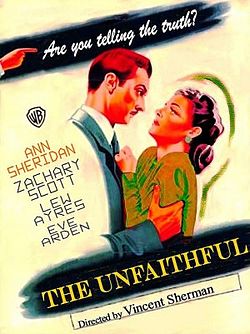
"Neverennaya" ( English The Unfaithful ) - film noir directed by Vincent Sherman , released on screens in 1947 .
| Invalid | |
|---|---|
| The unfaithful | |
 | |
| Genre | Film noir Melodrama |
| Producer | Vincent Sherman |
| Producer | Jerry wold |
| Author script | David Goodies James gunn |
| In the main cast | Ann Sheridan Lew Ayrs Zachary Scott |
| Operator | Ernest Heller |
| Composer | Max Steiner |
| Film company | Warner Bros. |
| Duration | 109 min |
| A country |  USA USA |
| Tongue | English |
| Year | 1947 |
| IMDb | |
The film tells about the wealthy woman of the world ( Ann Sheridan ), who in self-defense killed her former lover, but tries to hide from her husband ( Zachary Scott ) and the investigation the fact that she knew the deceased. When the truth comes out, her marriage is put to the test, but the lawyer and a family friend ( Lew Ayrs ) seeks to justify the woman in court, and then convinces the couple to save the marriage.
Although this is not reflected in the credits, many film scholars believe that the film was based on the 1927 Somerset Maugham play and is a remake of William Wyler 's Noir film noir (1940).
Critics have paid attention to the acute statement in the film of the actual problem of the mass distribution of divorces in post-war America, and also noted the strong directorial work and the strong acting game Sheridan, Airs and Scott.
Content
Story
In one of the wealthy neighborhoods of Los Angeles, the social lady Chris Hunter ( Ann Sheridan ) is awaiting her husband, successful entrepreneur Bob Hunter ( Zachary Scott ), to return from a business trip to Oregon . The day before his arrival, she attends a party of her husband's cousin Paula ( Yves Arden ), whom she arranged on the occasion of her divorce. At the party, Chris meets a close friend of the family, lawyer Larry Hannaford ( Lew Eyres ), who is overwhelmed with divorce cases, which greatly oppresses him. When Chris returns from the party, a man attacks her right next to the door, closing her mouth and pushing her into the house. A struggle begins inside, screams are heard, after which the light goes out and silence ensues. When the next morning, Bob drives up to the house, he sees a lot of police cars. Inside, he is met by a detective, police lieutenant Reynolds ( John Hoyt ), who reports that at night Chris killed a man here who was identified by letters in his pocket as Michael Tanner. One of the maids in the house reported that she had heard terrible screams in the middle of the night, and when she went downstairs, she saw Chris with a bloody dagger in her hand, which in a few moments lost consciousness. Bob tells the detective that he married Chris about three years ago, but two weeks after the wedding, he went to the army, where he served two years, returning home a little less than a year ago. He believes that he has a very happy marriage. Meanwhile, Chris comes to his senses and tells his version of what happened, claiming that he had never seen the attacker before and did not know him. She claims that the attacker demanded to give away the jewels, but when she tried to escape, the offender grabbed her, after which a fight broke out between them, during which Chris accidentally turned a dagger and killed the attacker. Reynolds assumes that the criminal prepared for the crime in advance, as he came on the day when Bob was away on a business trip, but he was surprised that the robber did not have any weapons with him at all, that this type of crime is extremely rare.
The next morning, when Chris and Bob, accompanied by Larry, come to the police department to fix their testimony, Larry introduces them to Tanner's widow (Martha Mitrovich), who says that her husband was a sculptor who was interrupted by one-time earnings, and they lived in mainly on her salary. In addition, Tanner often disappeared from home for a few days, so she was not very worried that he did not come to sleep yesterday, and found out about his death from the newspapers. However, a woman categorically claims that her husband is not a thief. After the departure of Tanner's widow, Reynolds reports that the sculptor has no criminal past, and then suggests that, perhaps, Tanner simply chased Chris as a woman, which, according to the experience of the detective, is quite common. When Reynolds receives information that Tanner was still quite a dark personality, and, perhaps, had already participated in the robbery, he ends the meeting, saying that the case is likely to be closed. Chris, Bob and Larry dine at a restaurant when a lawyer is called from the office, telling someone that he wants to give him important information about Chris. Leaving at the received address, Larry finds a seedy shop owned by art dealer Martin Barrow ( Steven Geray ). Martin shows Larry Tanner's bust of Chris, which the merchant bought from the author for $ 75. Martin offers Larry to buy this bust for 10 thousand dollars, threatening to give it to the police otherwise. The lawyer angrily rejects this proposal, accusing Martin of trying to blackmail, and then comes to Chris for clarification. At first, Chris denies everything, but then, under the pressure of arguments, admits that he met with Tanner while Bob served abroad during World War II. She agreed to pose for the sculptor, but when he tried to have an affair with her, she ceased all relations with him. However, Tanner did not back down and continued to pursue her even after Bob returned. According to Chris, she did not report this to the police, because she was afraid that the scandal could damage the business reputation and social position of her husband. Larry needs to tell Reynolds and Bob immediately, but Chris promises to do it, but only the next day. That same evening, Chris comes to Martin, hoping to buy the bust, but he declares that he has already sold it to Tanner's widow.
Upon learning that Chris tried to buy the sculpture, Larry realizes that she still had an affair with Tanner. Confessing to a lawyer that she really cheated on her husband with Tanner, Chris nevertheless insists that the sculptor tried to kill her on the night of the murder, and begged Larry to help her buy out the bust. However, the lawyer discourages her, arguing that you should wait for a step on the part of the blackmailers. Meanwhile, Mrs. Tanner intends to transfer the bust to the police to make Chris suffer as she suffers. However, Martin discourages her, offering to first make Bob pay, and then give him the opportunity to deal with his wife himself. The next day, Martin assigns Bob a meeting, after which he brings him home to Mrs. Tanner, where he shows him a bust, causing a deep psychological trauma. When, on returning home, Bob directly asks Chris about what was between her and Tanner, she confesses everything and asks for forgiveness for his mistake. Chris explains that after Bob’s departure for the war, she suffered from loneliness, and first, after persistent requests, she agreed to pose for Tanner, and then once gave way to him. After that, Chris tried to break off all contact with him, but the sculptor continued to pursue her. She tried to write first, and then tell Bob about it, but she could not find the right moment. Bob decides to redeem the bust, and after the case is closed, divorce. At this point, police arrive to arrest Chris on suspicion of premeditated murder. At the loud process, Chris frankly talks about everything that happened, and Larry manages to prove to the jury that although Chris is guilty of cheating on her husband, as well as of deceiving the investigation, she nevertheless killed Tanner from self-defense. As a result, her justify, but Bob still refuses to forgive his wife. Then Larry persuades a couple to think over everything once more, remembering their love and all the good things that bind them, and try to save the marriage. Seeing in the eyes of Bob and Ann, a willingness to reconcile and a desire to stay together, Larry leaves, leaving a couple alone.
Cast
- Ann Sheridan - Chris Hunter
- Lew Ayrs - Larry Hannaford
- Zachary Scott - Bob Hunter
- Yves Arden - Paula
- Steven Geray - Martin Barrow
- John Hoyt - Detective, Lieutenant Reynolds
- Martha Mitrovich - Mrs. Tanner
- Jerome Cowan - the prosecutor in court
- Peggy Knudsen - Claire
- Douglas Kennedy - Roger
- John Elliott - Judge Edward R. McVay (not listed in the credits)
Film makers and leading actors
Director Vincent Sherman became known for his anti-Nazi crime comedy with Humphrey Bogart's " Throughout the Night " (1942) and the melodramas featuring Bett Davis " True Friend " (1943) and " Mr. Skeffington " (1944). After staging two noir melodramas with Ann Sheridan - “ Nora Prentiss ” (1947) and “Neverennaya” (1947) - in the 1950s, Sherman put on such films noir as “The Damned Do Not Cry ” (1950), “ Return Fire ” ( 1950), “ The Scam on Trinidad ” (1952) and “ Textile Jungle ” (1957). One of the best late Sherman films was the drama “ Young Philadelphians ” (1959), starring Paul Newman [1] .
As the film historian Richard Harland Smith writes, the acting career of Ann Sheridan abruptly went uphill in 1939 after popular columnist Walter Winchell expressed admiration for her “amazing qualities” in her column. Advertising service studio Warner Bros. here she used this enthusiastic assessment to create Sheridan's image of a “charming girl”, from which the actress “immensely won”. She was soon followed by her best roles in films such as They Went at Night (1940) with George Raft and Humphrey Bogart , The Man Who Came for Lunch (1942) with Bette Davis and Monty Wooley , and Kings Row (1942 ) with Robert Cummings and Ronald Reagan . Smith notes that, over time, Sheridan was able to soften his North Tech accent, while retaining her intrinsic wit. Having already reached stellar status, the actress gave up strong roles, first in Raul Walsh 's melodrama “The Reddish Blonde ” (1941), which departed to Rita Hayworth , and then in Michael Curtis ’s noir film “ Mildred Pierce ” (1945), which brought Oscar to her placeholder Joan Crawford [2] . Soon, the studio generally suspended Sheridan from work for eighteen months, after the actress demanded a salary increase. In the end, she secured a six-picture contract with script approval. However, as Smith writes, “some time later, Sheridan bought her contract from Warners , having played before in several recent films, among them the quasi-noirs Nora Prentiss and Nejerna, which were made with an emphasis on her image of a charming girl “. Both films were released in 1947 and both put Vincent Sherman " [2] . Shortly after leaving the Warners, Sheridan won an Oscar for the main female role, playing in tandem with Cary Grant in Howard Hawks' eccentric comedy “ I was a military bride ” (1949), which, according to Smith, “became the highest achievement of her career, but also became for her, the pinnacle as a Hollywood star " [2] . In his 1996 memoir, Sherman wrote about Sheridan: “I always felt that Ann did not attract to become a big movie star. For a while, she enjoyed the benefits of being in the spotlight ... but I always felt that she would prefer to be a housewife with a loving husband and children. She was a beautiful and talented girl, acquaintance and work with which brought joy ” [2] .
Lew Eyres began his Hollywood career back in the late 1920s, and in the 1930s he had already played in such notable films as the war drama " On the Western Front Without Change " (1930), the criminal drama " Gates to Hell " (1930) , comedy " Holiday " (1938), and then - in a series of nine dramas about Dr. Kildare during 1938-42 [3] . During World War II, Ayrs became a conscientious objector , and served in medical units. This threatened to destroy his post-war career, however, as noted by film expert Denis Schwartz, “surprisingly, Hollywood forgave him, and his career did not suffer much after the war” [4] . In particular, Ayrs played the main male role in the film Noir Dark Mirror (1946), and then played the role of a doctor in the extremely successful drama Johnny Belinda (1948), which earned him an Oscar nomination and became the pinnacle of his acting career [3 ] . Zachary Scott was best known as an actor of a noir genre, playing his most notable roles in the films Dimitrios Mask (1944), Mildred Pierce (1945), Hazard Signal (1945), Ruthless (1948) and The Way of the Flamingos (1949) [5] .
Film making history
As Smith writes, “after the success of the Sherman film“ Nora Prentiss ”with Sheridan in the lead role, studio head Jack Warner demanded the continuation”. Sherman and producer Jerry Wald originally wanted to make a movie based on James M. Kane 's novel "Serenade" (1937) with Sheridan and Dennis O'Keefe in the lead roles, but the presence in the novel of a secondary storyline related to homosexuality hindered the implementation of this plan. Then Sherman suggested that the studio put the film on the unfinished script of James Gann "Nevernaya", which would be an unofficial remake of the film " Letter " (1940), directed by William Wyler . In spite of the fact that the studio management was afraid to give a green light to the launch of the production of the film according to an unfinished scenario, after two weeks Sherman began work [2] .
As noted on the website of the American Film Institute , “although David Goodies and James Gunn are listed in the credits as the authors of the original script, some observers drew attention to the similarity of their history with the film Warner Bros. “Letter” (1940), the script of which was written by Howard Koch, and the main role in it was played by Bette Davis ”, and some modern sources consider this film a remake of“ Letters ” [6] . In particular, Hal Ericson noted that “although from the very beginning it is not quite obvious, Nevernaya is a remake of the Letter film (1940) with Bett Davis, which is in turn based on the play by Somerset Maugham . Compared to Moema's play was moved from the jungle of Malaya into the cozy framework of an American suburb [7] .
On January 24, 1947, the Los Angeles Daily News reported that Ann Sheridan would play the unfaithful wife, who would ultimately escape punishment, which was contrary to the Hayes Code , according to which the traitor should be punished. Nevertheless, the American Film Association has agreed to such a scenario, provided that the film clearly conveys the idea of the undesirability of divorce [6] .
Ann Sheridan got the lead, Zachary Scott and Lew Eyres were also cast in the lead, and Yves Arden played the second female lead. Before starting work, Sherman gave the actors only a breakdown by scenes and the first twenty pages of the script prepared by him. Nevertheless, "all the actors agreed to work in such an unusual situation, demonstrating faith in their director." After watching the first information about the film, Jack Warner declared to Sherman: “Any son of a bitch who is able to make such a picture without a script can remain at the studio as long as he wishes” [2] .
In her 1985 memoir, Three Faces of Eve, Yves Arden shared her impressions of "participating in this vain and sometimes unpredictable work that was the subject of curiosity, gossip and anxiety throughout the filming period." She wrote: “We had no choice but to rely on a sense of humor. What we did, having come to the point that at some point we could not, without laughing, look at each other. It became painful both for us and for the director, but we could not help it. When I managed to control myself long enough to utter a phrase, Eni’s lip began to tremble, and her eyelashes blink frequently. And when Zachary’s voice broke, the director shouted: “Taken!”. While we were trying to pull ourselves together, someone thoughtlessly threatened to invite Jack Warner to the set. It finally finished us. Tears of laughter washed off the makeup three times, and we took a pause to calm down and clean up. Our neck was saved only by the fact that at that time we were three of the most professional actors of the studio ” [2] .
The film contains field shooting on the funicular railway Angelz Flight and MacArthur Park in Los Angeles, as well as in one of the residential single-family houses in Beverly Hills , which served as the home of Chris and Bob Hunters [6] .
As Smith notes, “despite the fears of the actors and the creative team, the film again brought success (and almost got to Oscar, as it did with Letter)), allowing Vincent Sherman to bargain for a substantial wage increase and an improved five-year contract. [2] .
Movie evaluation by criticism
Overall film score
After the release of the screens the film received mostly positive reviews from critics. Thus, the newspaper " New York Times " in his review rated him as "a detective with a murder above the average level", however, she considered that the picture was "too overloaded with melodrama in those moments" when the creators of the film "obviously wanted to say about an acute social problem" . The film is trying to speak out "on the topic of hasty divorce, as well as the dangerous consequences for the society of this ill-advised cure for all family problems, but he never brings the matter to a decisive blow." The article notes that “although the film repeatedly returns to the ever-expanding problem of divorce, he, nevertheless, never tries to solve it seriously,” right up to the very end of the film. However, at this moment “unfortunately, moralization in the preaching spirit begins.” Summing up, the reviewer notes that if the picture does not fully succeed, at least it deserves praise for “trying to achieve something worthy” [8] .
TimeOut magazine called the picture “an excellent melodrama,” which proposed a new interpretation of Letters by Somerset Maugham , “transferring the problem to the solitude of military wives.” The review draws attention to the “somewhat ornate narrative,” but closer to the final in the scene of the “trial, it grows to a passionate call for understanding the heroine” [9] . Film expert Spencer Selby believes that the film is dedicated to the theme “the horrendous effects of female infidelity” [10] , and Michael Keene, calling the film a “free remake of Letters,” notes that “although the film is too moral about women’s adultery,” less “enjoyable thanks to the strong game of Sheridan and Airs” [11] . According to Dennis Schwartz, this picture is a “good glossy remake of the Letters of Wyler”, remotely based on the play by Somerset Maugham, “in which the situation was more strained due to the racial aspect”. Schwartz believes that this "melodrama has a certain urgency," it is "well played and well done," and its "few mistakes failed to inflict serious damage on it" [4] . Erickson notes that, in contrast to “the work of Maugham,” this film is “devoid of class and race issues, not to mention eroticism and bitter irony.” Nevertheless, he “succeeds in a more logical way to arrive at a happy (or, at least, satisfactory to all) outcome” [7] .
Evaluation of the work of the director and creative team
Although the reviewer of the New York Times considered the plot of the film “deliberately artificial”, however, he noted that “due to an unusually convincing game and skillful setting,” the film “looks amazingly good.” Telling the story of his wife, "who changed her husband while he was away, and who sincerely regrets his fall", "the film could easily have slipped into slobbering sentiment more than once." However, the confident work of the creators of the picture saves the case [8] . According to TimeOut , that part of the script, which is made in the style of a thriller, in particular, the intricate circumstances associated with blackmail, written by David Goodys excellent [9] . Schwartz noted that “director Sherman performed the film well, the scene of which was transferred from the rubber plantation in Malaya to the booming post-war upscale suburbs of Los Angeles” [4] .
Actor Assessment
Critics praised the play of all the performers of the main roles. Thus, the reviewer of the New York Times noted that “Sheridan deserves great gratitude” for creating a convincing image of Chris Hunter, even though there is no “in-depth analysis of a woman who covered herself with shame”. The critic also notes "the magnificent game of Lew Airs as a lawyer and friend who intends to convince his clients not to rush thoughtlessly from one marriage to another." He weighs heavily on the screen and captures the audience attention. “Zachary Scott is serious and convincing in the role of a husband, and John Hoyt is no less successful in the role of a police lieutenant.” [8] According to TimeOut , “the gorgeous Sheridan gives out one of his best acting jobs as a woman who falls into sin, and then is forced to kill her annoying lover so as not to let her beloved husband know about it,” and “Scott as her husband and Eyres in the role of a benevolent lawyer, they give her good support " [9] .
Notes
- ↑ Highest Rated Feature Film Director With Vincent Sherman (Eng.) . Internet Movie Database. The appeal date is February 5, 2017.
- ↑ 1 2 3 4 5 6 7 8 Richard Harland Smith. Articles: The Unfaithful (1947 ) . Turner Classic Movies. The appeal date is February 5, 2017.
- ↑ 1 2 Highest Rated Feature Film Titles With Lew Ayres (Eng.) . Internet Movie Database. The appeal date is February 5, 2017.
- ↑ 1 2 3 Dennis Schwartz. A satisfactory glossy remake of Wyler's The Letter (Eng.) . Ozus' World Movie Reviews (19 August 2010). The appeal date is February 5, 2017.
- ↑ Highest Rated Feature Film Titles With Zachary Scott (Eng.) . Internet Movie Database. The appeal date is February 5, 2017.
- ↑ 1 2 3 The Unfaithful (1947): Note (English) . American Film Institute. The appeal date is February 5, 2017.
- ↑ 1 2 Hal Erickson. The Unfaithful (1947). Synopsis (English) . AllMovie. The appeal date is February 5, 2017.
- 2 1 2 3 TMP 'The Unfaithful', Post-War Study Starring Ann Sheridan, Lew Ayres and Zachary Scott, Has It Premiere at the Strand (Eng.) . The New York Times (28 June 1947). The appeal date is February 5, 2017.
- ↑ 1 2 3 TM. The Unfaithful (1947). Time Out Says . TimeOut. The appeal date is February 5, 2017.
- ↑ Selby, 1997 , p. 191.
- ↑ Keaney, 2003 , p. 448.
Literature
- Spencer Selby. Dark City: The Film Noir . - Jeffeson, NC: McFarland & Co Inc, 1997. - ISBN 978-0-7864-0478-0 .
- Michael F. Keaney. Film Noir Guide: 745 Films of the Classic Era, 1940–1959 . - Jefferson, North Carolina, and London: McFarland & Company, Inc., Publishers, 2003. - ISBN 978-0-7864-1547-2 .