

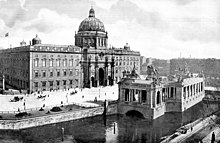


The National Monument to Kaiser Wilhelm ( German: Kaiser-Wilhelm-Nationaldenkmal ) is an un-preserved equestrian statue of the first German Emperor Wilhelm I by Reinhold Begas . It was located in the center of Berlin on Schlosfreheit Square opposite the Eosander portal on the west side of the City Palace on the banks of Kupfergraben . The masterpiece of Neubaroque - style Reingold Begas along with the Victory Avenue and the Bismarck National Monument , originally erected at the Reichstag , is a typical example of monuments of the Wilhelminism era. The creation of the monument was directly controlled by Kaiser Wilhelm II . The monument survived the Second World War without much damage, but was demolished in 1950 in accordance with the decision of the leadership of the GDR for ideological reasons.
A year after the death of Kaiser Wilhelm in 1888 , the three emperors in Germany announced a public competition for the project of the main national monument to the German emperor on Palace Square in Berlin. The project of the imperial forum, proposed by the architect Bruno Schmitz, won this competition. Later this project was declared unsuccessful, and in 1891 a new, already closed competition was held, to which eight sculptors were invited. The monument to the Kaiser was planned to be installed already at the western facade of the City Palace on Schlosfrayheit. Probably, at the insistence of William II, Reinhold Begas and Munich sculptor Wilhelm von Rumann were also involved in the competition. Having learned about this, half of the initially invited sculptors refused to participate in the competition. As expected, the first prize in the competition was received by the favorite of Kaiser Begas, who created the sculptural ensemble together with his students. The architectural part of the project was carried out by the Stuttgart architect Gustav Halmguber . This creative duo of Begas and Galmguber managed to defeat the project of the court adviser for the construction of Ernst von Ine .
The implementation of the monument project began in June 1894 with the demolition of a number of buildings on Schlosfrayheit Square. The first stone in the foundation of the monument was laid on August 18, 1895, on the day of the 25th anniversary of the Battle of Saint-Priv, Gravelot . The opening ceremony of the national monument in the presence of numerous guests of honor took place on March 22, 1897 as part of a ten-day celebration of the centenary of the birth of Emperor Wilhelm. The national monument to Kaiser Wilhelm cost four million gold marks , an impressive amount for that time. The monument has been criticized for its monumental size and non-barreled shape. The height of the structure was 21 m, the height of the equestrian statue - 9 m. On the left hand of a Kaiser sitting on a horse accompanied the genius of the world in a female form. The bronze pedestal, at the corners of which four goddesses of victory soared on the balls, was decorated with the signature “William the Great, the German Emperor, King of Prussia 1861-1888” on the front side, and “As a sign of gratitude and love. The German people. " On the granite steps leading to the pedestal, there were two monumental statues created by Eugene Burmel : on the north side - “War”, on the south - “Peace”. At the corners of the basement of the monument, four lions guarded trophies . Soon, the monument to William earned the caustic nickname "William in the Lion's Ditch", alluding to the biblical story of the then-popular painting of Brighton Riviera depicting the prophet Daniel surrounded by lions. The monument was criticized as a terrible example of the manner of some sculptors to frame statues that were pretty good with unnecessary tinsel: in addition to the Kaiser and his horse, 19 half-naked women, 22 men and 12 children were represented on the monument. The Berliners, who didn’t recognize the conventions, called the new national monument “Wilhelm II Zoo”, because the monument depicted 21 horses, two donkeys, 8 sheep, four lions, 16 bats, 6 ordinary mice, one squirrel, 10 pigeons, two ravens, two eagles, 16 owls, one kingfisher, 32 lizards, 18 snakes, one carp, one frog, 16 crayfish, total 157 representatives of the fauna.
The nine-step high pedestal of the monument was made of polished Swedish granite from Virbo and allowed holding national festivals. The ensemble of the equestrian statue was surrounded on three sides by a colonnade of an ionic sandstone order with a colored mosaic floor , which was completed on two sides by two corner pavilions. Four sculptures symbolized the kingdoms of Prussia (the work of Peter Christian Breyer ), Bavaria (the work of August Gaul ), Saxony (the work of August Kraus ) and Württemberg (the work of Breyer) on the colonnade’s cornice in the front. The four sculptural groups on the back of the Spree were called "Trade and Shipping," "Art," "Science," and "Agriculture and Industry." The southern corner pavilion was crowned by the bronze quadriga of Bavaria by Karl Hans Berniewitz . Johannes Götz created the pandanus for him at the northern corner pavilion, the quadriga of Borussia.
The monument to Kaiser Wilhelm was damaged during the fighting in the November Revolution . As a result of the subsequent discussions, a decision was made in favor of the restoration of the monument instead of its demolition. In the Second World National Monument at the City Palace resisted without major damage. In the winter of 1949-1950, the GDR authorities decided to demolish the monument to the basement. The decision was purely political in nature, as well as in relation to the demolished shortly before this City Palace. The base of the national monument to Kaiser Wilhelm, recognized as an architectural monument, has been preserved to this day and is found at the southwestern edge of Palace Square . From the demolished national monument, two sculptural groups of lions have also been preserved, which without trophies in a slightly modified design were installed in pairs at the predator pavilion “ Alfred Brehm 's House” in the Friedrichsfeld zoo . One of the eagle sculptures by August Gaul is owned by the Brandenburg Museum and is displayed in its courtyard. The remaining sculptural elements of the former monument to Kaiser Wilhelm were destroyed.
On the site of the former national monument to Kaiser Wilhelm, it was planned to erect a monument to Freedom and Unity in honor of the unification of Germany in 1990, but in April 2016, they finally refused to implement this project for financial reasons. On November 11, 2016, the Bundestag decided to reconstruct the historical colonnade of the monument on the former Schlosfrayheit , the cost of these works is estimated at 18.5 million euros.
Literature
- Gustav Klitscher: Die Hundertjahrfeier in Berlin in: Die Gartenlaube, 1897, Heft 16, S. 268—271
- Bodo Rollka, Klaus-Dieter Wille: Das Berliner Stadtschloß. Geschichte und Zerstörung , Mit einer Nachbemerkung von Wolf Jobst Siedler, 2. erw. Aufl., 1993, ISBN 3-7759-0302-X
- Alfred Gotthold Meyer: Reinhold Begas , aus der Reihe: Künstler-Monographien , herausgegeben von H. Knackfuß, Berlin und Leipzig, 1897.
- Reinhard Alings: Monument und Nation. Das Bild vom Nationalstaat im Medium Denkmal - zum Verhältnis von Nation und Staat im deutschen Kaiserreich 1871-1918 , Berlin / New York, 1996
- Alfred Kerr: Wo liegt Berlin? - Briefe aus der Reichshauptstadt 1895-1900 , Berlin 1997, S. 253-258.
- Eger: Die Gründungsarbeiten zum Bau des Nationaldenkmals für Kaiser Wilhelm I an der Schloßfreiheit in Berlin . In: Zentralblatt der Bauverwaltung , Jahrgang 16 (1896), S. 373-375 and 386-389.