The Nanjing War Crimes Tribunal was established in 1946 by the Chiang Kai-shek government to try four officers of the Imperial Japanese Army accused of war crimes committed during the Second Sino-Japanese War in Nanjing . It was one of thirteen tribunals organized by the government of Chiang Kai-shek.
| Part of a series of articles on the Nanjing massacre |
| Nanjing massacre |
|---|
The Battle of Nanjing |
| Japan war crimes |
International Military Tribunal for the Far East |
| Historiography of the Nanjing Massacre |
Japan's war crimes in Japanese history books |
| Eyewitnesses |
Jon Rabe |
| Sources and research |
|
| Films |
Battle for china |

Content
- 1 process
- 2 Consequences
- 3 notes
- 4 Literature
Process
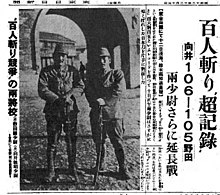
The tribunal tried the 6th division commander, Lieutenant General Hisao Tani , Captain Gunkichi Tanak and lieutenants Toshiaki Mukai and Tsuyoshi Noda, who became famous after their competition in killing 100 people with a sword . The lieutenants were put on trial because in 1937 their “contest” was praised by the Japanese press. The defendants were arrested in Japan and transferred to the Chinese government by the American occupation administration.
In July 1948, General Yasuji Okamura was also accused by the tribunal of war crimes, but was released from responsibility by Chiang Kai-shek [1] , who used him as a military adviser. [2] However, during interrogations, this general testified about the Nanking massacre : [3]
“My assumptions are based on what I heard from staff officer Miyazaki, the head of the special department of Canada and the head of the special department in Hangzhou Hagiwara, a day or two after I arrived in Shanghai. Firstly, tens of thousands of acts of violence against civilians, rape and robbery after the capture of Nanjing really took place. Secondly, our frontline units used the vicious practice of executing prisoners of war under the pretext of lack of provisions. ”
The main perpetrator of the massacre, Prince Asaka Yasuhiko , as a member of the imperial family, received immunity from persecution and evaded responsibility. General Ivane Matsui was sentenced to death at the Tokyo process . Several officers involved in the massacre died or committed suicide before the tribunal. Thus, Hisao Thani was the only high-ranking Japanese officer to be tried for the Nanking massacre in China itself. As a result, the tribunal issued a death sentence to all the defendants, and they were shot in 1947. According to the verdict of the tribunal against Hisao Thani, “More than 190,000 civilians and prisoners of war were shot from machine guns, and their corpses were burned to conceal evidence. In addition, more than 150,000 victims of violence were buried by charitable organizations. Thus, the number of victims exceeds 300,000. " [4] These estimates are based on funeral records and witness statements.
Consequences
The 300,000 death toll is the official estimate of the PRC government. It is knocked out on a stone wall at the entrance to the Memorial to the victims of the Nanking massacre .
Today, a significant part of Japanese society denies the crimes of the Japanese army in Nanjing. Relatives of the convicts Noda and Mukai sued in 2003, trying to prove that the lieutenants had been slandered and claimed compensation of $ 300,000. This process was lost [5] , because while still in Japan, lieutenants openly talked about the "competition" and stated that it was not too difficult. Noda also did not hide the fact that "directly in hand-to-hand combat" he killed "no more than five people" [6] .
Notes
- ↑ en: Herbert Bix , en: Hirohito and the Making of Modern Japan , 2000, p. 594.
- ↑ [1] Pacific War Online Encyclopedia
- ↑ Akira Fujiwara, Bob Wakabayashi. The Nanking Atrocity 1937-1938: Complicating the Picture. - Berghan Books, 2007.
- ↑ Tokushi Kasahara, Le massacre de Nankin et les mécanismes de sa négation par la classe politique dirigeante Archived on May 27, 2013. .
- ↑ Hogg, Chris . Victory for Japan's war critics , BBC News (August 23, 2005). Date of treatment January 8, 2010.
- ↑ Honda, Katsuichi (1999), Gibney, Frank , ed., The Nanjing Massacre: A Japanese Journalist Confronts Japan's National Shame , ME Sharpe, ISBN 0-7656-0335-7 , < https://books.google.com/ books? id = _H0JEjAqMcsC & lpg = PP1 & dq = The% 20Nanjing% 20Massacre% 3A% 20A% 20Japanese% 20Journalist% 20Confronts% 20Japan% 27s% 20National% 20Shame & pg = PA126 # v = onepage & q = > . Retrieved February 24, 2010.
Literature
- Philip R. Piccigallo, The Japanese on Trial: Allied War Crimes Operations in the East , 1945–1951, University of Texas press, 33, 73