Type 4 ( Japanese 四 式 二十 糎 噴 進 砲 - Yonshiki nijyū-senchi funshinhō) is a launcher for an unguided missile that was in service with the Imperial Army of Japan during the Second World War .
| jet mortar Type 4 | |
|---|---|
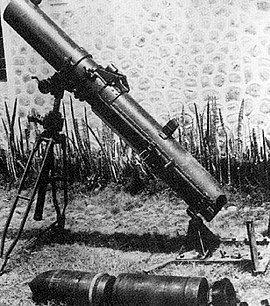 Type 4 20 cm Rocket Mortar. Note that the baseplate is incorrectly positioned, extending backwards. It should face forward in order not to get damaged during firing. | |
| Type of | Rocket artillery |
| A country |  |
| Service History | |
| Years of operation | 1943-1945 |
| Adopted | |
| In service |  Imperial Army of Japan Imperial Army of Japan |
| Wars and conflicts | The Second World War |
| Specifications | |
| Weight kg | 227.6 |
| Barrel length mm | 1.923 |
| Shell | 83.7 kg |
| Caliber mm | 203 |
| Elevation angle | 40 ° to + 65 ° |
| Angle of rotation | 300 ° |
| starting speed projectile, m / s | 175 |
| Maximum range, m | 2400 |
History
In popular and even special reference books, the term "jet mortar" is common. In fact, the so-called Soviet and German artillery systems of the Second World War are not mortars in any way, but belong to the MLRS class. The only artillery system that can really be attributed to " rocket launchers " (that is, to a weapon that combines the technical properties of a rocket launcher and the mortar itself) was the Japanese 20-cm Type 4 rocket launcher , adopted by the Japanese Imperial Army in 1944 .
Outwardly, this weapon looked like an ordinary mortar of the classical scheme ("imaginary triangle"), with a base plate, a biped, mortar sight and leveling mechanism . The difference was in the smooth barrel tube open on both sides (the upper half of which was pivotally swiveled upwards for ease of loading with turbojet (i.e. stability was imparted to the projectile by rotating the projectile along the longitudinal axis and rotation was created by additional inclined nozzles) with a 200 mm caliber projectile with high-explosive or chemical munition with the latter, however, did not receive practical application - the warhead) and the ammunition used ( unguided missile , not an artillery mine ).
An obvious disadvantage of this design solution is the use of a guide tube as a supporting leg. When fired, the rocket nozzle was extremely close to the ground and raised clouds of dust. To change the position, this device had two long handles, similar to shovel cuttings, holding on to which several soldiers could carry it some distance from the launch site, which, given the low range of the missile, was probably a good target for the enemy’s counter-battery fire. Since rockets could have been launched without this device, soldiers often used articulated guiding devices: pipes, wooden frames, and even just slopes or trenches.
The Type 4 jet mortar was actively used by the Japanese army during the unsuccessful defense of the Mariana Islands , the Philippines , Iwo Jima and Okinawa from the forces of the Allies in 1944-1945. [one]
See also
- 8.8 cm Raketenwerfer 43 "Püppchen" (German Puppchen - doll) - German anti-tank gun (actually an easel grenade launcher), firing rockets.
Notes
- ↑ R. S. Ismagilov et al. Artillery and mortars of the 20th century (Neopr.) . - Smolensk, Rusich. - 2001. - S. 150. - ISBN 5-8138-0373-4 .
Links
- Type 4 on Taki's Imperial Japanese Army page
- YouTube video