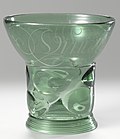

Berkemeyer , Berkemeyer ( German: Berkemeyer ) - a wine glass with a cylindrical base and a cone-shaped bowl, widespread in Germany and the Netherlands of the 16th – 17th centuries [1] .
Berkemeyer originally called wooden circles, carved from the branches of a birch ( Dutch. Berkemei ). Perhaps this name was later transferred to a glass goblet due to the fact that the bulges “raspberries” adorning its leg, allowing the glass not to slip out of greasy fingers, reminded of the rough surface of the birch bark [2] .
Berkmeier is a lot like a rimer . The main difference between these types of glasses is in the shape of the upper part: for a riemer it is barrel-shaped, and for a berkemeyer it has the shape of an inverted cone [3] . Berkemayer can be considered the forerunner of the Roemer: the latter appeared only at the end of the XVI century, while the Berkemeier existed earlier [4] .
Like Römer, the Berkemeyer was made primarily from forest glass . In the earliest instances, the cup and base were a single whole; subsequently, the lower part took the form of a cylinder, and the upper part became a cone, and a clear boundary between them was identified [5] .
Often the glasses were decorated with engraving, it could be a drawing or an inscription. The Berkemayers adorned by the Dutch poetess and engraver Anna Rumers Wissher have survived . Her favorite technique was the so-called diamond puncturing: drawing small dots and strokes on the surface of the glass using a special rod with a diamond at the end. In addition to gift inscriptions and quotes in Latin and Greek, Anna Wissher often used images of flowers and insects in her works [6] .
Dutch painters of the 17th century ( Peter Klas , Willem Klas Kheda and others) liked to depict Berkemeier glasses on their still lifes . They were also found in genre painting , for example, by Frans Hals (the paintings “A cheerful drinking companion ”, “Lute player with a glass of wine”) [7] .
Notes
- ↑ Hess, Husband, 1998 , p. 253.
- ↑ Berkemeyer with engraving . Rijksmuseum. Date of treatment January 29, 2017.
- ↑ Tarasov Yu. A. Dutch still life of the 17th century. - St. Petersburg: Publishing House of St. Petersburg University, 2004. - S. 29.
- ↑ Henkes .
- ↑ Hess, Husband, 1998 , p. 46.
- ↑ Berkemeyer with engraving: Decoration . Rijksmuseum. Date of treatment January 29, 2017.
- ↑ A Militiaman Holding a Berkemeyer, Known as the 'Merry Drinker' . Rijksmuseum. Date of treatment January 29, 2017.
Literature
- Catherine Hess, Timothy Husband. European Glass in the J. Paul Getty Museum: Catalog of the Collections . - Getty Publications, 1998 .-- 272 p. - ISBN 0892362553 . (eng.)
Links
- Wikimedia Commons has media related to Berkemeier in painting
- HE Henkes. False berkemeiers on Van Meegeren's Vermeer forgery . Museum Boijmans Van Beuningen (2011). Date of treatment January 29, 2017. (English)
- Copies of ancient berkemeyers (photo) (German) . Date of treatment January 29, 2017.
- Berkemeyer engraved by Anna Wissher . WGA Date of treatment January 29, 2017.