Clever Geek Handbook
📜 ⬆️ ⬇️

Sphericity

Schematic representation of the difference in particle shape. Two parameters are shown: sphericity (the higher the object, the higher the sphericity) and roundness (the right of the object, the higher the roundness).

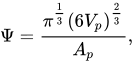
Sphericality is a measure of how spherical (round) an object is. Defined by H. Wadell in 1935, [1] sphericityΨ {\ displaystyle \ Psi} {\ displaystyle \ Psi} particle is the ratio of the surface area of ​​the sphere (the same volume as this particle) to the surface area of ​​the particle:

Ψ=πone3(6Vp)23Ap,{\ displaystyle \ Psi = {\ frac {\ pi ^ {\ frac {1} {3}} (6V_ {p}) ^ {\ frac {2} {3}}} {A_ {p}}},} {\ displaystyle \ Psi = {\ frac {\ pi ^ {\ frac {1} {3}} (6V_ {p}) ^ {\ frac {2} {3}}} {A_ {p}}},}

WhereVp {\ displaystyle V_ {p}} V_ {p} equal to the volume of the particle andAp {\ displaystyle A_ {p}} A_ {p} equal to the surface area of ​​the particle. The sphericity of a sphere is unity by definition, and due to isoperimetric inequality, the sphericity of any other body is less than unity.

Ellipsoidal objects

SphericityΨ {\ displaystyle \ Psi} {\displaystyle \Psi } flattened spheroid is equal

Ψ=πone3(6Vp)23Ap=2ab23a+b2a2-b2ln⁡(a+a2-b2b),{\ displaystyle \ Psi = {\ frac {\ pi ^ {\ frac {1} {3}} (6V_ {p}) ^ {\ frac {2} {3}}} {A_ {p}}} = { \ frac {2 {\ sqrt [{3}] {ab ^ {2}}}} {a + {\ frac {b ^ {2}} {\ sqrt {a ^ {2} -b ^ {2}}} } \ ln {\ left ({\ frac {a + {\ sqrt {a ^ {2} -b ^ {2}}}} {b}} \ right)}}},} {\displaystyle \Psi ={\frac {\pi ^{\frac {1}{3}}(6V_{p})^{\frac {2}{3}}}{A_{p}}}={\frac {2{\sqrt[{3}]{ab^{2}}}}{a+{\frac {b^{2}}{\sqrt {a^{2}-b^{2}}}}\ln {\left({\frac {a+{\sqrt {a^{2}-b^{2}}}}{b}}\right)}}},}

where a and b are equal to the major and minor semiaxes of the spheroid.

Formula Output

Hakon Waddell defined sphericity as the ratio of the surface area of ​​a sphere equal to the volume of a given particle to the surface area of ​​a given particle. Express the surface area of ​​the sphereAs {\ displaystyle A_ {s}} A_s through the volume of a particleVp {\ displaystyle V_ {p}} V_{p} :

As3=(fourπr2)3=four3π3r6=fourπ(four2π2r6)=fourπ⋅32(four2π232r6)=36π(fourπ3r3)2=36πVp2.{\ displaystyle A_ {s} ^ {3} = \ left (4 \ pi r ^ {2} \ right) ^ {3} = 4 ^ {3} \ pi ^ {3} r ^ {6} = 4 \ pi \ left (4 ^ {2} \ pi ^ {2} r ^ {6} \ right) = 4 \ pi \ cdot 3 ^ {2} \ left ({\ frac {4 ^ {2} \ pi ^ { 2}} {3 ^ {2}}} r ^ {6} \ right) = 36 \ pi \ left ({\ frac {4 \ pi} {3}} r ^ {3} \ right) ^ {2} = 36 \, \ pi V_ {p} ^ {2}.} {\displaystyle A_{s}^{3}=\left(4\pi r^{2}\right)^{3}=4^{3}\pi ^{3}r^{6}=4\pi \left(4^{2}\pi ^{2}r^{6}\right)=4\pi \cdot 3^{2}\left({\frac {4^{2}\pi ^{2}}{3^{2}}}r^{6}\right)=36\pi \left({\frac {4\pi }{3}}r^{3}\right)^{2}=36\,\pi V_{p}^{2}.}

Consequently,

As=(36πVp2)one3=36one3πone3Vp23=623πone3Vp23=πone3(6Vp)23.{\ displaystyle A_ {s} = \ left (36 \, \ pi V_ {p} ^ {2} \ right) ^ {\ frac {1} {3}} = 36 ^ {\ frac {1} {3} } \ pi ^ {\ frac {1} {3}} V_ {p} ^ {\ frac {2} {3}} = 6 ^ {\ frac {2} {3}} \ pi ^ {\ frac {1 } {3}} V_ {p} ^ {\ frac {2} {3}} = \ pi ^ {\ frac {1} {3}} \ left (6V_ {p} \ right) ^ {\ frac {2 } {3}}.} {\displaystyle A_{s}=\left(36\,\pi V_{p}^{2}\right)^{\frac {1}{3}}=36^{\frac {1}{3}}\pi ^{\frac {1}{3}}V_{p}^{\frac {2}{3}}=6^{\frac {2}{3}}\pi ^{\frac {1}{3}}V_{p}^{\frac {2}{3}}=\pi ^{\frac {1}{3}}\left(6V_{p}\right)^{\frac {2}{3}}.}

Then the expression for sphericityΨ {\ displaystyle \ Psi} \Psi has the form

Ψ=AsAp=πone3(6Vp)23Ap.{\ displaystyle \ Psi = {\ frac {A_ {s}} {A_ {p}}} = {\ frac {\ pi ^ {\ frac {1} {3}} \ left (6V_ {p} \ right) ^ {\ frac {2} {3}}} {A_ {p}}}.  

The sphericity of some objects

TitlePictureVolumeSurface areaSphericity
Platonic solids
Tetrahedron 212s3{\ displaystyle {\ frac {\ sqrt {2}} {12}} \, s ^ ​​{3}}  3s2{\ displaystyle {\ sqrt {3}} \, s ^ ​​{2}}  (π63)one3≈0.671{\ displaystyle \ left ({\ frac {\ pi} {6 {\ sqrt {3}}}} \ right) ^ {\ frac {1} {3}} \ approx 0.671}  
Cube (hexahedron) s3{\ displaystyle \, s ^ ​​{3}}  6s2{\ displaystyle 6 \, s ^ ​​{2}}  

(π6)one3≈0.806{\ displaystyle \ left ({\ frac {\ pi} {6}} \ right) ^ {\ frac {1} {3}} \ approx 0.806}  

Octahedron one32s3{\ displaystyle {\ frac {1} {3}} {\ sqrt {2}} \, s ^ ​​{3}}  23s2{\ displaystyle 2 {\ sqrt {3}} \, s ^ ​​{2}}  

(π33)one3≈0.846{\ displaystyle \ left ({\ frac {\ pi} {3 {\ sqrt {3}}}} \ right) ^ {\ frac {1} {3}} \ approx 0.846}  

Dodecahedron onefour(15+7five)s3{\ displaystyle {\ frac {1} {4}} \ left (15 + 7 {\ sqrt {5}} \ right) \, s ^ ​​{3}}  325+tenfives2{\ displaystyle 3 {\ sqrt {25 + 10 {\ sqrt {5}}}} \, s ^ ​​{2}}  

((15+7five)2π12(25+tenfive)32)one3≈0.910{\ displaystyle \ left ({\ frac {\ left (15 + 7 {\ sqrt {5}} \ right) ^ {2} \ pi} {12 \ left (25 + 10 {\ sqrt {5}} \ right ) ^ {\ frac {3} {2}}}} \ right) ^ {\ frac {1} {3}} \ approx 0.910}  

Icosahedron five12(3+five)s3{\ displaystyle {\ frac {5} {12}} \ left (3 + {\ sqrt {5}} \ right) \, s ^ ​​{3}}  five3s2{\ displaystyle 5 {\ sqrt {3}} \, s ^ ​​{2}}  ((3+five)2π603)one3≈0.939{\ displaystyle \ left ({\ frac {\ left (3 + {\ sqrt {5}} \ right) ^ {2} \ pi} {60 {\ sqrt {3}}}} right) ^ {\ frac {1} {3}} \ approx 0.939}  
Axially symmetric bodies
Cone
(h=22r){\ displaystyle (h = 2 {\ sqrt {2}} r)}  
 one3πr2h{\ displaystyle {\ frac {1} {3}} \ pi \, r ^ {2} h}  

=223πr3{\ displaystyle = {\ frac {2 {\ sqrt {2}}} {3}} \ pi \, r ^ {3}}  

πr(r+r2+h2){\ displaystyle \ pi \, r (r + {\ sqrt {r ^ {2} + h ^ {2}}})}  

=fourπr2{\ displaystyle = 4 \ pi \, r ^ {2}}  

(one2)one3≈0.794{\ displaystyle \ left ({\ frac {1} {2}} \ right) ^ {\ frac {1} {3}} \ approx 0.794}  
Hemisphere 23πr3{\ displaystyle {\ frac {2} {3}} \ pi \, r ^ {3}}  3πr2{\ displaystyle 3 \ pi \, r ^ {2}}  

(sixteen27)one3≈0.840{\ displaystyle \ left ({\ frac {16} {27}} \ right) ^ {\ frac {1} {3}} \ approx 0.840}  

Cylinder
(h=2r){\ displaystyle (h = 2 \, r)}  
 πr2h=2πr3{\ displaystyle \ pi r ^ {2} h = 2 \ pi \, r ^ {3}}  2πr(r+h)=6πr2{\ displaystyle 2 \ pi r (r + h) = 6 \ pi \, r ^ {2}}  

(23)one3≈0.874{\ displaystyle \ left ({\ frac {2} {3}} \ right) ^ {\ frac {1} {3}} \ approx 0.874}  

Thor
(R=r){\ displaystyle (R = r)}  
 2π2Rr2=2π2r3{\ displaystyle 2 \ pi ^ {2} Rr ^ {2} = 2 \ pi ^ {2} \, r ^ {3}}  fourπ2Rr=fourπ2r2{\ displaystyle 4 \ pi ^ {2} Rr = 4 \ pi ^ {2} \, r ^ {2}}  

(9fourπ)one3≈0.894{\ displaystyle \ left ({\ frac {9} {4 \ pi}} \ right) ^ {\ frac {1} {3}} \ approx 0.894}  

Sphere four3πr3{\ displaystyle {\ frac {4} {3}} \ pi r ^ {3}}  fourπr2{\ displaystyle 4 \ pi \, r ^ {2}}  

one{\ displaystyle 1 \,}  

See also

  • Isoperimetric ratio

Notes

  1. ↑ Wadell, Hakon. Volume, Shape and Roundness of Quartz Particles (English) // Journal of Geology : journal. - 1935. - Vol. 43 , no. 3 . - P. 250-280 . - DOI : 10.1086 / 624298 .
Source - https://ru.wikipedia.org/w/index.php?title=Sphericity&oldid=100953776


More articles:

  • Endangered Species
  • Glass, Robert
  • Armenian flavor
  • Onnen, Aike
  • Danilyuk, Ruslan Nikolaevich
  • Morandi, Rodolfo
  • Nizaloy
  • Shkurko, Tamara Ivanovna
  • Vetluzhskikh, Andrey Leonidovich
  • Moiseev, Vladislav Vladimirovich

All articles

Clever Geek | 2019