Glyotoxin is an organic compound , a sulfur-containing mycotoxin , a derivative of 2,5-diketopiperazine. Contaminant . It is a secondary metabolite of epipolythiodioxypiperazine and is produced by some types of micromycetes of the genera Aspergillus , Trichoderma and Penicillus . It was originally isolated in 1936 and isolated from the mycelium Gliocladium fimbriatum, from where it got its name. The structure was determined in 1958. Highly toxic. It has pronounced cytotoxicity, an immunosuppressant. In addition, it has a strong bacteriostatic and bactericidal effect. Limited use in agriculture as a fungicide (in mixtures with benzene or kerosene).
| Glyotoxin | |
|---|---|
 | |
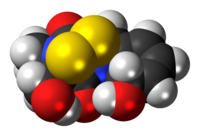 | |
| Are common | |
| Systematic name | (3 R , 6 S , 10a R ) -6-hydroxy-3- (hydroxymethyl) -2-methyl-2,3,6,10-tetrahydro-5a H -3,10a-epidithiopyrazino [1,2- a ] indole-1,4-dione |
| Traditional names | Glyotoxin aspergellinum. |
| Chem. formula | C 13 H 14 N 2 O 4 S 2 |
| Physical properties | |
| condition | white to yellowish crystalline solid |
| Molar mass | 326.398 g / mol |
| Density | 1.75 g / cm³ |
| Thermal properties | |
| T. melt. | 200-202 ° C |
| Classification | |
| Reg. CAS number | 67-99-2 |
| PubChem | |
| Reg. EINECS number | |
| Smiles | |
| Inchi | |
| Chebi | |
| ChemSpider | |
| Security | |
| LD 50 | 45 mg / kg (rabbit, intravenous), 67 mg / kg (mouse, oral) |
| Toxicity | Highly toxic, strong immunosuppressant, has cytotoxicity. |
| R phrases | R25 |
| S-phrases | S36 S37 |
| H phrases | H301 |
| P-phrases | P301 , P310 |
| GHS icons |  |
Sources
Sources of gliotoxin are some microscopic fungi producing mycotoxins of the genus Aspergillus (mainly Aspergillus fumigatus or Aspergillus fuming [1] , pathogenic for humans), Trichoderma veride , T.lignorum and Penicillium ( Penicillium obscurum ). It was also reported about the possible production of gliotoxin by fungi of the genus Candida [2] , however, the results of other studies have questioned the production of this metabolite of fungi of the genus Candida [3] [4] .
Physico-chemical properties
It is a white or slightly yellowish substance crystallizing in the form of small needles. Insoluble in water and carbon tetrachloride , it is well soluble in organic solvents - chloroform , benzene , acetone and especially in DMSO , dioxane and pyridine . Optically active. At temperatures above 200 ° C, a rapid destruction of the structure occurs. It is steady in the acidic environment. Easily destroyed by the action of alkalis.
Toxicology
Gliotoxin exhibits immunosuppressive properties, as it can suppress and induce apoptosis in certain types of cells of the immune system , including neutrophils , eosinophils , granulocytes , macrophages and thymocytes. It also acts as an inhibitor of farnesyl transferase. It irreversibly inhibits chymotrypsin-like activity of 20S proteaosomes.
Gliotoxin intoxication is manifested in the form of aspergillofumigatotoxicosis. There is an acute and chronic form.
Glyotoxin as an antibiotic
Gliotoxin has pronounced antibiotic properties, especially for gram-positive bacterial species. It acts weakly on gram - negative bacteria. Glyotoxin is also able to suppress the growth of Mycobacterium tuberculosis . It also has high antifungal activity. However, it does not have practical use as an antibiotic, due to its extremely high toxicity, LD 100 with intraperitoneal administration of the mouse 5 mg / kg, and when administered orally, it is highly toxic (LD 50 = 67 mg / kg, mice).
Notes
- ↑ Scharf DH, Heinekamp T., Remme N., Hortschansky P., Brakhage AA, Hertweck C. Biosynthesis and function of gliotoxin in Aspergillus fumigatus (Eng.) // Applied Microbiology and Biotechnology : journal. - Springer , 2012 .-- Vol. 93 . - P. 467-472 . - DOI : 10.1007 / s00253-011-3689-1 . - PMID 22094977 .
- ↑ Larsen, B, Shah, D, 1991 "Candida isolates of yeast produce a gliotoxin-like substance" Mycopathologia 116: 203-208, 1991.
- ↑ Kupfahl C., Ruppert T., Dietz A., Geginat G., Hof H. Candida species fail to produce the immunosuppressive secondary metabolite gliotoxin in vitro (neopr.) // FEMS Yeast Res. - 2007. - T. 7 , No. 6 . - S. 986-992 . - DOI : 10.1111 / j.1567-1364.2007.00256.x . - PMID 17537180 .
- ↑ Kosalec I., Puel O., Delaforge M., Kopjar N., Antolovic R., Jelic D., Matica B., Galtier P., Pepeljnjak S. Isolation and cytotoxicity of low-molecular-weight metabolites of Candida albicans ( English) // Frontiers in Bioscience : journal. - Frontiers in Bioscience 2010. - Vol. 13 . - P. 6893-6904 . - DOI : 10.2741 / 3197 . - PMID 18508703 .