

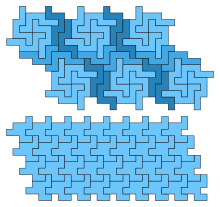
Conway criterion - a set of conditions under which paves a plane. Named for the English mathematician John Horton Conway [1] .
According to the criterion, the tile must be a with six consecutive points A , B , C , D , E and F on the border and the following conditions must be met:
- part of the border from A to B is compatible with parallel transfer with part from E to D ;
- each of the parts of the boundary BC , CD , EF and FA is centrally symmetrical , that is, each of them coincides with itself when rotated 180 ° relative to the midpoint;
- some of the six points may coincide, but at least three of them must be different [2] .
Any proto-tile that meets the criteria of Conway allows periodic tiling of the plane, while only parallel transfer and rotation of 180 ° are used. The Conway criterion is a sufficient condition for proving that protoplate paves the plane, but is not a necessary condition - there are tiles that do not meet the criterion, but tiling the plane [3] .
Examples
The simplest statement of the criterion states that any hexagon whose opposite sides are parallel and equal in length paves the plane using only parallel transfer. Such figures are called parallelogons [4] . If some points coincide, the criterion can be applied to other polygons and even to figures with a curve as a perimeter [5] .
The Conway criterion is able to distinguish many figures, in particular polyforms - with the exception of two nonamino on the right, all the tiling plane of the polymino right up to the nonamino can form at least one tile that meets the Conway criterion [3] . Two nonamino tiles show that the Conway criterion is sufficient, but not necessary for tiling the plane.
Notes
- ↑ Schattschneider, 1980 , p. 224-233.
- ↑ Periodic mosaic: common polygons
- ↑ 1 2 Rhoads, 2005 , p. 329–353.
- ↑ Martin, 1991 , p. 152.
- ↑ Five types of tiles for the Conway criterion Archived on July 6, 2012. , Pdf
Literature
- Doris Schattschneider. Will It Tile? Try the Conway Criterion! // Mathematics Magazine. - 1980 .-- T. 53 .
- Glenn C. Rhoads ,. Planar tilings by polyominoes, polyhexes, and polyiamonds // Journal of Computational and Applied Mathematics. - 2005. - T. 174 , no. 2, 15 (Feb 15) .
- George Martin Polyominoes: A Guide to Puzzles and Problems in Tiling. - Washington, DC: Mathematical Association of America, 1991. - (Spectrum). - ISBN 0883855011 .
Links
- History and introduction to polygon models, polyominoes and polyhedra, by Anthony J Guttmann
- GC Rhoads. Planar tilings by polyominoes, polyhexes, and polyiamonds, // Journal of Computational and Applied Mathematics. - 2005. - T. 174 p . - S. 329-353 .