Santa Fe is an impact crater on Mars , on the plain of Chris . Diameter - 20.3 km , center coordinates - . Named after the city of Santa Fe in New Mexico , USA . This name was approved by the International Astronomical Union in 1976 [1] .
| Santa fe | |
|---|---|
| lat Santa fe | |
 CTX camera image on satellite Mars reconnaissance orbiter | |
| Specifications | |
| Diameter | 20.3 km |
| Title | |
| Eponym | Santa Fe (New Mexico) |
| Location | |
| Heavenly body | Mars |


Using the example of Santa Fe, we studied the peculiarity of some young craters - light and dark rays visible on night infrared images radially diverging from the crater. Areas with high thermal inertia look bright in such images, which may be a consequence of the large size of soil particles and, accordingly, the large thermal conductivity of the surface (a surface covered with fine dust does not conduct heat well, cools quickly and looks dark). According to the findings of the authors of the study, the mentioned rays of Santa Fe and similar craters did not appear when the rocks ejected by the impact fell (a common cause of the appearance of rays at craters), but when the supersonic steam flows formed on impact exceeded solid emissions on the surface. Like the rays from the fall of emissions, the described rays are short-lived, and their presence means the youth of the crater. The age of Santa Fe, judging by the calculation of small craters superimposed on it, does not exceed several hundred million years [2] .
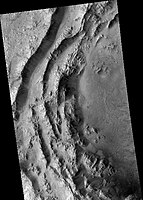
Part of the edge of the crater
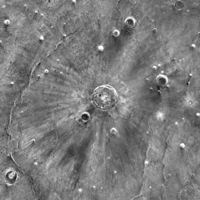
Map of thermal inertia of the vicinity of the crater: visible light and dark rays
Notes
- ↑ Santa Fe . Gazetteer of Planetary Nomenclature . IAU Working Group for Planetary System Nomenclature.
- ↑ Schultz PH, Quintana SN Impact-generated winds on Mars (English) // Icarus. - 2017 .-- Vol. 292 . - P. 86-101 . - DOI : 10.1016 / j.icarus.2017.03.03.029 . - .
Links
- Santa Fe Gazetteer of Planetary Nomenclature . IAU Working Group for Planetary System Nomenclature.