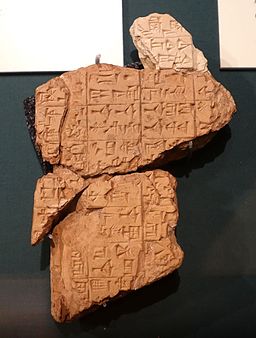
The teachings of Shuruppak are one of the most important examples of Sumerian literature of wisdom . [2] Literature of wisdom designed to teach due piety, inculcate virtue, and preserve social norms , was common in the Ancient Near East . [3] The text was compiled in ancient times with the following incipit : "In the old days, in the old days, in the old nights, in the old nights, in the old years, in the old years." The instructions were spoken by Tsar Shuruppak (SU.KUR.RU ki ), son of Ubar-Tutu . Ubar-tutu is recorded in most surviving copies of the Royal List as the last pre- flood king of Sumer. Grouped with other cuneiform tables from Abu Salabih , the teachings date from the beginning of the 3rd millennium BC. e. and are one of the oldest surviving works of ancient literature .
The text consists of Shuruppak's warning statements addressed to his son and the subsequent hero of the myth of Gilgamesh and the Flood Ziusudra ( in Akkadian Utnapishtim). Named as one of the five antediluvian Sumerian cities, Shuruppak is found only in one of the copies of the Royal List (plate WB-62, it is written SU.KUR.LAM), where it is recorded as the king who ruled in the times between Ubar-Tutu and Ziusudra, who during all other copies are considered father and son. Lambert argues that such a transformation could occur as a result of the fact that the epithet of his father ("Shuruppak man") was mistaken for a proper name. [4] However, this epithet, found in table XI of the myth of Gilgamesh and the flood, applied to Utnapishtim, and not to his father.
A tablet from Abu Salabih dating from the middle of the 3rd millennium BC. e. [5] - This is the oldest surviving copy, and numerous copies confirm its continued popularity within the Sumerian-Akkadian literary canons . [6]
The tips in the three linked lists are concise, taking from one to three lines of cuneiform writing. Some tips are purely practical: "Do not break the field on the road; .... Do not cultivate your field well: people will destroy it for you" (lines 15-18). The moral commandments point to the negative practical results of the act: “Do not flirt with a married young woman: slander can be serious” (lines 32-34). Public opinion and the likelihood of defamation (line 35) play an important role, the opinion of the “court” (line 62) or the market where “insults and stupid talk get the attention of the country” (line 142) was valued.
See also
- Sumerian literature
- Ancient literature
- Public domain
Notes
- ↑ Instructions of Shuruppak - Ancient Mesopotamia: This History, Our History.
- ↑ "The most significant piece of wisdom literature in Sumerian," says Canadian assyrologist Paul-Alain Beaulieu in Wisdom Literature in Mesopotamia and Israel (2007: 4) edited by Richard J. Clifford.
- ↑ Instructions of Shuruppak from Babylonian Wisdom Literature (WG Lambert, 1996). The text is translated into English.
- ↑ Lambert, WG Babylonian Wisdom Literature . - Eisenbrauns, 1996. - P. 92. - ISBN 9780931464942 .
- ↑ Biggs, Robert D. Inscriptions from Tell Abū Ṣalābīkh . - University of Chicago Press , 1974. - ISBN 0-226-62202-9 .
- ↑ Two fragmentary Akkadian versions survived from the 15th century BC. e. and from the end of the 2nd millennium BC. e.: "Its great antiquity and popularity is evidenced by the large number of manuscripts of it that have survived" (Paul-Alain Beaulieu edited by Richard J. Clifford, 2007: 4).
Links
- Bendt Alster The Instructions of Shuruppak. A Sumerian Proverb Collection , (Copenhagen: Akademisk Forlag) 1974.
- Shuruppak's teachings (The Electronic Text Corpus of Sumerian Literature) and bibliography .