Ranunculus pedátus ranunculus ( lat. Ranunculus pedátus ) is a small perennial herbaceous plant of the Ranunculus family , a species of the genus Ranunculus ( Ranunculus ).
| Stop Buttercup |
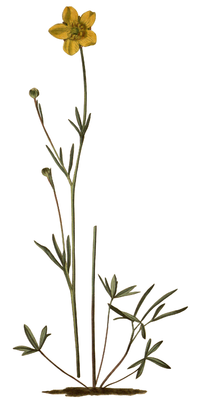
Botanical illustration from Curtis's Botanical Magazine (1820) |
| Scientific classification |
|---|
| Order : | Ranunculanae Takht. ex Reveal , 1993 |
|
| International scientific name |
|---|
Ranunculus pedatus Waldst. & Kit. , 1803 |
|
Steppe and forest-steppe plant with tuber-shaped thickened roots, with three- and five-part leaves with narrow whole-edge lobes.
Perennial herb with upright, slightly branching stalk 15-30 cm tall. The roots are tuberous thickened. Basal leaves on long petioles, three- five-separated, their lobes linearly oblong to linear. The first leaves of the season are often less dissected, three-lobed. Stem leaves whole or also tripartite. Leaves and stems almost bare or with scattered, pressed hairs.
Flowers are 1.5-2.5 cm in diameter, few in number, located at the top of the stem. Sepals are ovoid, with few hairs, sometimes almost naked, 4-6 mm long. Petals obovate, twice as long as sepals.
The fruit is an ovoid multi-root . Nuts 2-4 × 1.7-2.3 mm, obovate, flattened laterally, bordered by a wing, at the apex with a spout curved at the end. The surface is bare, dark brown, slightly shiny, the wing is light brown.
Diploid set of chromosomes - 2n = 16.
Mostly steppe and forest-steppe plant, found in the steppes and meadows, from Central Europe to Western Siberia and the Tien Shan . Sometimes clogs crops.
