The Helsinki Suburban Railway ( Fin. Pääkaupunkiseudun lähiliikenne , Swedish. Huvudstadsregionens närtrafik ) is a system of railways serving Greater Helsinki , Finland . The operator is Finnish Railways - VR Group . Together with the Helsinki Metro , buses , and trams, the network forms a unified system of public transport in Helsinki and the surrounding area.
| Helsinki Suburban Railway | |
|---|---|
| fin. Pääkaupunkiseudun lähiliikenne | |
| Description | |
| Type of | Suburban Transportation |
| A country |  Finland Finland |
| Location | Uusimaa , Kanta-Häme , Päyät-Häme |
| opening date | 1969 |
| Owner | VR Group |
| Daily passenger traffic | 174000 (2015) |
| Route network | |
| Number of lines | 4 (15 routes) |
| Number of stations | 54 |
| Net length | 235 km |
| Technical details | |
| Track width | 1520 mm |
| Electrification | alternating current 25 kV |
| Top speed | 120 - 160 km / h |
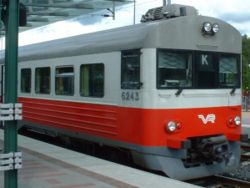
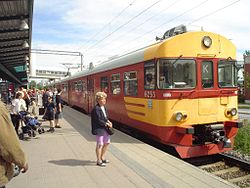

Trains run on land routes within the suburban area of Helsinki. Within the municipalities of Espoo , Helsinki , Kauniainen , Kerava , Kirkkonummi and Vantaa , tickets are used that are common with the bus, tram and metro, which are managed by the Helsinki Regional Transport Authority (HSL), founded in 2010. When traveling outside Kerava and Kirkkonummi, VR tickets are used, sold in areas from A (Helsinki) to H (Lahti). The HSL zone lies entirely within the VR zones A, B, and C.
The network consists of 14 routes, shown in the diagram below . They run along four lines departing from the Helsinki-Central station. The system includes 60 stations, 14 of which are located in the city of Helsinki . About 850 flights depart on weekends. The railway carried 55.1 million passengers in 2011. [one]
History
In the Helsinki region, suburban rail transportation began in the 1880s. On the Main Line, traffic opened to Rekola Station.
The coastline opened in 1903. This line was originally conceived as a suburban, so immediately began the rapid construction of houses near the stations.
In the era of steam locomotives, trains consisted of steam locomotives of the Pr1 type ("Paikku") and wooden wagons with very wide doors for quick pick-up and drop-off of passengers. The number of trips increased sharply after Finland gained independence in 1917: 4 million trips in 1920 and 9 million in 1924. The Depression of the 1930s hit hard on suburban traffic, at least 3 million trips. By 1939, the number of trips increased to 4 million. [2]
During the short era of diesel locomotives from the late 1950s to the early 1970s, suburban transportation was carried out by diesel trains of classes Dm7 , Dm8 and Dm9.
Ways did not expand much during the era of steam and diesel locomotives. On the Main line and at the beginning of the Shoreline (to Kirkkonummi ) there were only two routes for freight, suburban and long-distance trains. The coastline is still single track from Kirkkonummi to Turku .
The suburban movement began to take its current form in 1969, when the first section of Helsinki - Kirkkonummi was electrified. The route designation was introduced on May 28, 1972. In the same year, all the then suburban routes were completely electrified, the third route from Helsinki to Tikkuril was laid. The third route was extended to Kerava in 1981.
The line from Huopalahti to Martinlaakso , opened in 1975, was built specifically for commuter trains, becoming the first such line in Finland. She was later (1991) extended to Vantaankoski . In 2015, it was connected to the Hiekkaharju Station of the Main Line, the Ring Line was formed.
Now, on sections between Helsinki and Leppävaara, and between Helsinki and Kerava, suburban trains use parallel rails, but separately from the rails used by long-distance trains that follow the S-Bahn principle. The fourth way, which allowed to separate the “intracity traffic”, was ready to Tikkuril in 1996 and to Kerava in 2004. On the Coastline, the section between Pasila and Leppävaara was expanded to four ruts in 2001.
The line from Kerava to Lahti , opened in 2006, was built for long-distance trains, but is also used as a commuter train on route Z.
Renewal Prospects
The ring line opened on July 1, 2015. The station at the Helsinki Airport opened later: at the Tietotie exit on July 10 and a direct connection to the terminal in the fall. A ring line connects the line to Vantaankoski via Aviapolis and Helsinki Airport with the Main Line just north of Tikkurila Station. The extension includes five stations with a reserve for another three. Unlike other routes, the line through the airport runs in a tunnel with the underground stations Airport and Aviapolis. The ring line was planned and constructed with the expectation of a future extension to Klaukkala .
There are plans to extend the four-way line to Espoo from Leppävaar . This would increase the frequency to Kauklahti , as well as facilitate traffic to long-distance trains to Turku, which follow the same routes with local trains on the section between Kirkkonummi and Leppävaara.
It is planned to increase the capacity of the Helsinki-Central station, which is now exhausted during peak hours. A Helsinki city loop is being designed, which would begin underground under the south of Pasila station, pass around the city center and come back. There would be three underground stations in Töölö (west), the center of Helsinki (south) and the Hakaniemi metro station (east). The loop length will be 7 kilometers. [3] Construction will come out expensive (€ 956 million) and complete in the 2020s.
Routes
Coastline
Route Y is the longest on the line. Passes between Helsinki and Siuntio with very few intermediate stops. Trains run rarely, from three to seven flights per day, depending on the day of the week. Stops: Pasila, Huopalahti, Leppävaara, Masala, Kirkkonummi. When the first electrified line in Finland opened (Helsinki-Kirkkonummi), the first route was Y. In 1987, route Y was canceled and replaced by S and U in 1988. In 2002, the letter Y appeared again when the roads to Leppävaar were completed, which allowed the launch of a fast commuter train to Karjaa. Prior to this, some S and U flights went from further from Kirkkonummi to Karjaa. In March 2016, route Y was shortened to Siuntio.
Route X introduced in March 2016. He repeats the pattern of stops on route Y, but ends in Kirkkonummi.
The U train runs from Helsinki to Kirkkonummi. Goes twice an hour. Stop between Helsinki and Leppävaara only Pasila and Huopalahti. Between Leppävaara and Kirkkonummi, the train follows with all stops. In March 2016, two stations between Kauklahti and Masala were closed and now the U train runs twice an hour, replacing the earlier S.
Train L runs from Helsinki to Kirkkonummi. It goes only at night and in the morning at the weekend. There is one flight from Karyaa on Sundays in the morning. It has more stops than all other trains running on the Karyaa - Helsinki section. Prior to the introduction of train A in 2002, train L also ran in the daytime.
Train E runs from Helsinki to Kauklahti. It stops between Helsinki and Leppävaara only in Pasila and Huopalahti, then follows with all the stops. It goes every half hour, except for Sundays. The route was extended in August 2007 to Kauklahti from the previous terminus in Espoo. If the city routes are extended from Leppävaara to Espoo, then the train E will run with all the stops, becoming the basis of the Coastline traffic.
Train A runs from Helsinki to Leppävaara . It should be with all the stops. It runs at intervals of 10 minutes during peak hours, the rest of the time at intervals of 20 minutes on weekdays and 30 minutes on weekends. Initially, the designation A was introduced on May 28, 1972 to May 25, 1974 for the route to Kirkkonummi, re-introduced in 2002.
Circle line
Trains I and P run in opposite directions between Helsinki and Helsinki-Vantaa Airport . Follow with all the stops. Train I runs counterclockwise, departing from Helsinki via Tikkurila, Helsinki Airport, Martinlaakso and returning to Helsinki. Train P follows the same route clockwise, departing from Helsinki via Martinlaakso, Helsinki, Tikkurila Airport and back to Helsinki.
The ring line opened in 2015 as a result of the extension of the Vantaankoskinskaya line. As a result, train M was replaced by P, and train I was extended from the previous final Tikkuril.
Main (Rihimyak) line
Train K follows from Helsinki to Kerava . He walks every 10 minutes in the afternoon. Between Helsinki and Tikkurila it stops at Pasila, Oulunkylä, Malmi and Puistola. Further to Kerava follows with all stops. An extension is planned to the Nikil station in Sipoo with the use of the existing line to the Kilpilahti oil refinery. K is the original lettering introduced in 1972. In the 1970s and early 1980s, K trains did not stop in Puystola, Malmi and Oulunkylä. The Oulunkylä stop was introduced only in 2004 after the completion of city routes to Kerava.
Train N follows from Helsinki to Kerava . It should be with all the stops. It runs at a time when trains I and P do not work (at night, in the early morning), replacing train K. The last flights start and in the morning go like T. N is the original letter designation introduced in 1972, but until 2010 the train went to low passenger traffic in the early morning and late evening.
The T train runs at night once an hour from Helsinki to Rijhimäki. There is a break of a few hours late at night. T follows with all stops. It has been walking since 1972.
Train R runs from Helsinki to Rijhimäki twice an hour in the afternoon. All R trains have a low floor level and a schedule that allows acceleration to 160 km / h. Trains stop between Helsinki and Rijhimäki in Pasila, Tikkurila, Kerava, Ainola, Järvenpää, Saunakallio, Jokela and Hyvinkäa. R is the original letter designation introduced in 1972 and has been running since then with the same stops, but with one exception: a stop in Tikkurila was added in the 1980s, and Ainola and Saunakallio in 2016. Train R began to run more often after the cancellation of train H. Some R flights were extended to Tampere and Kouvola.
Train D runs from Helsinki to Rijhimäki. It is entered at peak hours and stops in few places. Many D trains consist of old cars from the 80s, driven by an electric locomotive instead of electric trains.
Lahti Line
Train Z runs from Helsinki to Lahti once an hour. All Z trains have a low floor and a schedule that allows acceleration to 160 km / h. Trains stop between Helsinki and Lahti to Pasila, Tikkurila, Kerava, Haaryoki, Mäntsälä. During rush hours, trains are often crowded between Helsinki and Kerava, so they allow longer trains. Two Z trains depart in the morning from Kouvola and return there in the evening rush hour. These are trains under electric traction. Also, the last Z train extended in the evening to Kouvola.
Unmarked trains
There are several flights from Rijhimäki in the morning and from Helsinki in the evening at rush hour, which do not have a letter designation, since they do not fall under any stopping scheme. There are also 1 or 2 departures during the day. They all follow between Helsinki and Rijhimäki. Typically, shoreline train types are used.
Canceled Routes
Train P ran from Helsinki to Hiekkaharju with all the stops. The route was introduced in 1972 and was canceled in August 2004. The letter P was re-introduced in 2015 with the opening of the Ring Line.
Train G ran from Helsinki to Saunakallio . He walked six times a day in every direction and was the only train that did not stop at Tikkurila. Introduced on June 4, 2007, canceled in 2011. He stayed in Helsinki, Pasila, Küröl, Järvenpää and Saunakallio.
Train M ran from Helsinki to Vantaankoski . Walked every 10-30 minutes and followed with all the stops. It was introduced in 1975, when the line was built on Martinlaakso, and was canceled in 2015, when this line was extended and looped. In 1991, the line was extended by one stop beyond Martinlaakso (to Vantaankoski). Replaced by train P.
Train S ran from Helsinki to Kirkkonummi. Walked every hour in every direction. Of the two day trains that ran between Helsinki and Kirkkonummi, S was the fastest. Between Helsinki and Leppävaara, train S stopped at Pasila and Huopalahti. Further to Kauklahti I walked with all the stops. Between Kauklahti and Kirkkonummi, the only stop was Masala. From May 28, 1972 to May 25, 1974 S trains ran from Helsinki to Kauniainen. The route was extended to Kirkkonummi on September 27, 1987. It was canceled in March 2016, when two stops were closed, on which only the U train stopped, and the U and S routes ceased to differ from each other. Replaced by train U.
Train H ran from Helsinki to Rijhimäki once an hour. He stopped between Helsinki and Kerava in Pasila and Tikkurila, then followed with all the stops. Introduced in 1972. Until 1990–1998, train H stopped at Monny, Palopuro, Takoya, Hiikko, Ristinummi and Kütömaa. These stops were canceled due to low passenger traffic, and also because the train slowed down traffic, being too slow. Stops with all infrastructure were dismantled between 1990 and 1998. In March 2016, the Purola and Nuppulinna stations were closed, and train H was replaced by train R.
Line Length
- Helsinki - Rijhimäki 71 km (54 min)
- Helsinki - Lahti 104 km (60 min)
- Helsinki - Kerava 29 km (23 min)
- Helsinki - Tikkurila 16 km (14 min)
- Helsinki - Karjaa 87 km (1 h 7 min)
- Helsinki - Kirkkonummi 38 km (30 min)
- Helsinki - Kauklahti 24 km (29 min)
- Helsinki - Leppävaara 11 km (12 min)
- Helsinki - Vantaankoski 15 km (22 min)
- Vantaankoski - Hiekkaharju 18 km (26 min)
Line
| Y | |||||||||||||||||||||
|---|---|---|---|---|---|---|---|---|---|---|---|---|---|---|---|---|---|---|---|---|---|
| Karyaa | T | R | D | Z | |||||||||||||||||
| Inkoo | Martinlaakso | Vantaankoski | Rihimäki | Lahti | |||||||||||||||||
| Siuntio | S | U | L | Lukhela | Wehkala | Hyvinkyaa | |||||||||||||||
| Kirkkonummi | Muyurmyaki | Kiwiste | Yokela | ||||||||||||||||||
| Tolsa | Malminkartano | Aviapolis | Nuppulant | ||||||||||||||||||
| Jorvas | Kannelmäki | Vantaa Airport | Purola | Mäntsälä | |||||||||||||||||
| Masala | North Haaga | Laneela | Saunacallio | ||||||||||||||||||
| Luoma | Järvenpää | Haarajoki | |||||||||||||||||||
| Mankki | E | K | N | Ainola | |||||||||||||||||
| Kauklahti | Kerava | ||||||||||||||||||||
| Espoo | Savio | ||||||||||||||||||||
| Tuomarila | Corsa | ||||||||||||||||||||
| Koivuhovi | Recola | ||||||||||||||||||||
| Kauniainen | Koivukülä | ||||||||||||||||||||
| Kera | Sand ridges | ||||||||||||||||||||
| Kilo | A | Tikkurila | |||||||||||||||||||
| Leppävaara | Puistola | ||||||||||||||||||||
| Mäkkylä | Tapanila | ||||||||||||||||||||
| Pityanmyaki | Malmi | ||||||||||||||||||||
| Valimo | Pikinmaki | ||||||||||||||||||||
| Huopalahti | Oulunkylä | ||||||||||||||||||||
| Ilmala | Kapul | ||||||||||||||||||||
| Pasila | Pasila | ||||||||||||||||||||
| Helsinki-Central | Helsinki-Central | ||||||||||||||||||||
| Y | S | U | L | E | A | P | I | I | P | K | N | T | R | D | Z | ||||||
Rolling stock
Electric trains:
- Sm1 , 50 compounds built in 1969–73 (Valmet / Strömberg) are now replaced by Sm5
- Sm2 , 50 formulations built in 1975–81 (Valmet / Strömberg), now in the process of being replaced by Sm5
- Sm4 , 30 trains built in 1999–2005 (Fiat Ferroviaria / CAF / Alstom)
- Sm5 , 41 members built in 2008–13 ( Stadler FLIRT ). Trains are driven by VR, but are owned by Pääkaupunkiseudun Junakalusto Oy . The first Sm5 train began to run in November 2009. A total of 75 trains were ordered to replace the obsolete Sm1 and Sm2.
- Locomotives Sr1 ( NEVZ ) or Sr2 ( SLM / ABB ) with Eil / Eilf wagons , 57 wagons built in 1982–87 (the so-called “red wagons”).
Suburban traffic was the last use of wooden cars in Finland. They disappeared in the late 1980s when Eil wagons replaced them.
| Rolling stock | |||||||||
| |||||||||
Notes
- ↑ VR Group Vuosiraportti 2011 . VR Group. Date accessed August 24, 2012. (unavailable link)
- ↑ Herranen, Timo (1988) Från hästomnibussar till metro. Helsingfors stads publikationer nr 39
- ↑ Kari Ruohonen . The Future of AirRail . - "also be linked to the City Rail Loop, a 7-km long underground railway line running under the Helsinki city center. "The railway design will begin in 2012 and a decision about its implementation can be made in 2014.". (inaccessible link)