Fatherland Defense Forces ( lit. Tėvynės apsaugos rinktinė , abbreviated TAR ), officially known as Meder Regiment ( German Regiment Mäder ) and Meder Combat Group ( German Kampfgruppe Mäder ), also found the name of the Legion of Defense of the Homeland and the Homeland Defense Army [1] - Lithuanian collaborationist formation in the Wehrmacht , which participated in the defense of the German positions during the operation "Bagration" .
| Homeland Defense Forces | |
|---|---|
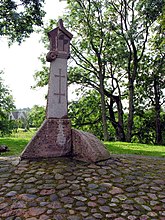 Monument to soldiers of the Defense Forces of the Fatherland ( Syada ) | |
| Years of existence | July - October 1944 |
| A country |  Germany Germany  Lithuania Lithuania |
| Subordination | Wehrmacht |
| Enters into | 9th Field Army |
| Type of | infantry |
| Includes | 2 shelf |
| Number of | 6 thousand people |
| Dislocation | Plinkshes, Mazeiky district |
| Nickname | TAR ( lit. Tėvynės apsaugos rinktinė ), Medera Regiment ( it. Regiment Mäder ), Medera Battle Group ( it. Kampfgruppe Mäder ), Samogitian Schumatsmanshaft [1] |
| Participation in | Eastern front of World War II :
|
| Commanders | |
| Famous Commanders |
|
It was collected from the Lithuanians who lived in the north-west of Lithuania, was subordinated directly to the Wehrmacht [2] . The forces of the defense of the fatherland were commanded by German Colonel Helmut Meder, who hoped to lead the division [3] . The formation consisted of only 6 thousand people, who were divided into two regiments , but were very poorly trained and prepared for battles [3] . The defense forces of the fatherland participated in the defense of Caddy on October 7 , confronting the 19th tank corps of the 6th Guards Army of the Red Army [4] , but were completely defeated and retreated to Memel , from where they left for East Prussia. The personnel there were divided into demining units [4] .
Content
Education
The 1st Baltic Front reached the borders of the Lithuanian SSR in the summer of 1944 and continued the offensive on the territory of Lithuania as part of the Baltic Strategic Operation . Lithuanian youth were called to the Red Army , but not many locals despised the Soviet government and fought against it, fleeing to the Germans or to the “ forest brothers ”. Several large groups (gangs) of the Forest Brothers acted in Samogitia [4] . On July 28, 1944, a group of Lithuanian officers gathered in the village of Pyvenyai to decide whether they should go to the Wehrmacht to fight against the Soviet troops or join the “Forest Brothers”, as advised by the leadership of the Lithuanian Liberation Army . According to the results of the voting, supporters of the Germans won with a slight advantage [5] , and soon the Lithuanians gathered a group of volunteers, which received the Lithuanian name of the Homeland Defense Force or TAP (the abbreviation of the Lithuanian name “ Tėvynės apsaugos rinktinė ”) [2] . The Lithuanians contacted the Wehrmacht 9th Army Colonel Helmut Meder through Bishop of Vilnius Julioas Steponavicius. Meder agreed to support the Lithuanians and supply them with weapons and uniforms [6] .
The headquarters of the Defense Forces of the Fatherland was moved from Pienienieus to Plinkshes, to the building of the school of agriculture [2] . The 1st Lithuanian Volunteer Regiment of the Defense Forces of the Fatherland under the command of Major Alfonsas Urbonas was formed in August 1944 [6] and consisted of 1,200 soldiers (including 47 officers) in two battalions [4] . The 2nd Lithuanian Volunteer Regiment under the command of Lieutenant Colonel Mezyus Kareiva was formed in September 1944 [4] . It was planned to expand the Defense Forces of the Fatherland to the size of the division, including the 3rd Regiment in the person of the battalions of the Lithuanian auxiliary police but this did not happen [6] . In total, the Force numbered about 6,000 people, including 112 officers [2] : the overwhelming majority of the personnel had no combat experience [6] . Only one Lithuanian general, Kazus Navakas, as responsible for food and finance, entered the Homeland Defense Force [7] . Povilas Plekhavicius , whom the Germans had just liberated from Salaspils and was appointed commander of the Lithuanian territorial defense , demanded from the Germans in exchange for the entry of full control over the Defense Forces of the Fatherland, but as a result did not receive a response and refused to join the Forces of the Fatherland [5] . Three more generals refused to join, not wanting to lose their soldiers and not trusting the initiative of their countrymen [5] [8] : one of them, divisional general Edvardas Adamkyavichus, said that the Lithuanians would simply lose their people and not detain the Soviet army [1] . Among the personnel there were a lot of young people from 17 to 20 years old (even Valdas Adamkus , the future president of Lithuania and nephew of Edvardas Adamkyavichus) [1] were among them, but she was not trained in military affairs [2] , Lithuanians also lacked supplies and radio stations [6] .
Activity
Soldiers of the Forces of the Fatherland Forces participated from the first days in the defense of positions along the Venta River [2] . From August to September, their front was relatively peaceful, since one part of the Soviet soldiers participated in the Riga operation , and the other in the Memel operation [6] . From July 18 to September 19, the Force published five issues of the newspaper “Lietuvos Gynėjas” ( lit. Defender of Lithuania ) [6] , and their soldiers engaged in providing material assistance to Lithuanian refugees [5] .
On October 5, 1944 , the offensive of the 1st Baltic Front on Memel began, the main purpose of which was to encircle the German armies . The 1st Lithuanian Regiment of the Defense Forces of the Fatherland was in charge of the defense of Syad, and the 2nd Regiment defended Barsticci [4] . Contrary to promises, the Germans did not provide reinforcements to the Lithuanians [2] . The 1st regiment was commanded by the former commander of the 4th battalion of Schutzmanshafta, Major Pranas Puojunas, and Lieutenant Liudas Norkus, who fought in the Wehrmacht against the Soviet troops [2] . The position of the 1st regiment was very unfortunate: the trenches were dug only on the line 200 m in front of the Varduva river, so in case of retreat the soldiers would have to cross the river on a single bridge [6] . The Germans decided to donate Lithuanian units to regroup their troops [2] [6] .
On October 7, units of the 19th Tank Corps of the Red Army General I. D. Vasilyev approached Sade . Armed with “ Panzerfaustami ” Lithuanians managed to knock down eight T-34 tanks , but the Lithuanians quickly ran out of ammunition and they were forced to retreat [4] . During the crossing, about 100 people were killed in battle or drowned in Varduva [4] [2] , 30 people were captured [6] . On October 8, 1944 , Order No. 193 was issued on awarding Soviet soldiers and military commanders who distinguished themselves during the capture of a number of settlements, among which was Syada [6] .
The fleeing Lithuanians retreated to Barsticci, where they failed to regroup. Fearing complete defeat and repulsing subsequent Soviet attacks, the Fatherland Defense Forces retreated in the direction of Kretinga and Klaipeda [4] . About half of them decided not to go to the Germans, but to enlist the support of the “forest brothers” [6] ; the survivors (about 1 thousand people) continued on their way to East Prussia and became part of 8 sapper companies that participated in the construction of the fortifications of Danzig , Lomza and Lübeck [6] .
Historical research
The history of the Lithuanian Fatherland Defense Forces is a little-studied phenomenon in the history of Lithuania due to the absence of a number of archives: the archives of the 1st regiment survived, which were preserved by Captain Jonas Chesna, who left for the United States after the war [9] . After the restoration of independence of Lithuania, the archives were transferred to the former fighter of the Fatherland Defense Forces Vladas Kazlauskas, who published several works on these archives. However, all messages from the archives are not systematized and often contradict each other, which causes a lot of questions from researchers and undying interest [9] . The archives of the 2nd regiment have not been preserved, little is known about its structure [5] .
The question of the loyalty of the Homeland Defense Forces to the Germans also remains open: on the one hand, the soldiers received support in terms of weapons and supplies from the Germans; on the other hand, the complete disorganization of the Germans in the Baltic States turned the Fatherland Defense Force into a detachment that did not submit to the de facto Wehrmacht. There is no mention of Germany or the Third Reich in the text of the oath taken by the fighters, but only about the fight against the Bolsheviks [6] . According to Lithuanian historians, it was an attempt to create an army of the Republic of Lithuania, which was to achieve its independence from the USSR [2] [4] .
Notes
- ↑ 1 2 3 4 5 Does President Adamkus hide his participation in the Holocaust? Rubaltic.ru (February 11, 2016). The date of circulation is January 25, 2017. Archived December 26, 2016.
- ↑ 1 2 3 4 5 6 7 8 9 10 11 Laisvės kryžkelės (XXX). Sedos kautynės (lit.) . Bernardinai.lt (October 16, 2006). The appeal date is April 24, 2015. Archived July 3, 2013.
- ↑ 1 2 Nigel, Carlos, 2012 , p. 38
- ↑ 1 2 3 4 5 6 7 8 9 10 Sedos kautynės (lit.) . 2014 m. atmintinos datos . Lietuvos gyventojų genocido ir rezistencijos tyrimo centras (2014). The appeal date is April 24, 2015.
- 2 1 2 3 4 5 Skiriama Tėvynės apsaugos rinktinės atminimui Neopr . Archived June 9, 2007.
- ↑ 1 2 3 4 5 6 7 8 9 10 11 12 13 14 Kęstutis, 1999 , s. 144–150.
- ↑ Stoliarovas, 2012 , s. 92
- Rudokas J. Vyrai žuvo prie Sedos ... (lit.) // Veidas . - 2004. - 7 Spalis (vol. 41). - ISSN 1392-5156 .
- ↑ 1 2 Kęstutis, 1999 , s. 44–45.
Literature
- Kęstutis K. Lietuvos karas . -Kaun. : Lietuvos politinių kalinių ir tremtinių sąjunga, 1999. - ISBN 9986-577-28-4 . (lit.)
- Nigel T., Carlos CJ Germany's Eastern Front Allies (2): Baltic Forces . - Osprey Publishing , 2012. - ISBN 978-1-780-96734-9 . (eng.)
- Tarpukario ir rezistencijos laikotarpio Lietuvos generolų s irrašas ir jų amžinojo poilsio vietos / Stoliarovas A. .. - Lietuvos kariuomenės generolų klubas, 2012. - ISBN 978-609-412-030-5 . (lit.)